

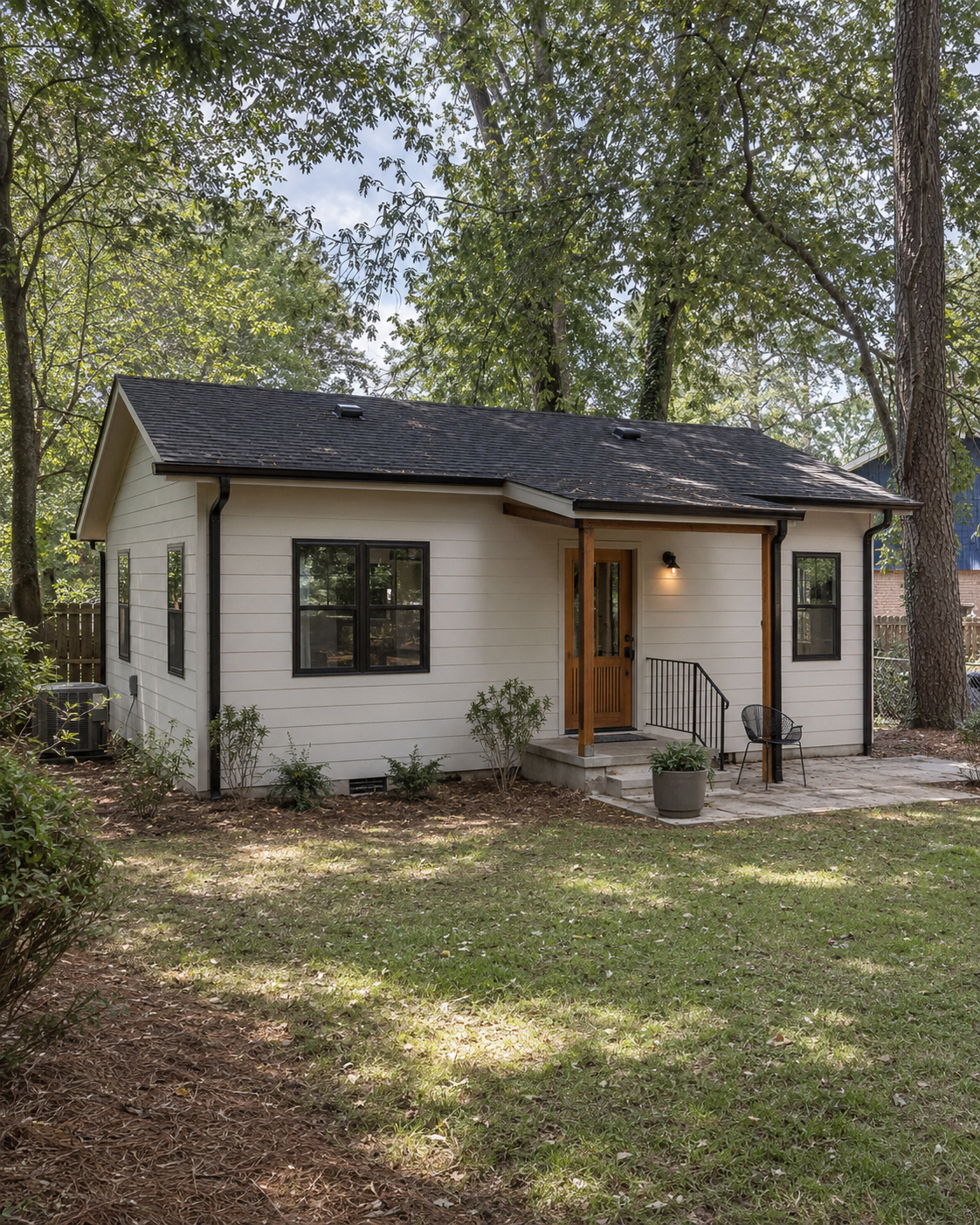
Could Your Atlanta Property Support an ADU?
Atlanta and Decatur have expanded ADU zoning over the past several years. Whether you own a home now or are considering buying one, understanding whether a property may support an accessory dwelling unit starts with a look at the zoning rules. This page explains what current rules allow and offers a preliminary screening at no cost.
What Is an Accessory Dwelling Unit?
An accessory dwelling unit (ADU) is a second, self-contained living space on a residential property. It has its own entrance, independent cooking facilities, bathroom, and sleeping area. Current Atlanta ADU ordinances address detached structures built on the same lot as the primary dwelling. Decatur’s rules address ADUs that may be developed in or adjacent to the principal dwelling.
Atlanta’s zoning code permits new detached ADU construction in R-4, R-4A, and R-5 residential districts in the City of Atlanta. Decatur has its own separate set of rules. ADU permission is parcel-specific. Whether a specific property may support an ADU depends on the parcel’s zoning designation, its overlay or special district status, and how the applicable rules apply to that lot and the configuration requested.
Homeowners research ADUs for different reasons. Some are planning for a family member who needs to live nearby. Some are considering the income potential of a rental unit. Some are buyers evaluating a property before making an offer. The preliminary screening offered on this page is designed for all of these situations.

What the Rules Currently Allow
The following information is drawn from official city ordinances. Where specific standards have not been confirmed from the official ordinance text, that is noted. These rules apply to the cities of Atlanta and Decatur. Rules for unincorporated DeKalb County, Fulton County, and other Metro Atlanta municipalities are separate and are not covered here.
City of Atlanta: Current ADU Rules
Atlanta’s current ADU rules are based on two city council ordinances: Ordinance 16-O-1548 (2016), which added ADUs to the R-5 (Two-Family Residential) district, and Ordinance Z-18-100 / 18-O-1581 (adopted May 2018), which extended ADU permission to R-4 and R-4A (Single-Family Residential) districts. These are the rules currently in effect.
Permitted districts: R-4, R-4A, and R-5 — Source: Ordinance Z-18-100 / 18-O-1581 (2018); Ordinance 16-O-1548 (2016)
Maximum size: 750 square feet — Source: Ordinance 16-O-1548 (2016)
Maximum units per parcel: 2 total (primary dwelling and one ADU) — Source: Confirmed from ordinance text
Off-street parking: None required — Source: Ordinance Z-18-100 / 18-O-1581 (2018)
Subdivision: ADU may not be subdivided from the primary parcel — Source: Confirmed from ordinance text
What About Attached ADUs, Garage Conversions, and Basement Apartments?
Atlanta’s current ADU ordinances address detached structures only. Attached ADUs are listed as “not currently permitted” under existing ordinances on the Atlanta Department of City Planning’s page. Garage conversions and basement conversions are not addressed in the current ADU ordinances and require direct inquiry with the Atlanta Office of Buildings. A proposed expansion of ADU options has been under consideration by the city, but the current legislative status of that proposal must be verified before relying on any proposed provisions.
Historic Districts and Special Public Interest Districts
ADU rules apply in R-4, R-4A, R-5, and certain Special Public Interest (SPI) districts. Properties located within an SPI district or a designated historic district overlay may face requirements that supplement or replace base zoning standards. The Atlanta Urban Design Commission (AUDC) administers historic district overlays. If a property falls within one of these areas, confirming ADU eligibility requires direct contact with the applicable planning or review body before proceeding.
City of Decatur: Current ADU Rules
The City of Decatur operates under its own Unified Development Ordinance (UDO), separate from the City of Atlanta. Decatur updated its ADU provisions in May 2024. Decatur ADUs are regulated under UDO Article 6, Section 6.8.3.
Minimum size: 300 square feet — Source: City of Decatur UDO Article 6, Section 6.8.3 (May 2024)
Maximum size: 800 square feet or 40% of the principal dwelling (whichever is less) — Source: City of Decatur UDO Article 6, Section 6.8.3 (May 2024)
Maximum bedrooms: 2 — Source: City of Decatur UDO Article 6, Section 6.8.3 (May 2024)
Maximum height: 25 feet — Source: City of Decatur UDO Article 6, Section 6.8.3 (May 2024)
Maximum stories: 2 — Source: City of Decatur UDO Article 6, Section 6.8.3 (May 2024)
Maximum ADUs per lot: 1 — Source: City of Decatur UDO Article 6, Section 6.8.3 (May 2024)
Owner occupancy required: Owner must occupy either the primary dwelling or the ADU as permanent residence for at least 8 months per year — Source: City of Decatur UDO Articles 6 and 12 (May 2024)
Placement: In or adjacent to the principal dwelling — Source: City of Decatur UDO Article 6, Section 6.8.3 (May 2024)
Setback requirements and off-street parking standards for Decatur ADUs require confirmation with the City of Decatur Planning and Zoning Department. For questions, contact Kc Krzic, Planning and Zoning Manager, at (678) 553-6512.
Decatur Operates Independently from the City of Atlanta
The City of Decatur has its own planning department and zoning code. Rules that apply within Atlanta’s city limits do not apply in Decatur. If your property is in Decatur, the Atlanta ordinances described above do not govern your project.
Who This Preliminary Screening Is Designed For
Current homeowners
You own a residential property in Atlanta or Decatur and want to understand whether current zoning may support adding an ADU, whether for a family member, a rental unit, or your own long-term plans.
Buyers evaluating a property
You are considering purchasing a home and want to know whether an ADU could be developed on the property. Understanding zoning before you make an offer is a legitimate part of due diligence.
Owners doing early research
You are not ready to build yet, but you want a clear-eyed picture of what the rules allow before you invest time in conversations with contractors or architects.
This screening covers zoning rules only. It is not a permit application, an architectural assessment, or a construction estimate. See the full scope of what the screening includes and does not include in the form section below.
What the Preliminary Screening Covers
After you submit the form below, Kristen Johnson Real Estate will review your property address against the applicable zoning records and prepare a written preliminary screening that includes:
The zoning district that appears to govern your property, based on publicly available records
Which jurisdiction applies (City of Atlanta, City of Decatur, or a note if it is outside those two)
How current ADU rules in that district apply to your stated configuration (detached structure, attached addition, garage or basement conversion, or general inquiry)
A preliminary result category: may support an ADU under current rules, current rules do not appear to support this configuration at this time, or additional information required
The specific rules that appear most relevant, with citations to the official source
Unresolved questions that would require confirmation from the applicable planning department
A recommended next step
The screening is based on publicly available zoning records and official ordinance documents. It is not a zoning determination, permit approval, or legal opinion. Kristen Johnson is a licensed Georgia real estate professional affiliated with Compass. This service does not constitute the practice of law, architecture, or engineering. Kristen Johnson, Georgia Real Estate License #385658, affiliated with Compass.
About Kristen Johnson
Kristen Johnson is a licensed Georgia real estate professional with approximately 10 years of experience and $50M+ in sales, recognized as a Top 5% agent. She grew up in East Point and lives in Edgewood, giving her a firsthand understanding of both the city and the suburbs. Before real estate, she worked as a doula and corporate professional. Kristen works with buyers, sellers, and investors across Metro Atlanta.
Request Your Free Preliminary Screening
ADU-Relevant Neighborhoods in the KJRE Service Area
If you are researching a specific neighborhood alongside ADU zoning questions, the following guides provide local context. ADU eligibility is parcel-specific and depends on the zoning designation of the individual property, not the neighborhood as a whole.
Edgewood | Kirkwood | Old Fourth Ward | Inman Park | Decatur
Official Sources
The zoning rules cited on this page are drawn from the following official government sources. Rules are subject to amendment. This page was last reviewed August 2026.
City of Atlanta, Ordinance 16-O-1548, R-5 ADU provision (enacted 2016).
City of Atlanta, Ordinance Z-18-100 / 18-O-1581, R-4 and R-4A ADU expansion (adopted May 7, 2018; approved by Mayor May 16, 2018). Source: atlantaga.gov
City of Decatur, Ordinance amending UDO Articles 6 and 12 (enacted May 20, 2024). Source: decaturga.com
City of Decatur, Unified Development Ordinance, Article 6, Section 6.8.3.
City of Atlanta Department of City Planning, ADU expansion proposal (not current law as of August 2026): citydesign.atlantaga.gov
Preliminary Screening Disclaimer
The preliminary ADU screening provided by Kristen Johnson Real Estate is based on a review of publicly available zoning records and official government ordinances. It is not a zoning determination, permit approval, code compliance letter, architectural assessment, structural evaluation, construction estimate, or legal opinion.
Zoning rules change. Overlay districts, special public interest districts, and historic district designations may impose additional requirements not addressed here. Any project should be verified directly with the applicable planning and building department before construction begins.
Kristen Johnson is a licensed Georgia real estate professional, License #385658, affiliated with Compass. This service does not constitute the practice of law, architecture, or engineering.