

Atlanta Neighborhoods with the Best Walkability Scores 2026: Intown Rankings, Suburban Town Centers & What It Means for Home Prices

Atlanta's overall Walk Score is 48 out of 100. Car-dependent by national standards, technically below average, and exactly the kind of statistic that gives relocating buyers pause. But that number tells you almost nothing useful if you're trying to figure out where to live.
The metro covers roughly 8,400 square miles and contains hundreds of distinct neighborhoods, and the walkability experience varies wildly depending on which block you're on. The same city that produces Walk Scores in the 90s in some intown neighborhoods produces scores in the teens in the outer suburbs. What the metro-wide average actually tells you is that Atlanta is a patchwork. The walkable parts are genuinely walkable. The car-dependent parts are very car-dependent. And knowing which is which, before you buy, matters more than knowing the metro average.
I work with buyers across Metro Atlanta and I get this question often, especially from relocating buyers who come from Chicago, New York, DC, or other cities where walking to coffee is a given. Can I live without a car in Atlanta? Where do I find real walkability? What do I actually give up when I move to the suburbs?
Nearly a decade helping Atlanta buyers means I've had this conversation across every price point and every part of the metro, and I know where the numbers hold up and where they don't.
Here's what you need to know.
What Walk Score Actually Measures (and Where It Falls Short)
Walk Score is a third-party metric that rates neighborhoods on a 0–100 scale based on how easily residents can complete everyday errands on foot. It factors in the distance and density of nearby amenities: grocery stores, restaurants, coffee shops, schools, parks, retail, and transit. A score of 90–100 is a "Walker's Paradise." A score of 70–89 is "Very Walkable." A score of 50–69 is "Somewhat Walkable." Below 50 is car-dependent territory.
The scores are useful, but they have limits. Walk Score measures access to amenities within a mapped radius. It doesn't measure sidewalk quality, street safety, hill grade, shade coverage, or how pleasant the walk actually is. Two streets with similar Walk Scores can feel completely different on foot, and in Atlanta, street-level variation within a single neighborhood can be significant.
The other thing Walk Score doesn't capture is the qualitative difference between a Walk Score driven by actual neighborhood retail and one driven by proximity to a strip mall on a six-lane arterial. Technically accessible on foot. Practically, nobody walks there.
When I work with buyers who prioritize walkability, I look at the number as a starting point, not a conclusion. Block-level scouting, understanding what the amenities actually are, and knowing which corridors have sidewalk infrastructure worth using matters more than the headline score.
With that framing established, here's how Atlanta's neighborhoods and suburbs rank.
The Walk Score Rankings: Intown Atlanta Neighborhoods
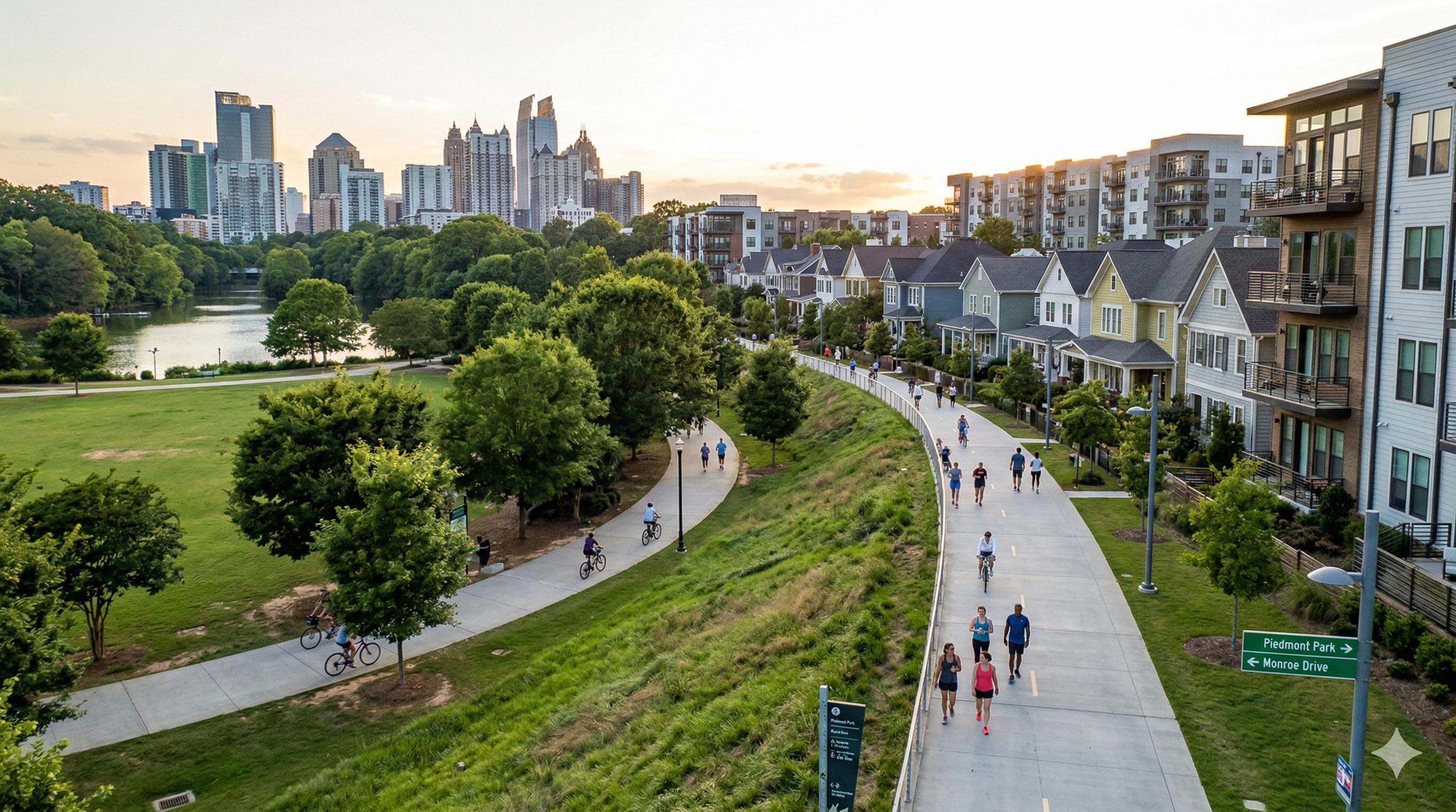
The highest Walk Scores in the Atlanta metro are concentrated in intown neighborhoods, most of which are connected to or near the Atlanta BeltLine's 22-mile trail loop.
Georgia State University area: Walk Score 96 The highest Walk Score in the city. Dense with student-serving retail, restaurants, and transit access. Not a traditional residential neighborhood for most buyers, but the scores are worth knowing as the ceiling.
Sweet Auburn: Walk Score 91 The historic district east of Downtown has genuine density and walkability. The Martin Luther King Jr. National Historic Site is in this neighborhood, along with the Sweet Auburn Curb Market, coffee shops, and transit. A 70 Transit Score and 81 Bike Score make this one of the most transit-friendly options in the city.
Peachtree Center: Walk Score 91 Downtown's commercial and transit core. Over 200 restaurants within walking distance. Direct access to MARTA's Peachtree Center station. Primarily high-rise residential and commercial, not the intown bungalow experience many buyers are looking for, but legitimately walkable in daily life.
Downtown Atlanta: Walk Score 90 The fourth most walkable area in the city. Centennial Olympic Park, the Georgia Aquarium, the College Football Hall of Fame, state government offices, and a dense restaurant and bar scene are all accessible on foot. Residential options are primarily condos.
Buckhead Village: Walk Score 93 The highest Walk Score among luxury residential neighborhoods. Over 140 restaurants, coffee shops, and bars within walking distance. The PATH400 trail provides pedestrian and cycling access connecting parks and retail, and the Buckhead MARTA station is nearby. Wide sidewalks and a dense street grid make this the most pedestrian-friendly part of what is otherwise a largely car-dependent Buckhead corridor.
Midtown: Walk Score 87 The most complete urban neighborhood experience in Atlanta for buyers who want high-rise living, walkable restaurants and arts, Piedmont Park access, and MARTA rail within blocks. Midtown's commercial density means most daily errands are genuinely walkable. Residential options include condos, townhomes, and some single-family homes on the residential streets east of Peachtree.
Inman Park: Walk Score 87 One of Atlanta's oldest planned neighborhoods and among its most walkable. The BeltLine's Eastside Trail runs directly through the neighborhood. The commercial corridor along Edgewood Avenue and the cluster around Krog Street Market give residents genuinely walkable dining, coffee, and local retail options. Inman Park's Bike Score of 90 is one of the highest in the city, reflecting the BeltLine connection and the neighborhood's street-level infrastructure.
Virginia-Highland: Walk Score 81–85 The Virginia Avenue and North Highland Avenue commercial corridors anchor real neighborhood walkability. Land of a Thousand Hills, Alon's Bakery, San Francisco Coffee, and a stretch of independent restaurants and boutiques give residents a daily routine that doesn't require a car for most needs. Piedmont Park is walkable. The BeltLine is accessible within the neighborhood. Home prices in early 2026 range from $750,000 to $1.1 million for single-family, with condos and townhomes from $350,000 to $700,000.
Old Fourth Ward: Walk Score 82 Ponce City Market is walkable from most of the neighborhood. The BeltLine Eastside Trail runs through. Daily coffee, lunch, grocery, and errand options are genuinely on foot for most residents. A strong fiber internet footprint and coworking proximity make this a top choice for buyers who also work from home.
Kirkwood: Walk Score low 70s The walkable core is along Hosea Williams Drive, where a concentrated stretch of coffee shops, restaurants, and local retail gives the neighborhood genuine pedestrian character. East Lake sits adjacent, and Pullman Yards is a nearby entertainment anchor. Walk Score drops off away from that corridor, but within the walkable core, the daily experience holds up.

The Suburbs: Where Real Town Centers Exist
Most Metro Atlanta suburbs are car-dependent by design. Walk Scores below 30 are common across the outer ring. But a handful of suburban cities have genuine walkable town centers, and they function differently from the rest of the metro. These are worth understanding separately because they're what most suburban buyers are actually asking about when they say they want walkability.
City of Decatur: Walk Score 60 (city-wide), higher in the downtown core Decatur is the most walkable city in Georgia by Walk Score ranking, and the designation holds up in practice. The historic courthouse square on Ponce de Leon Avenue anchors a genuine pedestrian environment: independent restaurants including Leon's Full Service and Kimball House, Dancing Goats Coffee, locally owned boutiques, the Decatur Book Festival, and a Saturday farmers market. The city is just four square miles, which means most homes are within a short walk or bike ride of the downtown. MARTA's Decatur station provides direct rail access to Midtown and Downtown Atlanta. Walkability here is real, not aspirational.
Home prices reflect it. Historic bungalows in the City of Decatur sell in the $600,000–$800,000 range. Renovated cottages and modern construction can push well above $800,000. Inventory is consistently constrained because the city is small and demand is high.
Downtown Smyrna (Market Village): Walk Score mid-30s city-wide The city-wide Walk Score undersells what downtown Smyrna actually delivers. Market Village, the walkable town center on Atlanta Road, has a farmers market, restaurants, local retail, and community green space that functions as a genuine pedestrian destination for residents in the surrounding blocks. It's not the density of Decatur's square, but for a Cobb County suburb at a Cobb County price point, the walkable core is real and usable. Smyrna home prices run $400,000–$600,000 for single-family with meaningful square footage, which is a significant value gap relative to Decatur.
Marietta Square: Walk Score mid-30s city-wide Downtown Marietta around the Square is one of the most architecturally distinct town centers in the metro. The Marietta Square Market, independent restaurants, antique shops, the Earl Smith Strand Theatre, and a genuine grid of walkable blocks give it neighborhood character that most suburbs don't have. The Square is very walkable for residents who live in the blocks immediately surrounding it. Like Smyrna, the city-wide score is weighed down by the broader suburban geography.
Downtown Roswell (Canton Street): Walk Score city-wide in the 30s Canton Street in historic Roswell is a walkable restaurant and retail corridor with independent character that Alpharetta's Avalon doesn't replicate. Weekend farmers market, local bars and restaurants, proximity to the Chattahoochee River National Recreation Area for trail access. For residents in the historic core, daily walkability is genuinely higher than the city-wide score suggests. Home prices in Roswell run $500,000–$700,000+ for single-family.
Alpharetta City Center and Avalon: Walk Score 21 city-wide Alpharetta's city-wide Walk Score is low, and that's accurate for most of the city. But Alpharetta City Center near downtown and the Avalon development on GA-400 are genuine walkable destinations. Avalon in particular has miles of pedestrian-friendly streetscapes, restaurants, retail, and an ongoing events calendar. For residents who live within walking distance of Avalon, the daily experience is notably different from the broader Alpharetta suburban grid. Most of the city, though, requires a car for nearly everything.
Downtown Marietta Square, Tucker, Chamblee, Avondale Estates These are worth naming for buyers with flexible search criteria. Tucker has a small but growing downtown walkable corridor along Main Street. Chamblee's Antique Row and nearby development have improved walkability near the Chamblee MARTA station. Avondale Estates has one of the most intact historic town centers in DeKalb County, small but genuinely pedestrian-scaled. None of these compete with Decatur or the intown neighborhoods on Walk Score, but they offer real neighborhood character that the scores alone won't surface.
The Walkability-Value Connection: What It Does to Home Prices
Walkability is not just a lifestyle preference. It is, nationally and in Atlanta specifically, a measurable driver of home values.
Research consistently shows that homes in walkable neighborhoods command price premiums over comparable homes in car-dependent areas. The premium exists because demand concentrates in walkable areas, supply is often constrained (you can't build more of intown Atlanta), and the lifestyle convenience compounds over time in ways buyers increasingly value.
In Atlanta, this shows up clearly when you compare price-per-square-foot across the walkability spectrum. Intown neighborhoods with Walk Scores in the 80s and 90s, including Virginia-Highland, Inman Park, Old Fourth Ward, and Midtown, carry significantly higher price-per-square-foot than comparable suburban product. You're paying for the walkability. You're also paying for location, school district in some cases, and neighborhood character. But walkability is doing real work in those valuations.
The BeltLine has been a particularly powerful catalyst. Neighborhoods with BeltLine trail access have seen consistent appreciation driven in part by the trail as a walkable amenity. Westside neighborhoods with BeltLine-adjacent development are commanding rent and sale price premiums over comparable areas without that access. Every mile of completed trail tends to lift adjacent values.
For buyers, the honest trade-off is this: you can get more house, more land, and more square footage per dollar in a car-dependent suburb. You will pay more per square foot for walkability in the intown neighborhoods and in places like Decatur. Whether that trade-off is worth it depends entirely on how you actually live. Buyers who end up regretting suburban purchases almost always say the same thing: they underweighted the daily friction of needing to drive for everything.
The BeltLine Factor: Why It Matters More Than the Walk Score
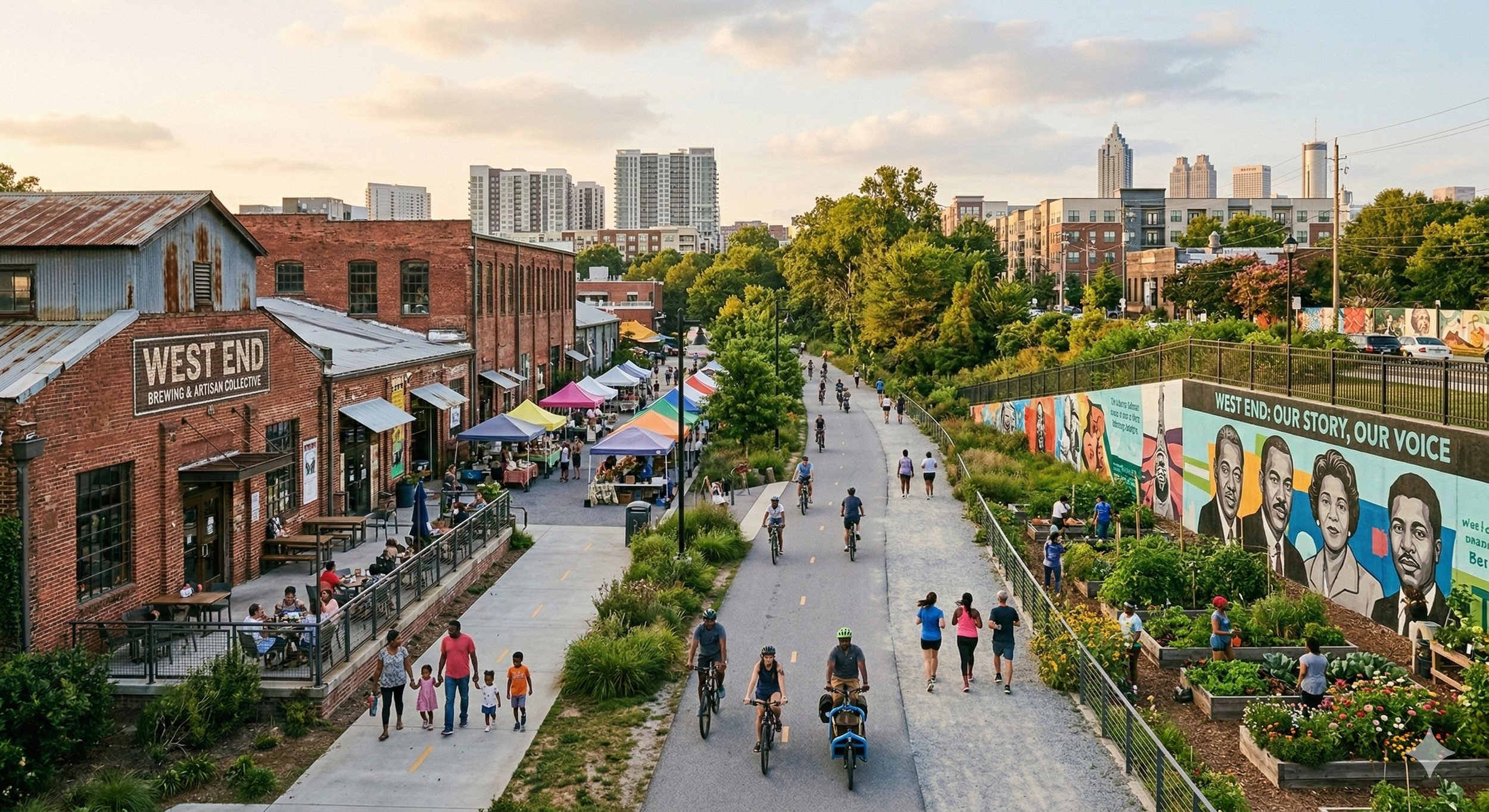
The Atlanta BeltLine is a 22-mile multi-use trail loop that connects 45 intown neighborhoods and is the single biggest driver of walkability improvement in the city. Completed sections include the Eastside Trail (from Ponce City Market south through Inman Park and Reynoldstown), the Westside Trail (through the West End and Adair Park), and growing segments in both directions.
For buyers prioritizing walkability, BeltLine access functions as a multiplier. A neighborhood with a Walk Score of 72 and direct BeltLine trail access delivers a materially different daily experience than a neighborhood with a Walk Score of 78 and no trail connection. The trail enables a loop of parks, restaurants, coffee shops, and entertainment that residents reach entirely on foot or by bike. The practical effect is real.
Neighborhoods with confirmed BeltLine trail access that buyers should know:
Eastside Trail access: Inman Park, Old Fourth Ward, Poncey-Highland, Reynoldstown, Kirkwood (Eastside Trail extension)
Westside Trail access: Adair Park, West End, Oakland City, Capitol View, Sylvan Hills
Northside/future segments: Underway and expanding through Midtown toward Buckhead, with completion on various segments ongoing
For buyers who prioritize walkability and outdoor access together, BeltLine proximity is often the deciding variable. I regularly see buyers choose between two comparable homes in the same price range, and the one with BeltLine access wins even at a modest premium.
Walkability by Buyer Type: Who Should Prioritize What
Walk Score tells you the number. It doesn't tell you whether that number matters for your life. Here's how I frame it for different buyers.
First-time buyers who want walkability on a tighter budget: Old Fourth Ward and Kirkwood are the most accessible intown options with genuine walkability. The City of Decatur delivers it at suburban scale with a higher price tag. For buyers who need to trade price for space, Smyrna's Market Village area and downtown Marietta offer real walkable cores at significantly lower price points than intown Atlanta.
Move-up buyers and families: Virginia-Highland and Inman Park are the strongest options for buyers who want top-tier walkability and can pay for it. Both are expensive and the supply of single-family homes is constrained. Decatur is the strongest suburban option, especially for buyers who also want rail access and a walkable school-age kid environment.
Luxury buyers: Buckhead Village and Midtown high-rises are the walkable luxury options at the top of the price range. Buckhead Village's Walk Score of 93 is the highest among luxury residential neighborhoods in the city. Virginia-Highland and Inman Park deliver walkability with historic neighborhood character at a somewhat lower luxury price point.
Relocating buyers coming from walkable cities: This is the buyer type that most often feels the Atlanta reality gap hardest. My honest advice: if walkability is genuinely non-negotiable for you, the intown neighborhoods are where it exists at a level comparable to what you're leaving. If you want more space than the intown options provide at your budget, the suburban town centers, particularly Decatur, downtown Smyrna, and downtown Roswell, are the honest choices. Most of the outer metro will require a real adjustment in how you think about your daily routine.
Investors: Walkable neighborhoods in Atlanta have consistently appreciated and continue to attract buyer and renter demand. BeltLine-adjacent properties carry real premiums and the demand trajectory is supported by continued trail expansion. For buyers evaluating long-term appreciation, the research on walkability's effect on values is well-established: more walkable properties outperform over time in markets where the infrastructure continues to improve.
A Realistic Note: What Walk Score Doesn't Tell You About Atlanta
Atlanta's walkability story has a few important caveats that any number-first approach misses.
The sidewalk problem. Many Atlanta intown neighborhoods have inconsistent sidewalk coverage. Some blocks have excellent infrastructure. Others have gaps that make the Walk Score technically possible but practically frustrating on foot. This varies block by block. Before you commit to a specific street based on Walk Score, walk it during a regular errand run and see what the infrastructure actually feels like.
Street design vs. amenity access. Some Atlanta streets score well on Walk Score because amenities are technically nearby, but the street design routes pedestrians through parking lots, across high-speed arterials, or along roads without shade or sidewalks. Technically walkable on a map. Not the walkable experience buyers from denser cities expect.
The heat factor. Atlanta summers are long and hot, with high humidity that makes extended outdoor walks uncomfortable from roughly June through September. Shade coverage, distance to amenities, and time of day matter in ways that don't show up in Walk Score. Buyers who move from northern cities sometimes underestimate how much the heat shapes when and whether they actually walk for errands versus driving out of comfort.
The car question even in walkable neighborhoods. Even in Old Fourth Ward and Virginia-Highland, most residents own cars. Walkability in Atlanta's context usually means being able to complete a meaningful portion of errands on foot, not living without a vehicle entirely. Car-free living is possible in some intown contexts, especially with MARTA access, but it requires specific proximity to rail and deliberate lifestyle planning in ways that New York or Chicago don't require.
Frequently Asked Questions
What are the most walkable neighborhoods in Atlanta?
By Walk Score, the highest-scoring residential neighborhoods in Atlanta are Buckhead Village (93), Sweet Auburn (91), Midtown (87), Inman Park (87), Virginia-Highland (81–85), and Old Fourth Ward (82). All are either connected to MARTA rail or directly accessible to the Atlanta BeltLine. Among these, Inman Park, Old Fourth Ward, Virginia-Highland, and Midtown are the most consistent options for buyers looking for residential neighborhoods with daily walkability.
Is Atlanta actually walkable?
Metro Atlanta overall has a Walk Score of 48, which classifies it as car-dependent. But within specific intown neighborhoods, Atlanta is genuinely walkable at a level comparable to other mid-sized American cities. The honest answer is that Atlanta is highly variable: very walkable in a concentrated set of intown neighborhoods, very car-dependent everywhere else. Knowing which category your target neighborhood falls into is essential before you buy.
What is the Walk Score of Decatur GA?
The City of Decatur has a city-wide Walk Score of approximately 60, making it the most walkable city in Georgia by that measure. The score is higher in the immediate downtown core around the courthouse square, where daily errands, restaurants, and transit are genuinely accessible on foot. Decatur also has MARTA rail access via the Decatur station, which adds transit connectivity beyond what the Walk Score captures.
Does walkability affect home values in Atlanta?
Yes, measurably. Homes in Atlanta's most walkable neighborhoods consistently carry price-per-square-foot premiums over comparable homes in car-dependent areas. The BeltLine has been a particularly significant driver, with neighborhoods along completed trail segments showing consistent appreciation tied in part to the trail as an amenity. Nationally, research shows walkable homes outperform car-dependent homes on appreciation over time in markets where walkability infrastructure continues to improve. Atlanta's ongoing BeltLine expansion supports that trajectory for intown properties.
Which Atlanta suburbs have walkable town centers?
Several Atlanta suburbs have genuine walkable town centers even if the city-wide Walk Score is low. The strongest options are the City of Decatur (most walkable overall), downtown Smyrna's Market Village, Marietta Square, and Canton Street in downtown Roswell. All four have real pedestrian-scale amenities, local restaurants, and weekend activity. Alpharetta's Avalon is a designed walkable development rather than an organic town center, but it functions as a walkable destination for residents in that corridor. For buyers who need more space than intown Atlanta provides, these suburban town centers are the honest alternative.
What is the BeltLine and why does it matter for walkability?
The Atlanta BeltLine is a 22-mile multi-use trail loop connecting 45 intown neighborhoods. Completed segments include the Eastside Trail (from Ponce City Market through Inman Park and Reynoldstown) and the Westside Trail (through the West End and Adair Park). The trail enables pedestrian and cycling access between neighborhoods, parks, restaurants, and entertainment that bypasses street-level traffic and parking entirely. For buyers prioritizing walkability, BeltLine trail access is one of the most valuable location attributes an intown property can have. Properties along completed segments consistently command premiums and the trail continues to expand.
What should I look for when evaluating walkability in Atlanta beyond the Walk Score?
Four things I look at beyond the number: the sidewalk infrastructure on the specific blocks you'll actually walk (gaps and poor conditions are common even in higher-scoring neighborhoods), what the nearby amenities actually are (strip mall access and neighborhood retail access both contribute to Walk Score but deliver very different experiences), shade and pedestrian-scale street design (Atlanta heat and high-speed arterials make some technically walkable routes unpleasant), and BeltLine or trail proximity. A home with a moderate Walk Score and direct BeltLine access often delivers more usable walkability than a higher-scored home on a busy arterial with better amenity density but poor pedestrian infrastructure.
Is it possible to live car-free in Atlanta?
In select intown neighborhoods with MARTA rail access, car-free living is possible with deliberate planning. Sweet Auburn, Midtown, Old Fourth Ward, Inman Park, and neighborhoods near MARTA rail stations are the most realistic options. Most Atlanta residents, including those in walkable intown neighborhoods, own at least one car because the metro geography and transit network make car-free living challenging for anything beyond the immediate neighborhood. The realistic goal for most buyers is reducing car dependency, not eliminating it.
Which Atlanta walkable neighborhood has the best value in 2026?
Old Fourth Ward gives you a Walk Score of 82, BeltLine access, Ponce City Market, and fiber internet at a price point that is high by suburban standards but lower than Virginia-Highland or Inman Park for comparable product. Condos and smaller homes start in the $400,000s, which is the entry point for intown walkable living in Atlanta's current market. Kirkwood is the next step down in Walk Score but also in price, with a genuine walkable commercial corridor on Hosea Williams Drive and home prices that still have room relative to the most expensive intown options.
How does Atlanta walkability compare to other Southern cities?
Among comparable Southern metros, Atlanta's intown walkability is stronger than most. Dallas, Houston, Phoenix, and Charlotte have less concentrated walkable intown density. Nashville's intown neighborhoods have improved but Atlanta's BeltLine gives it a more developed pedestrian infrastructure connecting multiple neighborhoods. Miami has higher walkability in its urban core. Atlanta's advantage is the combination of the BeltLine trail network, MARTA rail, and several genuinely walkable intown neighborhoods at price points below coastal cities. It's a legitimate walkable city within those specific corridors. Outside them, it's one of the most car-dependent metros in the country.
If walkability is a priority in your home search, the specific block you're on matters more than the neighborhood name, and the neighborhood name matters more than the metro average. I know which streets actually work for daily on-foot living in Atlanta and which ones look better on paper than they perform in practice.
Visit kristenjohnsonrealestate.com to get started.
Come as you are, come on home.
If you found this useful, I've written detailed guides to many of the neighborhoods covered here. For remote workers specifically, read Best Atlanta Neighborhoods for Remote Workers: Walkability, Fiber & Quality of Life 2026. For neighborhood-by-neighborhood guides, browse the full series at kristenjohnsonrealestate.com.