

How Much Do I Need to Buy a Home in Atlanta? Down Payment and Closing Costs Explained
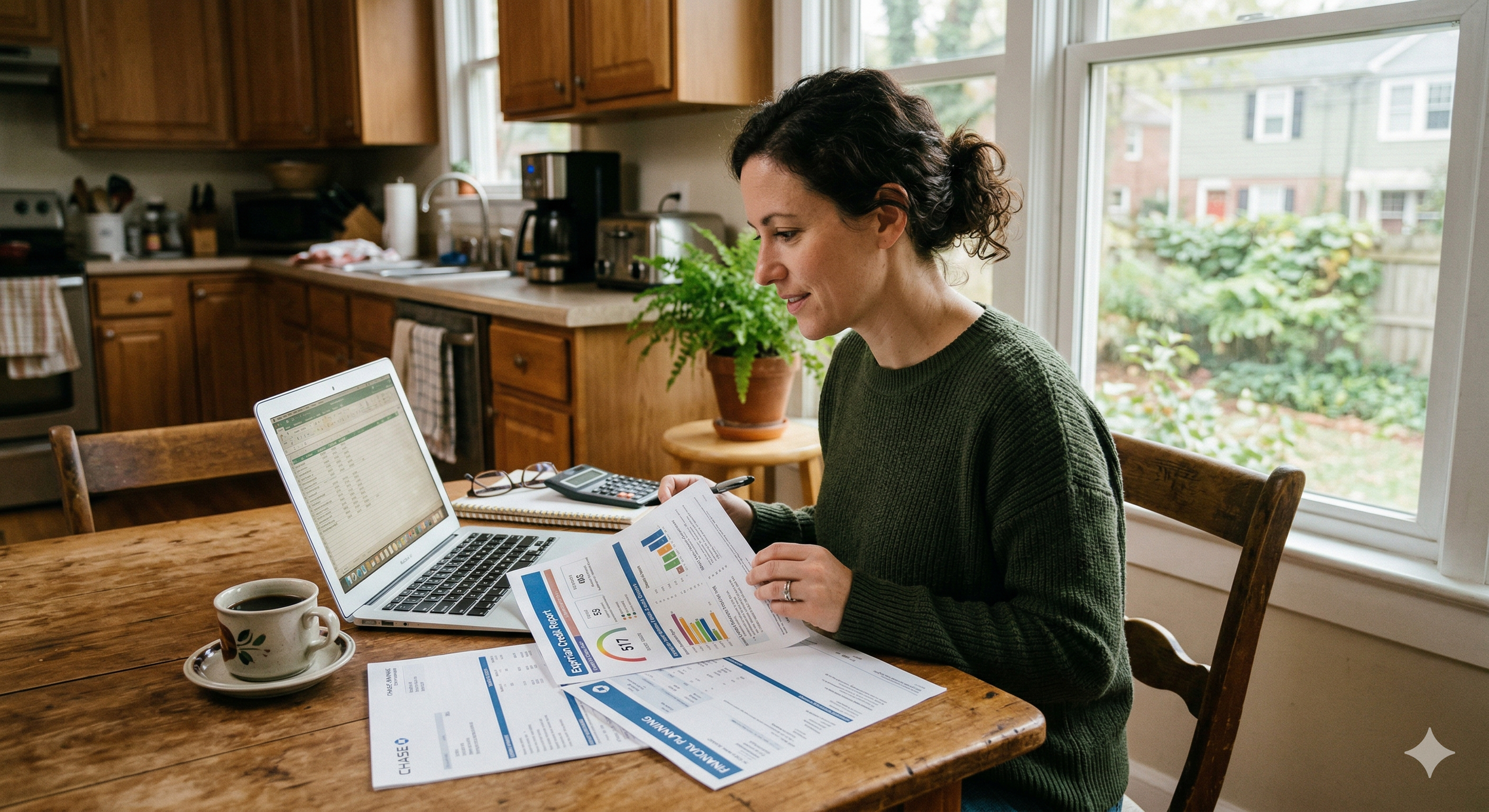
The number one question I get from buyers who are just starting out is some version of this: "How much money do I actually need?" And it's a fair question, because the internet gives you five different answers depending on where you look. Here's what I tell every buyer I work with: the down payment is only part of what you need at closing. The closing costs are a separate line item, and if you don't plan for them, you'll get to the finish line short.
I work with buyers across Metro Atlanta at every price point, from first-time buyers figuring out how to stretch a $350,000 budget in the suburbs to relocators putting together offers on $800,000 homes in Buckhead and Brookhaven. Nearly a decade of doing this means I've sat across the table from a lot of buyers who did not know what they didn't know until we were too close to closing for comfort.
This post is the breakdown I give my clients before we start looking at houses. Down payments by loan type, closing costs specific to Georgia, what the state and city programs actually cover, and what your cash-to-close number is really going to look like on a Metro Atlanta home.
Here's what you need to know.
What Is a Down Payment, and How Much Do You Actually Need?
Let's start here because there's a persistent myth that you need 20% down to buy a home. You don't. The 20% figure is real, and there are good reasons to consider it, but it is not a requirement for most loan programs. Buyers in Atlanta are routinely closing on homes with 3%, 3.5%, and even zero down, depending on the loan type and assistance programs they qualify for.
Here's how the major loan programs break down:
Conventional Loans
Conventional loans are backed by Fannie Mae or Freddie Mac and not insured by a government agency. The minimum down payment for a conventional loan is 3% for first-time buyers who qualify for specific programs (like Fannie Mae's HomeReady or Freddie Mac's Home Possible), and 5% for most other buyers.
The 20% threshold matters with conventional loans because that's when private mortgage insurance (PMI) goes away. PMI is a monthly premium, typically between 0.5% and 1.5% of the loan amount annually, that protects the lender if you default. On a $400,000 loan, that's $2,000 to $6,000 per year, or $167 to $500 per month added to your payment. Once you reach 20% equity, you can request to have PMI removed.
Conventional loans also have stricter credit requirements. Most lenders want a minimum score of 620, and the better your score, the better your rate.
FHA Loans
FHA loans are insured by the Federal Housing Administration and are one of the most widely used loan types for first-time buyers in Atlanta. The minimum down payment is 3.5% for buyers with a credit score of 580 or higher. If your score falls between 500 and 579, FHA requires 10% down.
FHA loans are more flexible on debt-to-income ratios and credit history, which makes them accessible for buyers who have had some financial bumps in the past. The tradeoff is mortgage insurance. FHA loans carry both an upfront mortgage insurance premium (MIP), currently 1.75% of the loan amount, and an annual MIP that typically runs 0.55% of the loan balance. Unlike conventional PMI, FHA mortgage insurance stays for the life of the loan if your down payment is less than 10%, or for 11 years if you put down 10% or more.
On a $350,000 home with 3.5% down:
Down payment: $12,250
Upfront MIP: approximately $5,906 (can be rolled into the loan)
Annual MIP: approximately $1,848/year, or $154/month added to your payment
VA Loans
If you're an eligible veteran, active-duty service member, or surviving spouse, this is almost always the best loan available to you. VA loans require no down payment, no private mortgage insurance, and typically carry some of the lowest interest rates on the market. The funding fee (which replaces MIP) can be rolled into the loan and varies based on your service history and whether you've used a VA loan before.
For first-time VA loan users making no down payment, the funding fee is typically 2.15% of the loan amount. That said, certain veterans with service-connected disabilities may be exempt entirely.
USDA Loans
USDA loans are administered by the U.S. Department of Agriculture and are designed for buyers purchasing in eligible rural and suburban areas. Zero down payment is required. In Metro Atlanta, USDA-eligible areas include parts of Cherokee, Bartow, Paulding, Rockdale, and Newton counties, among others. Most city of Atlanta addresses, Fulton County neighborhoods close to the core, and dense suburban areas in Cobb, Gwinnett, and DeKalb do not qualify. But if you're open to communities in the outer ring, it's worth checking the USDA eligibility map before you assume you don't qualify.
USDA loans do require an upfront guarantee fee (currently 1% of the loan amount) and an annual fee (currently 0.35% of the loan balance), both of which are more affordable than FHA's insurance costs.

What Do Down Payments Look Like at Atlanta's Price Points?
Let me give you real numbers based on what I'm actually seeing in Metro Atlanta right now.
The median list price in Atlanta hovered around $365,000 in late 2025, and depending on where you're buying, that number shifts significantly. In the intown neighborhoods (Kirkwood, Grant Park, Old Fourth Ward, Edgewood), you're often starting conversations at $400,000 to $500,000. In established suburbs like Smyrna, Decatur, and Mableton, the $300,000 to $400,000 range is realistic. In the outer suburbs like Loganville, Douglasville, and parts of Henry County, you can still find quality single-family homes under $300,000.
Here's how down payments look across those tiers:
| Purchase Price | 3% Conventional | 3.5% FHA | 5% Conventional | 10% Conventional | 20% Conventional |
|---|---|---|---|---|---|
| $300,000 | $9,000 | $10,500 | $15,000 | $30,000 | $60,000 |
| $400,000 | $12,000 | $14,000 | $20,000 | $40,000 | $80,000 |
| $500,000 | $15,000 | $17,500 | $25,000 | $50,000 | $100,000 |
| $600,000 | $18,000 | $21,000 | $30,000 | $60,000 | $120,000 |
These are down payment only. Your closing costs come on top of this.
What Are Closing Costs, and What Do They Include?
Closing costs are the fees and expenses you pay to complete a real estate transaction. They are separate from your down payment and are paid at or before the closing table. For buyers in Atlanta, closing costs typically run 2% to 5% of the purchase price, though the exact number depends on your loan type, lender, the specific property, and what you've negotiated in the contract.
Georgia is an attorney state. That means a real estate attorney must oversee the closing and handle the transfer of title. The closing attorney fee is part of your closing costs and is not optional.
Here's what buyer closing costs in Georgia usually include:
Lender Fees
Loan origination fee: typically 0% to 1% of the loan amount, though some lenders charge a flat fee
Underwriting fee: usually $400 to $900
Processing fee: varies by lender, often $300 to $600
Discount points: optional, prepaid interest to lower your rate; each point is 1% of the loan amount
Title and Attorney Fees
Closing attorney or settlement fee: typically $300 to $1,200
Lender's title insurance policy: roughly $500 to $2,000 depending on loan amount
Owner's title insurance policy: in Atlanta, it is customary for the seller to pay the owner's policy, though this is negotiable
Title search fee: usually $150 to $400
Prepaid Items and Escrow Deposits
This is often the category that surprises buyers most, because these are ongoing homeownership costs you're paying upfront at closing.
Homeowner's insurance: lenders typically require the first year's premium paid at closing; in Metro Atlanta, annual premiums for a $350,000 to $450,000 home often run $1,500 to $2,500 depending on coverage and location
Prepaid interest: interest on your loan from the closing date through the end of the month; the closer you close to month-end, the smaller this number
Escrow account setup: initial deposits into your escrow account for property taxes and insurance; this varies significantly depending on your property's tax rate and the time of year you close
Inspection Fees
Home inspection: typically $350 to $600 for a standard single-family home, more for larger or older homes
Specialized inspections (radon, sewer scope, HVAC, pool): $100 to $400 each, as applicable
These are paid before closing, usually right after you go under contract
Other Fees
Appraisal fee: $500 to $900 in Metro Atlanta; often paid upfront before closing
Survey fee (if required): $300 to $700
Recording fees: usually a few hundred dollars
Georgia intangible recording tax: 0.3% of the principal loan amount (for example, $900 on a $300,000 loan)
HOA transfer and estoppel fees (if applicable): $100 to $400, sometimes a seller cost
What Does That Add Up To?
On a $350,000 purchase with a conventional loan, your closing costs could realistically land between $7,000 and $14,000, not counting your down payment. On a $500,000 purchase, you're looking at $10,000 to $20,000. On a $700,000 purchase, plan for $14,000 to $28,000.
These ranges exist because so much depends on your lender's fees, the specifics of your loan program, and how much of your prepaid costs are tied to your close date and property tax situation. Get a Loan Estimate from your lender early in the process. It's a standardized document your lender is required to provide within three business days of your loan application, and it breaks down every fee in your transaction.
What Is Cash to Close?
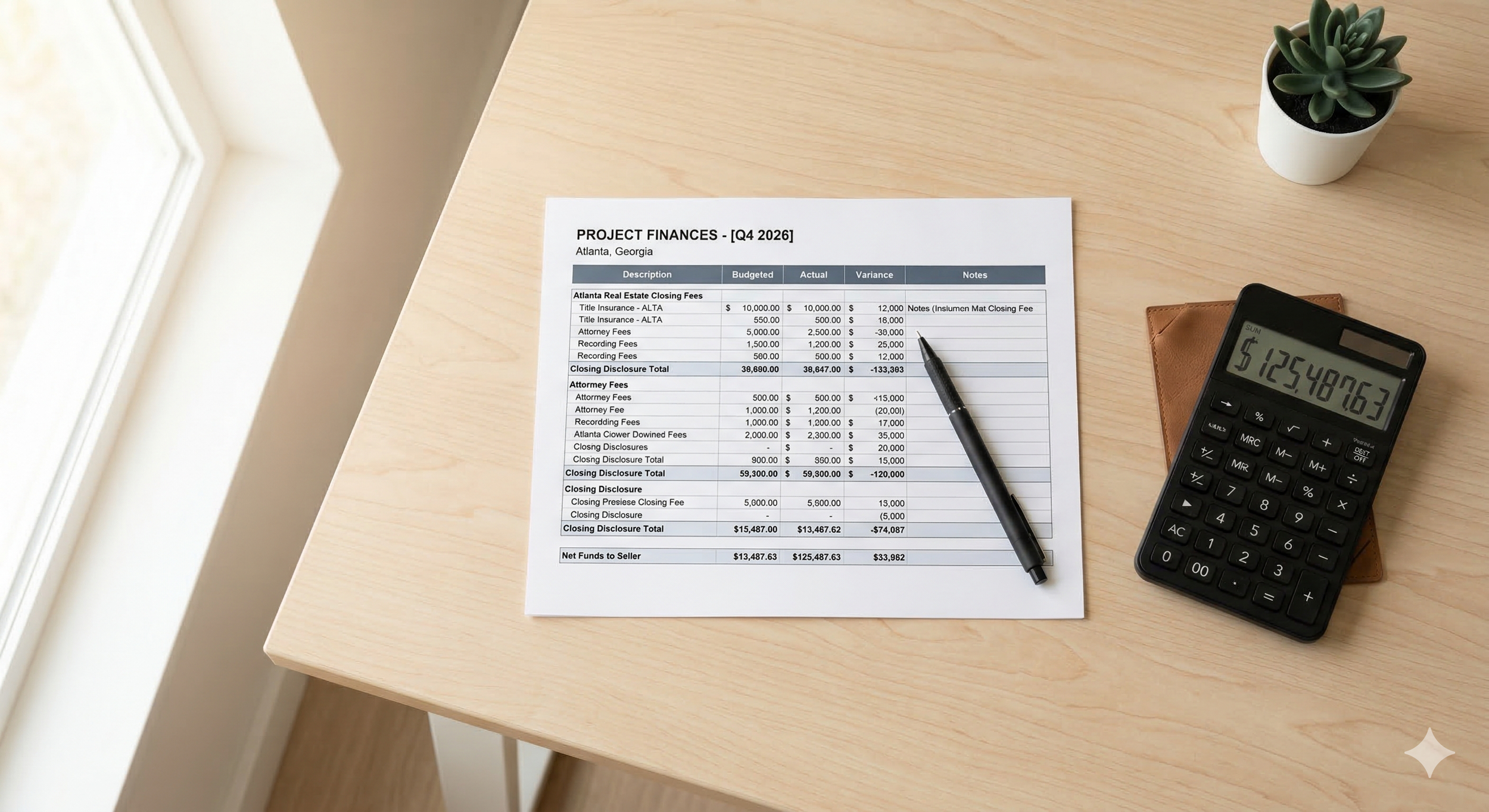
Cash to close is the total amount of money you need to bring to the closing table. It includes your down payment, your closing costs, minus any seller concessions you've negotiated, minus any assistance from a down payment assistance program, and minus any credits from your earnest money deposit (which you've already paid).
Here's an example for a $400,000 purchase with 5% down on a conventional loan:
| Item | Amount |
|---|---|
| Down payment (5%) | $20,000 |
| Estimated closing costs (3%) | $12,000 |
| Earnest money already paid | ($3,000) |
| Seller concession (negotiated) | ($5,000) |
| Estimated cash to close | $24,000 |
That's a meaningful number, and it's why I always tell buyers to think in terms of total cash needed, not just down payment. The down payment is only part of the story.
Down Payment Assistance Programs Available in Metro Atlanta
This is where I want to be direct with you: there is real money available to help buyers in Georgia, and a lot of buyers leave it on the table because they assume they won't qualify or their agent doesn't bring it up.
Here are the programs I refer my clients to most often. Availability, funding levels, and eligibility requirements can change, so always verify current status with the administering agency or your lender.
Georgia Dream Homeownership Program
This is Georgia's flagship first-time buyer assistance program, administered by the Georgia Department of Community Affairs (DCA). It pairs a 30-year fixed-rate mortgage with down payment assistance.
Key details as of 2025:
Down payment assistance of up to $10,000 as a zero-interest deferred loan
Repayment is deferred until you sell, refinance, or move out
Must be a first-time buyer (or not have owned a home in the past three years)
Minimum credit score of 640
Income limits: $130,290 for 1-2 person households and $149,833 for households of 3 or more, as of July 2025
Maximum purchase price of $550,000 for the standard program
Liquid assets must not exceed $20,000 or 20% of the purchase price, whichever is greater
Minimum buyer contribution of $1,000 toward the transaction
Homebuyer education is required
Georgia Dream also has a PEN program that provides up to $12,500 in assistance for eligible military members, educators, healthcare workers, and public safety employees.
You apply through a participating Georgia Dream lender, not directly through DCA. Ask your lender upfront whether they participate.
Invest Atlanta Programs
Invest Atlanta administers several programs for buyers purchasing within Atlanta city limits. These are funded through a combination of city and federal funds, and eligibility and availability shift year to year.
Notable programs include:
The Atlanta First-Time Homebuyers Down Payment Assistance Program, which provides up to $20,000 in assistance toward down payment and closing costs. The assistance is fully forgiven after you've lived in the home for a specified period (5 or 10 years depending on the amount). Buyers must earn at or below 80% of area median income.
The Perry Bolton TAD program, which offers up to $10,000 for buyers purchasing in that district, available to households earning up to 120% of AMI.
The Vine City program, which offers up to $20,000 as a forgivable grant for buyers purchasing in Vine City. Requirements include less than $25,000 in liquid assets and a $1,000 participation fee.
Invest Atlanta programs require buyers to use an affiliated lender and complete homebuyer education. Not all programs are active at all times and some have limited funding pools that can be exhausted mid-year.
Atlanta Housing Down Payment Assistance
The City of Atlanta's own down payment assistance program targets low-to-moderate income first-time buyers purchasing within Atlanta city limits. Eligible buyers can receive up to $20,000. Income limits are set at 80% of area median income.
Chenoa Fund and Private Programs
Several private and nonprofit programs operate alongside Georgia Dream, including the Chenoa Fund, which provides down payment assistance layered on top of FHA loans. Ask your lender which programs they can actually originate, not just which ones they've heard of.

Can You Negotiate Closing Costs?
Yes. And in some market conditions, you can negotiate quite effectively.
Seller Concessions
In a transaction where the seller is motivated, you can negotiate for the seller to contribute toward your closing costs. The seller doesn't hand you money directly; instead, the credit reduces the amount you owe at closing. Loan programs cap how much sellers can contribute:
FHA loans: up to 6% of the lesser of the sale price or appraised value
Conventional loans: 3% if putting less than 10% down, 6% with 10% or more down
VA loans: generally capped around 4%; confirm with your lender
USDA loans: up to 6%
In a competitive market with multiple offers, asking for seller concessions can weaken your offer. In a balanced market or on a home that's been sitting, it's a reasonable negotiation point.
Lender Credits
You can take a slightly higher interest rate in exchange for a lender credit that offsets your closing costs. This is called a no-closing-cost loan or credit-offset structure. It's not free money: you'll pay more in interest over the life of the loan. But for buyers who are stretched on cash and plan to refinance within a few years, it can be a useful tool.
What Is Not Negotiable
Transfer taxes, recording fees, the intangible recording tax, and attorney fees are set by law or by the attorney's fee schedule. These are not negotiable.
How Property Taxes Factor Into Your Upfront Costs
Georgia property taxes are assessed by county, and the rate varies significantly across Metro Atlanta. This matters at closing because of how tax prorations work.
If you're buying mid-year and the seller has already paid the annual property tax bill, you may owe the seller a prorated amount for the portion of the year you'll own the home. If taxes are paid in arrears (which is common), the seller typically credits you at closing for the days they owned the home during the current tax year.
Either way, you'll also be making initial deposits into your escrow account for property taxes. Depending on how many months the lender requires, this can add $2,000 to $5,000 or more to your upfront costs at closing.
Property tax rates across Metro Atlanta vary noticeably by county:
Fulton County inside Atlanta city limits tends to have higher millage rates; homeowners in incorporated Atlanta pay both county and city taxes
DeKalb County rates depend significantly on whether the property is in an incorporated city
Cobb County generally has lower tax rates than Fulton for comparable property values
Gwinnett County rates are generally competitive with other suburban counties
Clayton, Henry, and Douglas counties tend to have some of the lowest property tax rates in the metro
Your lender will calculate the exact escrow deposit required based on your specific property and county. Let your Loan Estimate and Closing Disclosure do the work on this number.
How Much Should You Have in Reserve After Closing?
This is the question buyers rarely ask and almost always wish they had.
Most lenders require you to have some reserves remaining after closing, typically 2 to 3 months of mortgage payments in the bank. But beyond the lender's requirement, I encourage buyers to think seriously about this from a practical standpoint.
Homeownership comes with costs that don't exist in renting: the HVAC unit that needs replacing, the roof repair, the appliance that fails in year two. Financial planners generally recommend setting aside 1% of the home's value annually for maintenance and repairs. On a $400,000 home, that's $4,000 per year. You don't spend it every year, but when the year arrives where you do spend it, you want to be ready.
Going into closing with nothing left in savings is not a position I want any of my buyers in. If the only way to close is to drain every dollar, let's talk about whether the timing is right or whether there's an assistance program that preserves more of your cash.
A Realistic Cash-to-Close Scenario: First-Time Buyer in Metro Atlanta
Let me walk you through what a realistic first-time buyer scenario looks like in Metro Atlanta right now.
Scenario 1: First-time buyer, $360,000 home in Mableton (Cobb County), FHA loan
| Item | Amount |
|---|---|
| Purchase price | $360,000 |
| Down payment (3.5%) | $12,600 |
| Estimated closing costs (3.5%) | $12,600 |
| Earnest money already paid | ($2,500) |
| Georgia Dream DPA (deferred loan) | ($10,000) |
| Seller concession (negotiated) | ($4,000) |
| Estimated cash to close | $8,700 |
That's a real number. It's not zero, but it's manageable for a buyer who has been saving. And if the buyer qualifies for an Invest Atlanta program or a local county assistance program, additional dollars could reduce it further.
Scenario 2: Move-up buyer, $550,000 home in Smyrna, conventional loan with 10% down
| Item | Amount |
|---|---|
| Purchase price | $550,000 |
| Down payment (10%) | $55,000 |
| Estimated closing costs (2.5%) | $13,750 |
| Earnest money already paid | ($5,000) |
| Seller concession | $0 |
| Estimated cash to close | $63,750 |
At this price point and market segment, the cash requirement is substantial. Buyers here are typically using equity from a home sale to fund the down payment, which changes the math entirely.
Frequently Asked Questions About Down Payments and Closing Costs in Atlanta
How much money do I need to buy a home in Atlanta?
It depends on the loan type, purchase price, and what assistance programs you qualify for. At minimum, plan for your down payment plus 2% to 5% of the purchase price in closing costs. With an FHA loan and down payment assistance through Georgia Dream or Invest Atlanta, some buyers close with less than $10,000 out of pocket on homes in the $300,000 to $400,000 range. Without assistance, a 5% down conventional purchase at $400,000 could require $30,000 to $45,000 in total cash to close.
Can I buy a home in Atlanta with no money down?
Yes, in specific situations. VA loans require no down payment for eligible veterans and active-duty service members. USDA loans require no down payment for buyers purchasing in eligible suburban and rural areas. Conventional and FHA loans require a minimum down payment, but down payment assistance programs can cover part or all of that requirement for qualifying buyers. Zero down does not mean zero closing costs; you'll still need funds for lender fees, title, and prepaid items unless those are covered by assistance or seller concessions.
What is Georgia Dream and should I use it?
Georgia Dream is the state's primary first-time buyer assistance program, administered by the Georgia Department of Community Affairs. It provides a zero-interest deferred loan of up to $10,000 (or up to $12,500 for eligible public servants) paired with a 30-year fixed-rate mortgage. Repayment is deferred until you sell, refinance, or move. If you meet the income and credit requirements, it's almost always worth exploring. The trade-off is that you must use a participating Georgia Dream lender, which limits your pool of rate comparisons.
What are closing costs in Georgia, and who pays them?
In Georgia, buyers typically pay 2% to 5% of the purchase price in closing costs. These include lender fees, title insurance, attorney fees, prepaid homeowners insurance, initial escrow deposits for property taxes, and inspection fees. Sellers are generally responsible for real estate commissions and often pay the owner's title insurance policy as a local custom. Some costs can be negotiated; others are fixed by law or set by third-party providers.
Do I need 20% down to buy a home in Atlanta?
No. The 20% figure is where private mortgage insurance disappears on a conventional loan, not a requirement to purchase. Buyers are routinely closing in Metro Atlanta with 3%, 3.5%, and even zero down, depending on their loan type. The question is whether the lower down payment makes financial sense for your overall position, including your monthly payment, mortgage insurance costs, and how much cash you preserve after closing.
What is earnest money and does it count toward my down payment?
Earnest money is a good-faith deposit you make when your offer is accepted. It's held in escrow and applied toward your costs at closing. In Metro Atlanta, earnest money typically runs 1% to 2% of the purchase price, though in competitive situations, higher deposits can strengthen your offer. Yes, earnest money counts toward your cash to close. If you've paid $3,000 in earnest money, your cash to close is reduced by $3,000.
Can the seller pay my closing costs?
Yes, through a mechanism called seller concessions. The seller can contribute toward your closing costs as part of the negotiated purchase contract. Each loan type caps how much the seller can contribute: FHA allows up to 6%, conventional loans allow 3% to 6% depending on your down payment, and VA loans cap concessions around 4%. Asking for seller concessions can affect your offer's competitiveness in a tight market. In a balanced market or on a property with days on market, it's a reasonable request.
What is PMI and can I avoid it?
PMI (private mortgage insurance) is a monthly premium required on conventional loans when the buyer's down payment is less than 20%. It protects the lender, not you, if you default. On a $400,000 loan with 5% down, PMI might add $150 to $400 per month to your payment. You can avoid PMI by putting 20% down, using a VA loan (no PMI ever), using a USDA loan (different fee structure), or structuring a piggyback loan (less common). Once you reach 20% equity on a conventional loan, you can request PMI removal. It automatically terminates at 22% equity.
What happens to my earnest money if the deal falls through?
Whether you get your earnest money back depends on the contingencies in your contract and which party terminates the deal. If you cancel during an active contingency period (inspection, financing, appraisal), your earnest money is typically refunded. If you cancel without a valid contingency, you may forfeit the deposit. This is why understanding your contract and working with a knowledgeable agent matters.
What is an escrow account and why do I have to fund it at closing?
An escrow account is a separate account managed by your lender to collect and pay your property taxes and homeowners insurance on your behalf. At closing, most lenders require an initial deposit to fund this account, typically several months of property taxes and insurance premiums. The amount varies by property and close date.
How does the intangible recording tax work in Georgia?
Georgia charges an intangible recording tax on mortgage loans at 0.3% of the principal loan amount. This is a buyer closing cost and is not negotiable. On a $350,000 loan, the intangible recording tax is $1,050. It is separate from recording fees for the deed and mortgage documents, which are typically a few hundred dollars.
Should I put more than the minimum down if I have the savings?
It depends on your full financial picture. A larger down payment reduces your loan balance, lowers or eliminates PMI, and reduces your monthly payment. It can also strengthen your offer in a competitive situation. But it ties up cash that could serve as reserves, an investment, or an emergency fund. There's no universal right answer. I'll tell you what I see clients do and how it plays out in the real market, but your mortgage lender and a financial advisor can help you model the actual numbers.

The Bottom Line: What to Do Before You Start Looking
Before you start scheduling showings, do these three things.
Get pre-approved, not just pre-qualified. A pre-qualification is based on information you provide. A pre-approval involves actual documentation: pay stubs, tax returns, bank statements, and a credit pull. Sellers in Metro Atlanta expect pre-approval letters, and I won't take buyers out without one. Your pre-approval also tells you which loan programs you actually qualify for, not just in theory.
Ask your lender about assistance programs. Not every lender participates in Georgia Dream or Invest Atlanta programs. Ask upfront. If they don't participate and you might qualify, find a lender who does. The dollars are meaningful.
Get a Loan Estimate for your specific scenario. A Loan Estimate is a standardized three-page document your lender provides within three business days of your application. It breaks down every fee, shows your projected monthly payment, and gives you a cash-to-close figure. Get this early and compare it across at least two lenders.
I work with buyers throughout Metro Atlanta and can refer you to lenders who know the market, know the assistance programs, and will give you a straight picture of your numbers before you fall in love with a house. If you're in the early stages and want to talk through what buying looks like for your situation, let's connect.
Visit kristenjohnsonrealestate.com or reach out directly at (404) 790-0080 or info@kristenjohnsonrealestate.com.
Come as you are, come on home.
Looking for more resources on buying a home in Metro Atlanta? I've covered neighborhoods across the city and suburbs, including West End, Grant Park, and Kirkwood. Browse the full guide series at kristenjohnsonrealestate.com.