

How Do You Evaluate an Atlanta Rental Property's True Cash Flow?
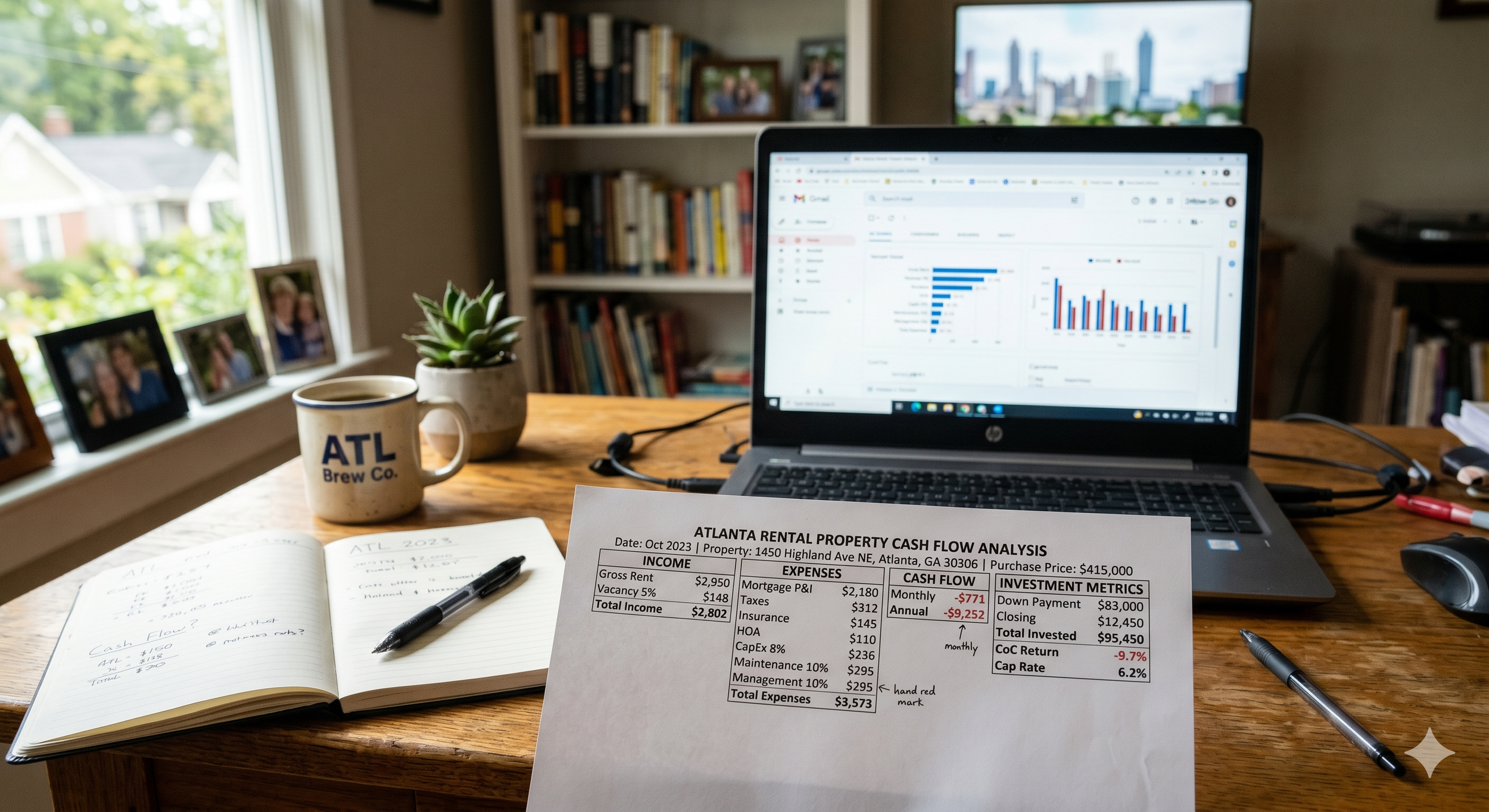
To evaluate an Atlanta rental property's true cash flow, you subtract every actual operating expense from the gross rent, then subtract the mortgage payment from what's left. The number that remains, monthly or annually, is your cash flow. The reason most new investors get this wrong is that they only count the obvious expenses (mortgage, taxes, insurance) and skip the ones that wreck pro formas: vacancy, capital expenditures, repairs and maintenance, property management, leasing turnover, and rising operating costs. In Atlanta in 2026, with insurance premiums up 20 to 40 percent over the past two years and Fulton and DeKalb tax assessments climbing, the gap between projected cash flow and actual cash flow is wider than it has been in years.
I work with buyers across Metro Atlanta, including investors purchasing single-family homes, townhomes, condos, and small multi-family properties from East Point to Lawrenceville. Investment property is a core part of my business, and I've watched buyers run the numbers on the same property and reach completely different conclusions because one of them used realistic operating expenses and the other used a calculator that asked for "monthly rent" and "monthly mortgage" and stopped there.
Nearly a decade in this market has taught me that cash flow analysis is the difference between an investment that builds wealth and one that quietly bleeds money for years before the owner figures it out.
Here's what you need to know.
Why "True" Cash Flow Is Different From Pro Forma Cash Flow
When a listing agent or wholesaler hands you numbers on an Atlanta investment property, you'll typically see something like this: rent of $1,800, mortgage of $1,400, taxes and insurance of $300, and a cash flow of $100 per month. That's pro forma cash flow, and it's almost always wrong because it's missing five expense categories that show up in real life and don't show up on the seller's spreadsheet.
True cash flow accounts for all of these:
Vacancy. Your property will not be rented 100 percent of the time. Tenants leave, units sit between leases, and turnovers take time.
Capital expenditures (CapEx). The roof, HVAC, water heater, and major appliances are wasting assets. They will fail. The only question is when and how much.
Repairs and maintenance. The day-to-day fixes: leaky faucets, garbage disposals, fence repairs, pest control, gutter cleaning, lawn care.
Property management. Even if you self-manage, your time has a cost. If you don't account for it, you're hiding it.
Leasing and turnover costs. Every new tenant means marketing, screening, possibly painting, possibly carpet cleaning, possibly a leasing fee.
When I underwrite a property with a buyer, we put real numbers next to every one of these line items. The pro forma "cash flow" usually shrinks by half. Sometimes it goes negative. That's not bad news, it's good news. Better to know now than three years in.
The True Cash Flow Formula
Here's the formula I use with every investor client:
Gross Annual Rent − Vacancy = Effective Gross Income − Operating Expenses (taxes, insurance, management, repairs, capex, leasing, utilities, HOA) = Net Operating Income (NOI) − Annual Debt Service (mortgage principal and interest) = Annual Cash Flow
That last line, divided by 12, is your real monthly cash flow. Divided by your total cash invested (down payment, closing costs, initial rehab), gives you cash-on-cash return.
This is not a complicated formula. The discipline is in being honest about every input.
Estimating Gross Rent the Right Way
Before you can subtract anything, you need an accurate rent number. This is where a lot of out-of-state investors get hurt buying Atlanta properties sight unseen.
Don't Use Zillow Rent Zestimate as Your Only Source
Zillow's rent estimate pulls from a wide algorithm that often misses Atlanta's hyperlocal differences. A house on the wrong side of an interstate, on a street with deferred-maintenance neighbors, or two blocks from the BeltLine versus six can have meaningfully different rent ceilings that an algorithm can't see.
What I Use Instead
For every investment property analysis, I pull rent comps from three places:
Active rental listings on the MLS within a half-mile radius, same bedroom count, similar condition. What's currently being asked.
Recently leased comps from the MLS, same parameters. What actually rented and at what price.
Rentometer for a hyperlocal cross-check, since they aggregate data Zillow doesn't always have.
The right rent estimate is the median of recently leased comps, adjusted for condition. Not the highest active listing. Not the optimistic pro forma. The median of what tenants actually agreed to pay in the last 90 days.
Atlanta Rent Benchmarks for 2026
To give you a rough sense of where rents are landing for single-family homes in different parts of Metro Atlanta as of early 2026, based on data from Zillow Rental Manager, RentCafe, and HomeScoutz Atlanta Property Management market reports:
Metro Atlanta single-family median rent: $1,750 to $1,900 per month
South Fulton (College Park, East Point, Hapeville): $1,500 to $1,800 for 3-bedroom homes
Intown 3-bedroom homes (Kirkwood, Reynoldstown, East Atlanta): $1,800 to $2,400
Class B suburban 3-bedroom (Lithonia, Stone Mountain, Lithia Springs): $1,700 to $2,100
Higher-end suburban (East Cobb, Alpharetta, Johns Creek): $2,500 to $3,500
These are starting ranges. For an actual rent number on a specific property, you need actual comps.
Vacancy: Plan for 5 to 8 Percent in Atlanta
Vacancy is the single most-skipped line item on bad pro formas. Investors assume their property will be rented every month of every year. It won't.
Metro Atlanta's overall vacancy rate has ticked up to roughly 7 to 8 percent according to HomeScoutz's 2026 market outlook, driven mostly by new apartment supply pulling renters from older inventory. Single-family rental vacancy is tighter at 4 to 6 percent in well-located properties.
For underwriting purposes, I tell investor clients to model 5 to 8 percent vacancy depending on the submarket and tenant class:
Class A properties (newer construction, premium suburbs, top school districts): 4 to 5 percent
Class B properties (well-maintained, solid neighborhoods, working professional tenants): 5 to 7 percent
Class C properties (older inventory, value submarkets, more turnover): 8 to 10 percent
On a $2,000 monthly rent at 7 percent vacancy, that's $140 per month, or $1,680 per year, off the top before any other expense.
Property Taxes: The Atlanta-Specific Issue You Cannot Ignore
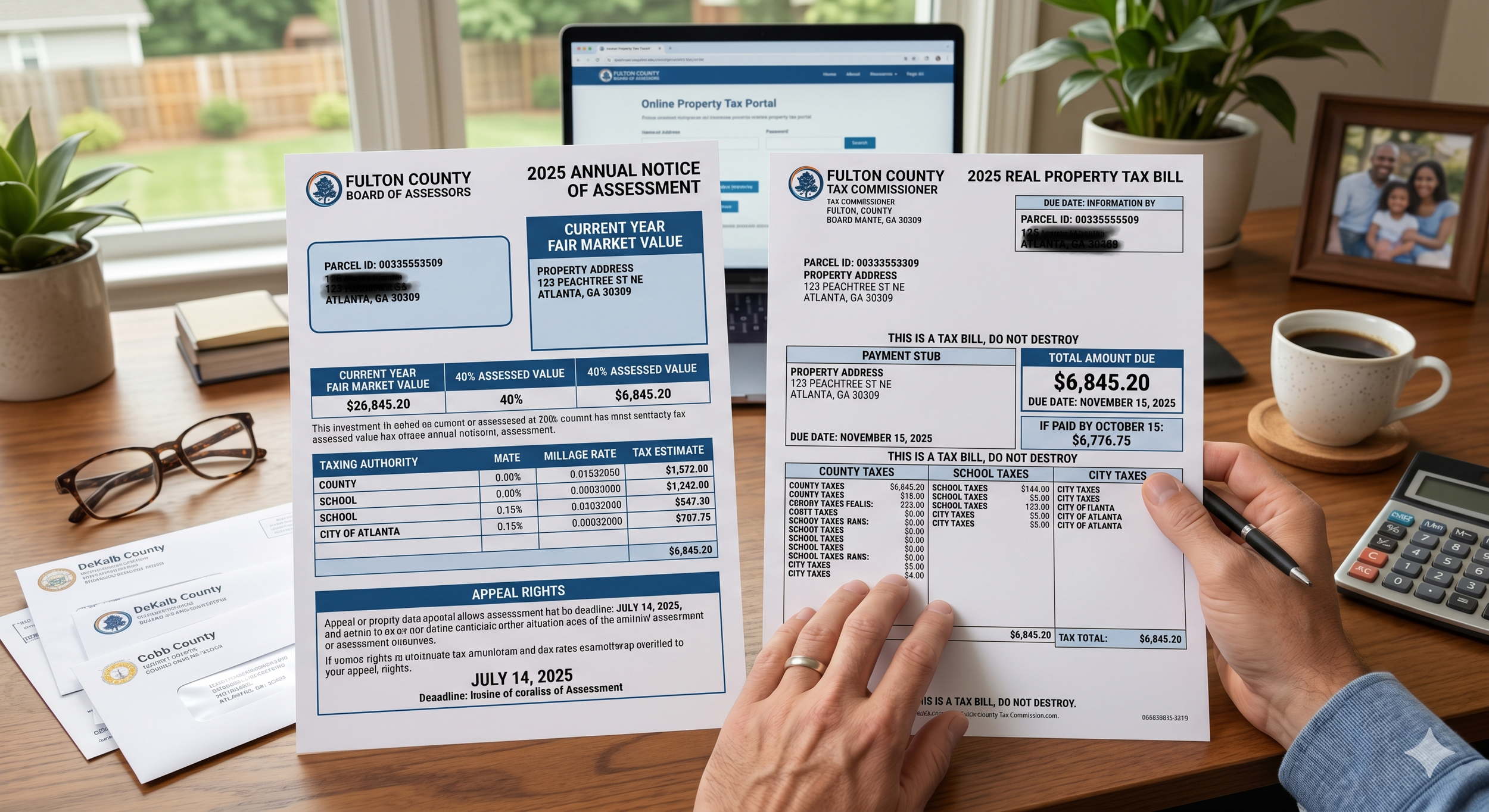
Georgia uses a 40 percent assessment ratio, which means your property tax bill is calculated on 40 percent of fair market value, multiplied by the combined millage rate, divided by 1,000. The combined millage rate stacks county, school district, and city rates.
A few specific points that trip up Atlanta investors:
You Lose the Homestead Exemption
If you're house-hacking or eventually moving out and converting your primary residence to a rental, the homestead exemption goes away. In Fulton County, the floating homestead exemption caps annual assessment increases at the rate of inflation or 3 percent, whichever is lower. The City of Atlanta caps base value increases at 2.6 percent annually. The moment that property becomes an investment, those caps are gone, and your assessment can climb to full market value.
Reassessments Hit Hard
In hot Metro Atlanta submarkets in Fulton, DeKalb, and Cobb, reassessments have driven property tax bills up significantly even when millage rates stayed flat. A property purchased at $300,000 may be assessed at $380,000 within two years if the surrounding market appreciates. That assessment increase flows directly to your operating expenses.
Approximate Tax Rates for Investment Property in Metro Atlanta (2026)
Without homestead exemption, here are rough effective property tax rates by county based on Fulton County millage data and SmartAsset's Georgia property tax research:
Fulton County (City of Atlanta): Combined millage around 34 to 42 mills depending on city, effective rate roughly 1.2 to 1.5 percent of market value annually
DeKalb County: Combined millage around 41 mills with the 2026 increase, effective rate roughly 1.4 to 1.6 percent
Cobb County: Lower millage, effective rate roughly 0.85 to 1.0 percent
Gwinnett County: Effective rate roughly 0.92 percent
Clayton County: Effective rate roughly 0.97 percent
On a $300,000 investment property in DeKalb, that's roughly $4,200 to $4,800 per year in property taxes. In Cobb, the same property might run $2,550 to $3,000. The county you buy in materially changes your cash flow.
Insurance: The Line Item That Is Wrecking 2026 Pro Formas
This is where I see the biggest disconnect between projected and actual cash flow on Atlanta investment properties right now.
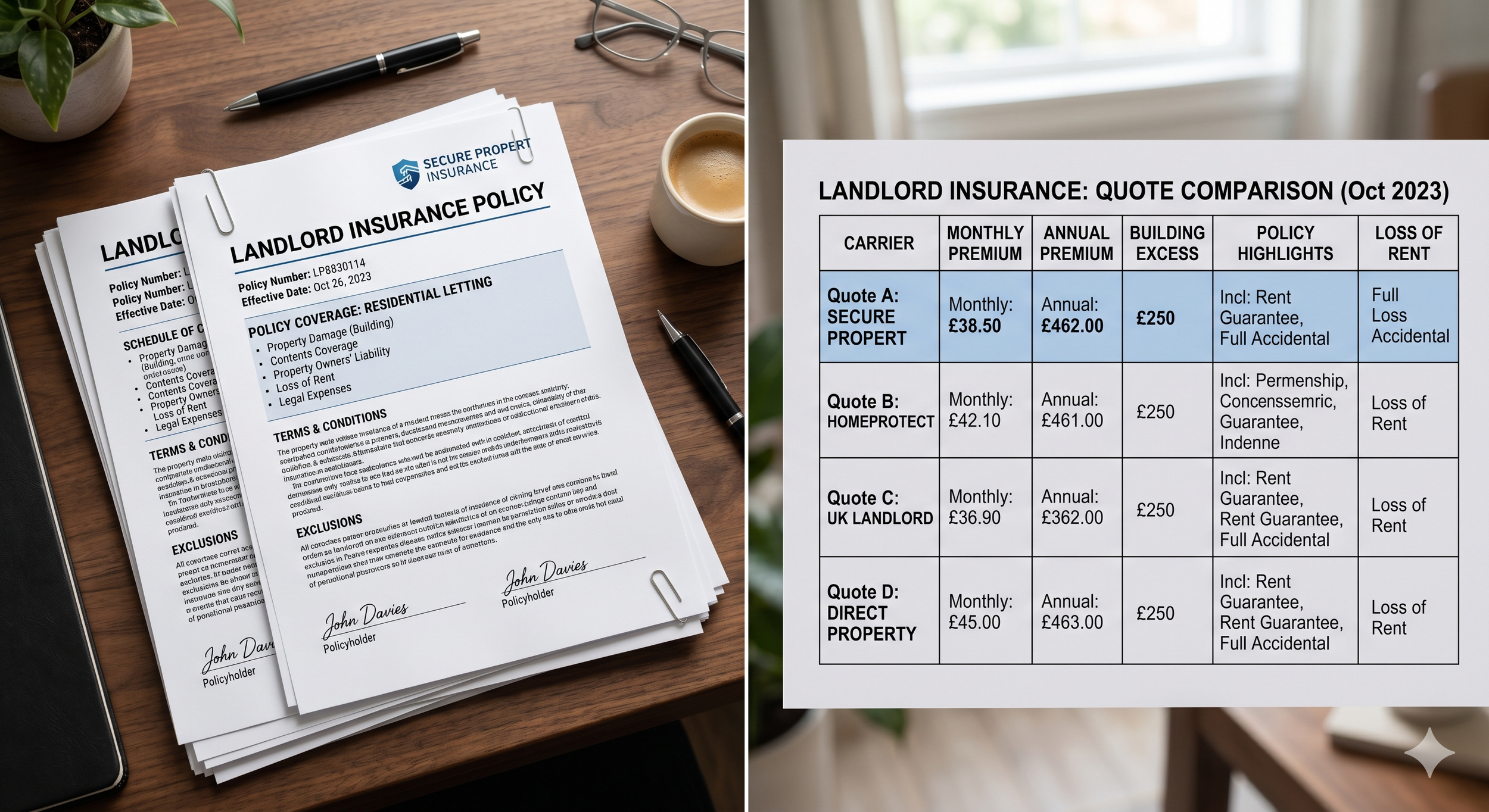
Landlord insurance (also called dwelling fire policies, typically DP-1 or DP-3) costs more than homeowners insurance because the underwriting risk is different. The median landlord insurance policy in Georgia runs around $1,433 per year according to Steadily, but Atlanta-area properties often carry higher liability exposure and replacement values. InsuranceCostCity puts the Atlanta landlord insurance average at $3,516 annually.
Most Atlanta investors I work with are seeing landlord insurance quotes between $1,500 and $3,000 per year for a typical single-family rental. Several have reported 20 to 40 percent premium increases at renewal over the past two years, driven by severe storm losses and rising replacement costs.
For underwriting, I tell investor clients to budget $1,800 to $2,400 per year for a standard single-family rental in Metro Atlanta, more for properties with finished basements, pools, or older systems. Get an actual quote before you go under contract. Don't trust the seller's number, which may reflect a long-term policy that won't transfer.
Property Management: 8 to 12 Percent of Collected Rent, Plus More
Atlanta property management fees are well-documented and consistent. According to iPropertyManagement's national survey, the Georgia average is 8.03 percent of collected rent. Industry sources, including TCS Management and Bay Property Management, put Atlanta in the 8 to 12 percent range, with most full-service managers landing at 9 to 10 percent.
But the monthly management fee is just one piece. Here's what you're actually paying for:
Monthly management fee: 8 to 12 percent of collected rent (some charge on scheduled rent, which means you pay even when the tenant doesn't, watch for this)
Leasing fee: 50 to 100 percent of one month's rent every time a new tenant is placed. Most Atlanta managers charge 75 percent.
Lease renewal fee: $200 to $500 flat, or a smaller percentage of rent, paid each time a tenant renews
Setup fee: $100 to $300 one-time when the property goes under management
Inspection fees: $75 to $200 per inspection
Maintenance markup: Some managers add 10 percent to all maintenance invoices
For a $2,000/month rental with a 10 percent management fee and one tenant turnover every 18 months, your blended management cost is closer to 12 to 14 percent of gross rent, not 10. Underwrite to that number.
If you self-manage, do not skip this line item. Your time has a cost, and self-management means you are on call for 2 a.m. plumbing emergencies, court dates if you have to evict, and the constant administrative work of rent collection and lease enforcement. I have clients who self-manage successfully and clients who self-managed for a year, burned out, and hired a manager. Build the cost into the model from day one and decide later whether to capture it as profit or pay it to a professional.
Capital Expenditures: The Expense Most Investors Underestimate
Capital expenditures are the big-ticket items that don't break every year but will eventually break, and when they do, they cost thousands. This is the single biggest blind spot in new investor pro formas.
The right way to budget for CapEx is to estimate the lifespan and replacement cost of every major component, then save monthly toward the eventual replacement.
Typical CapEx Items and Lifespans
Roof: 20 to 30 years, $8,000 to $20,000 in Atlanta depending on size and material
HVAC system: 12 to 18 years, $6,000 to $12,000 to replace
Water heater: 8 to 12 years, $1,200 to $2,500
Appliances (range, fridge, dishwasher, microwave): 8 to 15 years, $2,000 to $4,000 collectively
Flooring: 7 to 15 years depending on type, $5,000 to $15,000
Interior paint: Every 5 to 7 years between tenants, $2,500 to $5,000
Exterior paint or siding repair: 7 to 15 years, $3,000 to $10,000
Driveway, fence, deck: 15 to 25 years, varies widely
Plumbing and electrical major repairs: Sporadic, budget $500 to $1,500 per year average
How to Budget CapEx
A common rule of thumb is 5 to 10 percent of gross rent set aside monthly for CapEx, with older properties on the higher end. For a 1985 ranch in DeKalb pulling $1,900 in rent, I'd model 8 to 10 percent ($150 to $190/month). For a 2018 build in South Fulton pulling the same rent, I'd model 5 to 6 percent.
This money does not actually leave your account every month. It accumulates in a reserve account so that when the HVAC dies in year 8, you have the cash. If you don't reserve it, you're financing capital repairs on credit cards, which destroys the math.
Repairs and Maintenance: Different From CapEx
Repairs and maintenance are the smaller, more frequent costs. Garbage disposal replacement, leaking toilet, broken window blinds, gutter cleaning, lawn service, pest control, HVAC tune-ups.
Budget 5 to 10 percent of gross rent for repairs and maintenance, separate from CapEx. Older properties (pre-1980) often need 10 to 15 percent because deferred maintenance compounds.
For that same $1,900/month DeKalb rental, that's another $95 to $190/month set aside.
Other Operating Expenses to Account For
Depending on the property, you may also have:
HOA dues: Common in townhomes, condos, and some newer single-family communities. $100 to $400+ per month. Always get the HOA financials and reserve study before you buy a condo.
Lawn care and exterior maintenance: $80 to $200/month if you provide it (and in many Atlanta neighborhoods you'll need to, especially if the property has any code enforcement risk)
Utilities you pay: If the property has a shared meter or you're providing water/sewer/trash, that's on you. Most single-family rentals push utilities to the tenant, but small multi-family often doesn't.
Pest control: $300 to $600/year for ongoing service in Atlanta, where termites and rodents are real
Snow removal: Rare in Atlanta but worth noting for the occasional ice event
Accounting and legal: Tax prep for a rental property, business filings, occasional legal advice. $500 to $1,500/year.
A Real Atlanta Cash Flow Example
Let me walk you through a realistic example using a property type I see investors target frequently: a 3-bedroom, 2-bath single-family home in South Fulton purchased for $290,000 with 25 percent down on an investment property loan.
Acquisition:
Purchase price: $290,000
Down payment (25%): $72,500
Closing costs: ~$8,500
Initial rehab/turnover: $5,000
Total cash invested: $86,000
Loan:
Loan amount: $217,500
Rate (investment property, 2026): 7.5%
30-year fixed P&I: ~$1,521/month
Income:
Monthly rent: $1,850 (median for the submarket)
Annual gross rent: $22,200
Operating expenses (annual):
Vacancy at 7%: $1,554
Property taxes (Fulton, no homestead): $3,800
Landlord insurance: $2,000
Property management at 10%: $2,220
Leasing/turnover (averaged annually): $1,200
Repairs and maintenance at 7%: $1,554
CapEx reserve at 8%: $1,776
Lawn care: $1,200
Pest control: $400
Misc/accounting: $500
Total operating expenses: $16,204
Cash flow calculation:
Effective Gross Income: $22,200 − $1,554 (vacancy) = $20,646
NOI: $20,646 − $14,650 (operating expenses excluding vacancy) = $5,996
Annual debt service (P&I): $18,252
Annual cash flow: $5,996 − $18,252 = ‑$12,256
Monthly cash flow: ‑$1,021
This property loses about $1,000 per month in true cash flow at current rates. The pro forma version of this same deal, using just rent minus PITI, would have shown roughly $130/month positive. That's a $1,150/month difference between pro forma and reality.
This is not me telling you not to buy investment property in Atlanta. It's me telling you what most analyses miss. The investor who runs the real numbers and then chooses to proceed because of appreciation, tax benefits, or a long-term thesis is making an informed decision. The one who runs the bad numbers and is shocked when their account is empty in year three is not.
When Cash Flow Is Negative, What's Actually Going On
If you run real numbers and end up at negative cash flow, you have three honest options:
Don't buy it. This is sometimes the right answer. Negative cash flow is real money out of your pocket every month, and you cannot pay your other bills with hypothetical future appreciation.
Buy it anyway as an appreciation play. Atlanta's long-term appreciation has been steady. A property that loses $300/month for a year while appreciating $20,000 may still be a good investment. But you need the cash reserves to absorb the monthly losses, and you need to be honest that this is the strategy.
Restructure the deal so the numbers work. Larger down payment, different financing structure, lower purchase price, different submarket where rent-to-price ratios are stronger.
What you cannot do is pretend the negative number doesn't exist or assume rent will rise faster than expenses. In 2026 rent growth is moderating to 2 to 4 percent annually while insurance and taxes are rising faster.
Atlanta Submarkets Where the Rent-to-Price Math Still Works in 2026
Since the math is so submarket-dependent, here's where I see investor numbers work best in 2026, based on current rent-to-price ratios:
South Fulton (College Park, East Point, Hapeville): Median home prices $200,000 to $300,000, rents $1,500 to $1,900. Strongest gross yields in close-in submarkets, plus airport corridor employment.
Lithonia, Stone Mountain, parts of DeKalb: Lower price points, established rental demand, but watch the higher tax rates.
South Cobb (Mableton, Austell, Lithia Springs): Lower millage rates than Fulton/DeKalb, decent rent-to-price ratios, growing market.
Henry County (Stockbridge, McDonough): Newer inventory, tenant demand from logistics and corporate growth, lower operating costs.
Parts of Gwinnett (Lawrenceville, Loganville, Lilburn): Strong school districts support rent stability, lower insurance and tax burden than intown.
Intown Atlanta neighborhoods (Kirkwood, Reynoldstown, East Atlanta, Grant Park) are appreciation-driven plays right now. The cash flow rarely works at current prices and rates, but the long-term thesis can.
The Cash-on-Cash Return Sanity Check
Once you have your annual cash flow number, divide it by your total cash invested. That's your cash-on-cash return.
Cash flow $4,800/year ÷ $80,000 invested = 6 percent cash-on-cash. That's a reasonable Atlanta return for a stabilized property in 2026. Anything below 4 percent and I'd push back hard on the deal. Anything above 10 percent on a turn-key property and I'd ask what's missing from the analysis.
This is the number you compare to other investments. A 6 percent cash-on-cash on a property that should also appreciate 4 percent annually and where principal is being paid down by a tenant is meaningfully different from a 6 percent dividend stock. But you have to start with a real cash flow number to get there.
What I Do With Investor Clients
When I work with an investor on an Atlanta purchase, the underwriting process looks like this:
Define the buy box. Submarket, price range, property type, condition, tenant class.
Pull active and rented rent comps for any property we seriously consider.
Get a real insurance quote before going under contract, not at closing.
Check the actual tax bill and recalculate without homestead exemption.
Walk through CapEx item by item: roof age, HVAC age, water heater age, electrical, plumbing, foundation. Estimate dollars and timeline.
Build the full cash flow model with realistic vacancy and operating expense ratios.
Stress test. What happens if rent comes in $150 lower? Insurance jumps 20 percent at renewal? HVAC dies in year 2? If the deal can't survive any of those scenarios, it's too tight.
Make a recommendation. Sometimes that recommendation is to walk away.
This is the work that happens before you make an offer. Once you're under contract, you're in due diligence and inspection mode, and you should already know whether the numbers work.
Frequently Asked Questions About Atlanta Rental Cash Flow
What's a realistic cash-on-cash return for an Atlanta rental in 2026?
For a stabilized single-family rental in a working-class to middle-class submarket, 4 to 8 percent cash-on-cash is realistic with current interest rates and operating costs. Higher returns are possible with value-add strategies (BRRRR, light rehab) or in submarkets with stronger rent-to-price ratios like South Fulton. Returns above 10 percent on a turn-key property in 2026 usually mean someone is hiding an expense.
How much should I budget for vacancy on an Atlanta single-family rental?
Five to seven percent for a well-located, well-maintained property targeting professional tenants. Eight to ten percent for older inventory, lower-income submarkets, or properties that turn tenants frequently. Single-family rentals in Atlanta currently run 4 to 6 percent vacancy on the tighter end based on HomeScoutz's market data, but underwriting at 7 percent gives you a cushion.
Should I include property management fees if I plan to self-manage?
Yes. Always. Self-management has a real cost in time, expertise, and risk. If you don't price it into the model and you later need to hire a manager, the deal breaks. Better to underwrite at 10 percent management and pocket the savings if you self-manage successfully.
How much should I save monthly for capital expenditures?
Five to ten percent of gross rent depending on property age and condition. A 1990s house might need 6 to 7 percent. A 1950s house with original systems might need 12 percent. The reserve doesn't disappear, it accumulates, and when the HVAC dies you have the cash without raiding your savings.
Why are insurance costs up so much on Atlanta rentals in 2026?
Several factors stacked: severe storm losses across the Southeast, hurricane exposure that bled inland after Hurricane Helene in 2024, rising replacement costs, and reinsurance markets pulling back. Investors are reporting 20 to 40 percent premium increases at renewal. Get a real quote before contract, not at closing, and budget for further increases.
Does my mortgage rate change for an investment property?
Yes. Investment property mortgages typically run 0.5 to 1.0 percent higher than owner-occupied rates, and most lenders require 20 to 25 percent down. As of mid-2026, expect investment property rates in the 7 to 8 percent range for a 30-year fixed conventional loan, depending on credit and DTI. This materially affects cash flow versus owner-occupied analyses.
How do I figure out the property tax bill on a rental versus a primary residence?
Pull the current tax bill from the county tax commissioner's site (Fulton, DeKalb, Cobb, etc. all post bills publicly). Then back out any homestead exemption if the current owner has one, because you won't have it as a non-owner-occupant. Recalculate using the full assessed value, the current millage rate, and no exemptions. That's your real number.
What's the difference between gross rental yield and cash flow?
Gross rental yield is annual rent divided by purchase price (a $24,000/year rental on a $300,000 property = 8 percent gross yield). It's a quick screen, not a real return. Cash flow is what's left after every operating expense and the mortgage. A property can have a high gross yield and negative cash flow at the same time, which is exactly what trips up new investors.
Should I buy a turnkey rental or a fixer-upper for cash flow?
Depends on your capital, time, and risk tolerance. Turnkey rentals (renovated, tenant-ready, sometimes already leased) come with a premium price and lower cap rates but less risk. Fixer-uppers can produce stronger cash flow if you execute the rehab on budget, but rehab cost overruns are real and an over-leveraged BRRRR can sink you. I help investors decide based on their cash position and timeline.
How does the Atlanta short-term rental market change cash flow analysis?
Short-term (Airbnb/VRBO) cash flow modeling is a different exercise: higher gross income potential, much higher operating costs (cleaning, supplies, platform fees, furnishing), more volatility, and increasing regulatory risk (Atlanta and several Metro municipalities have active short-term rental ordinances). I underwrite STRs separately and conservatively. If a deal only works as a short-term rental, I want to know what the long-term rental fallback cash flow looks like in case regulations change.
What submarkets in Metro Atlanta have the best rent-to-price ratios in 2026?
South Fulton (College Park, East Point, Hapeville) consistently produces the strongest rent-to-price ratios in close-in Atlanta. South Cobb, parts of DeKalb (Lithonia, Stone Mountain), and Henry County (Stockbridge, McDonough) also produce workable numbers. Intown Atlanta is appreciation-focused, not cash-flow focused, at current prices.
How often should I re-run cash flow numbers on a property I already own?
Annually at minimum, and any time a major variable changes: insurance renewal, tax reassessment, vacancy, major repair. The property that cash flowed $200/month in 2022 may cash flow $50/month or break even in 2026 because of insurance and tax increases. Knowing that lets you decide whether to raise rent at renewal, refinance, or sell. Rentals that quietly slip into negative cash flow are how investors lose money slowly.
Can I deduct all of these expenses on my taxes?
Most operating expenses on a rental property are deductible: mortgage interest, property taxes, insurance, management fees, repairs, depreciation. Capital expenditures are typically capitalized and depreciated over time rather than expensed in the year incurred. This is a tax conversation to have with a CPA who understands real estate, not me. But the tax treatment can meaningfully change your after-tax return, and serious investors should model that too.
I work with buyers throughout Metro Atlanta, including investors building rental portfolios from the first single-family purchase to multi-property holders adding doors. If you're evaluating an Atlanta rental property, considering converting your current home to a rental, or trying to figure out which submarket fits your cash flow goals, let's talk through your numbers before you make an offer.
Visit kristenjohnsonrealestate.com or reach out directly. Come as you are, come on home.
Looking for more Atlanta buyer education? I've covered topics including How Much House Can I Afford in Atlanta, FHA vs Conventional Loan: Which Is Better in Atlanta, Negotiating in the 2026 Atlanta Market, and Is Now a Good Time to Buy a House in Atlanta. Browse the full guide series at kristenjohnsonrealestate.com.