

Living in West Midtown, Atlanta: The City's Creative Industrial Heart
I've been showing property in West Midtown for nearly a decade, and the question I hear most from buyers considering the area is some version of: "Is this actually a neighborhood, or is it just restaurants?" It's a fair question. West Midtown has been marketed so aggressively as a dining and nightlife destination that its identity as a place to live sometimes gets lost in the noise.
Here's my answer: West Midtown is absolutely a neighborhood — one of Atlanta's most dynamic ones — but it operates differently than somewhere like Kirkwood or Morningside. You're not moving here for a quiet street with kids riding bikes at dusk. You're moving here because you want to be close to the energy, the design culture, the food scene, and the BeltLine, and you're willing to trade some of the residential tranquility for all of that access. That's a completely legitimate set of priorities. I've worked with buyers for whom West Midtown is the exact right fit, and I've worked with buyers who thought they wanted it and didn't. This guide will help you figure out which you are.
West Midtown is not a formally designated neighborhood by the City of Atlanta — it's a colloquial area that encompasses over a dozen distinct neighborhoods and historic districts west of Georgia Tech and the core of Midtown. The area spans roughly from Howell Mill Road to Northside Drive and from I-75/85 north to Marietta Boulevard. The smaller communities within it include Home Park, Berkeley Park, Blandtown, Knight Park/Howell Station, Underwood Hills, the Marietta Street Artery, and Bolton, among others. If you've ever heard someone call it "the Westside" — that's the same place. The terms are used interchangeably by residents, businesses, and the real estate market, though the Atlanta Convention and Visitors Bureau technically distinguishes between "West Midtown" and "Atlantic Station" as two components of the broader Westside.
What unites all of it is a shared origin story: this was Atlanta's industrial corridor, built up around rail lines and manufacturing from the 1880s through mid-century, left largely abandoned for decades, and then systematically reclaimed starting in the late 1990s through a combination of adaptive reuse development, creative entrepreneurship, and eventually significant institutional investment. The result is a neighborhood that carries the bones of its industrial past in every brick warehouse and former factory now housing a restaurant, gallery, or loft — and builds on top of them with new construction that ranges from BeltLine townhomes to design-forward condos.
Here's what you need to know.
The Market: What Homes Actually Cost
West Midtown's housing market is genuinely diverse, and the price range is wider than most buyers expect coming in. Because the area spans multiple sub-neighborhoods with very different characters — from bungalows in Berkeley Park to high-rise condos near Atlantic Station to brand-new BeltLine townhomes — there's no single median that captures the whole picture accurately. Pull current comps with your agent based on the specific sub-neighborhood and property type you're targeting.
General price ranges as of 2025:
Condos and smaller lofts: $275,000–$450,000 (the entry point for the area, primarily older adaptive reuse buildings and smaller newer units)
Townhomes (resale): $400,000–$600,000 for 2–3 bedrooms
New construction townhomes and BeltLine-adjacent homes: $550,000–$900,000+ (Brock Built's West Town community on the BeltLine, for example, starts around $700,000–$800,000 for 3-story homes with 2,700+ square feet)
Renovated single-family bungalows (Berkeley Park, Home Park): $450,000–$750,000
Luxury lofts and upscale condos: $600,000–$1M+
The rental market is strong and active, driven by Georgia Tech students and faculty, Perimeter/downtown workers who want intown living, and young professionals in the area's creative and tech industries. Investors targeting the rental market have historically found West Midtown reliable for demand, though yield calculations have tightened as purchase prices have risen.
Days on market varies significantly by product type. Competitively priced, move-in-ready units in desirable buildings or close to the BeltLine move quickly. Older condo buildings with special assessment risk or dated finishes tend to sit longer. The West Midtown market as a whole is softer than its peak in 2022 — pricing accurately and presenting well matters more now than it did two years ago.
The Housing Stock: A Genuine Range
West Midtown doesn't have a single architectural identity the way Kirkwood's Craftsman bungalows or Morningside's Colonial Revivals do. What it has instead is layers — and that layered character is part of what makes it interesting to buyers who care about design.
Adaptive reuse lofts are the neighborhood's architectural signature. Former factories, warehouses, and industrial buildings converted into residential lofts starting in the late 1990s and continuing through the 2010s. These typically feature exposed brick, concrete floors, high ceilings (12–16 feet in the best examples), large industrial windows, and open floor plans. They tend to be in the Marietta Street Artery and the areas immediately around Westside Provisions District. If this is what you're picturing when you think of West Midtown, this is real — but it's one slice of the market, not the whole thing.
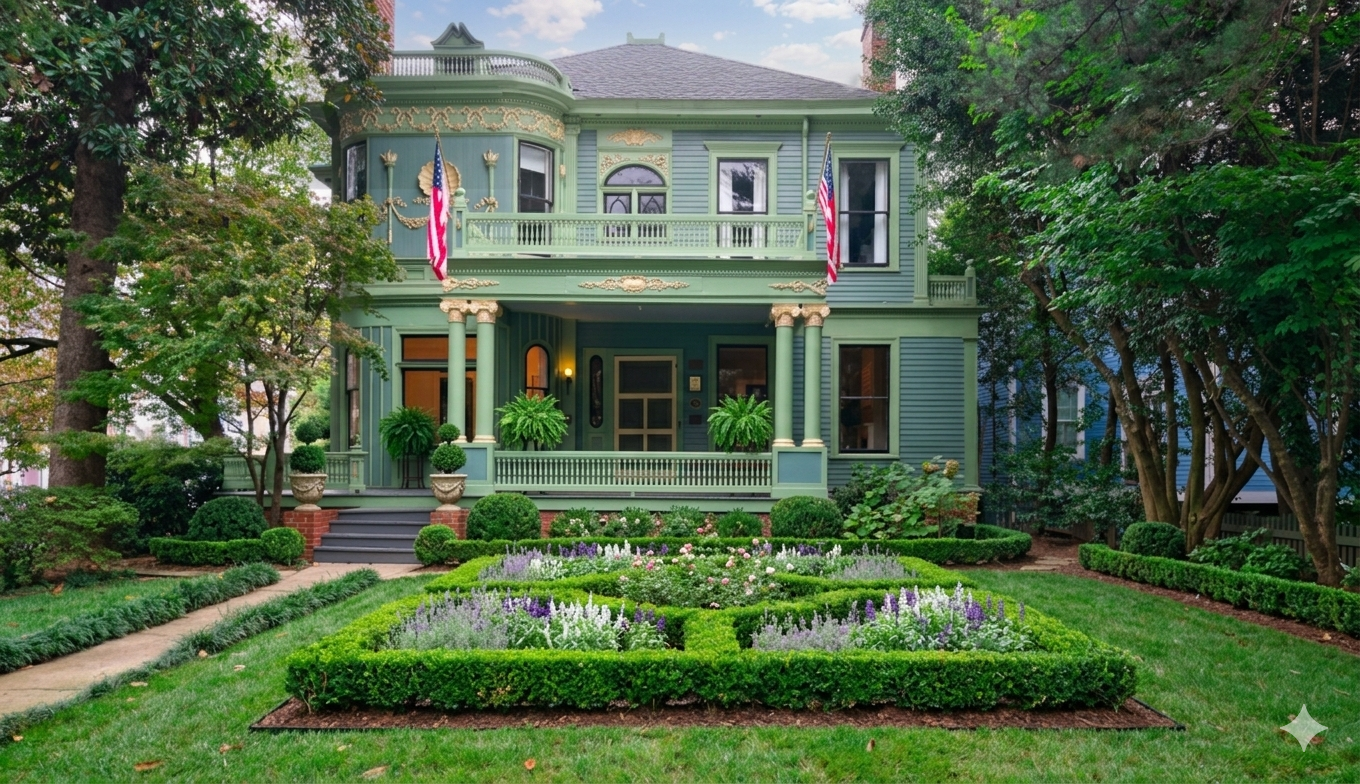
Historic bungalows in Berkeley Park and parts of Home Park date back to the late 1800s through the 1930s — some of the same construction era you'd find in Kirkwood or Edgewood. These are the single-family inventory that buyers looking for a yard, a porch, and a neighborhood street will gravitate toward. Renovation spreads are wide, from turnkey updated homes at the high end to fixer opportunities with significant upside.
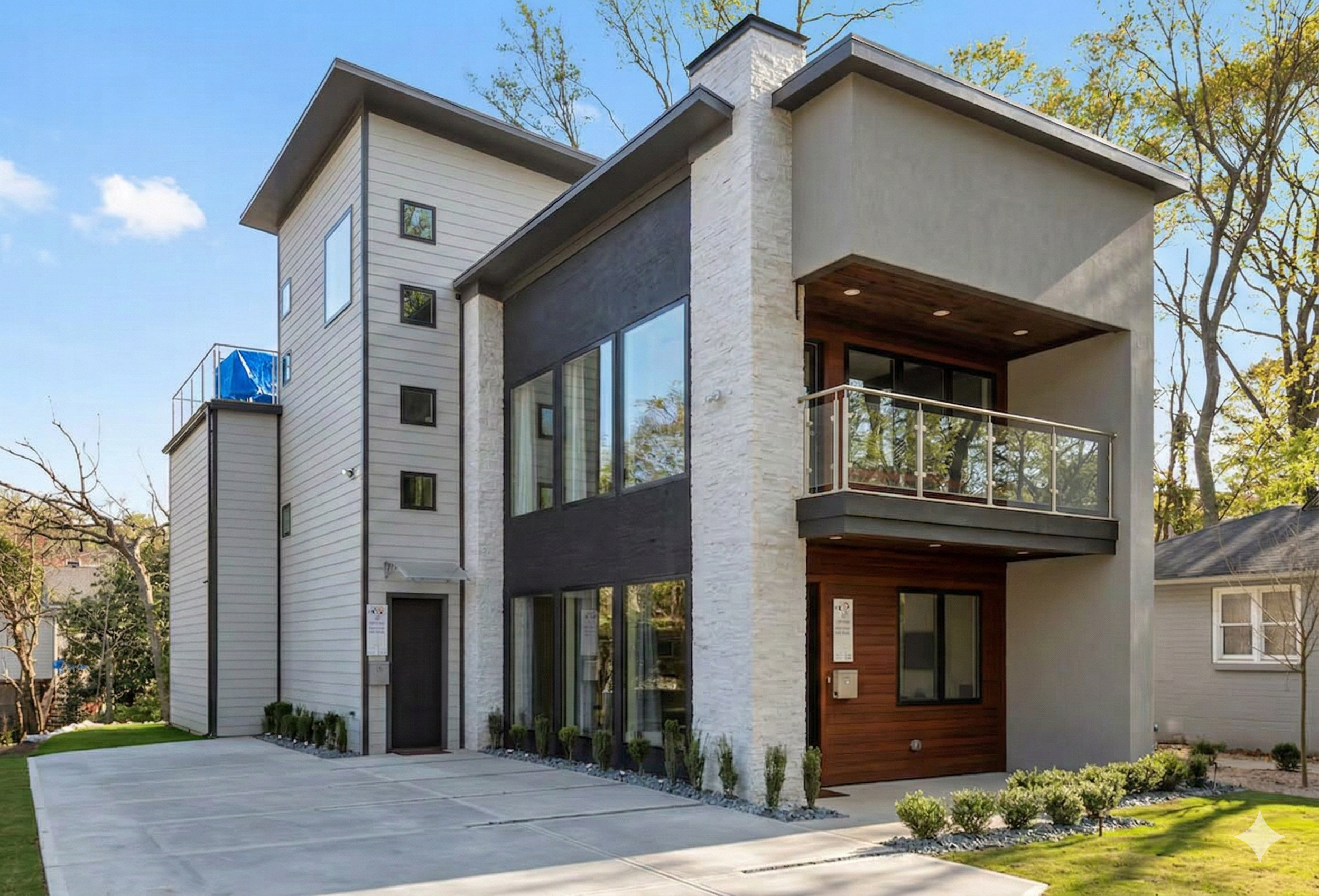
New construction townhomes have proliferated across West Midtown over the past decade, particularly in Blandtown and along BeltLine-adjacent corridors. These are typically three-story buildings with rooftop terraces, two-car garages, open-plan main levels, and contemporary finishes. Brock Built's West Highlands and West Town communities are the most prominent examples. West Town sits directly on the BeltLine Westside Trail — one of the few new construction communities with direct BeltLine frontage anywhere in Atlanta.
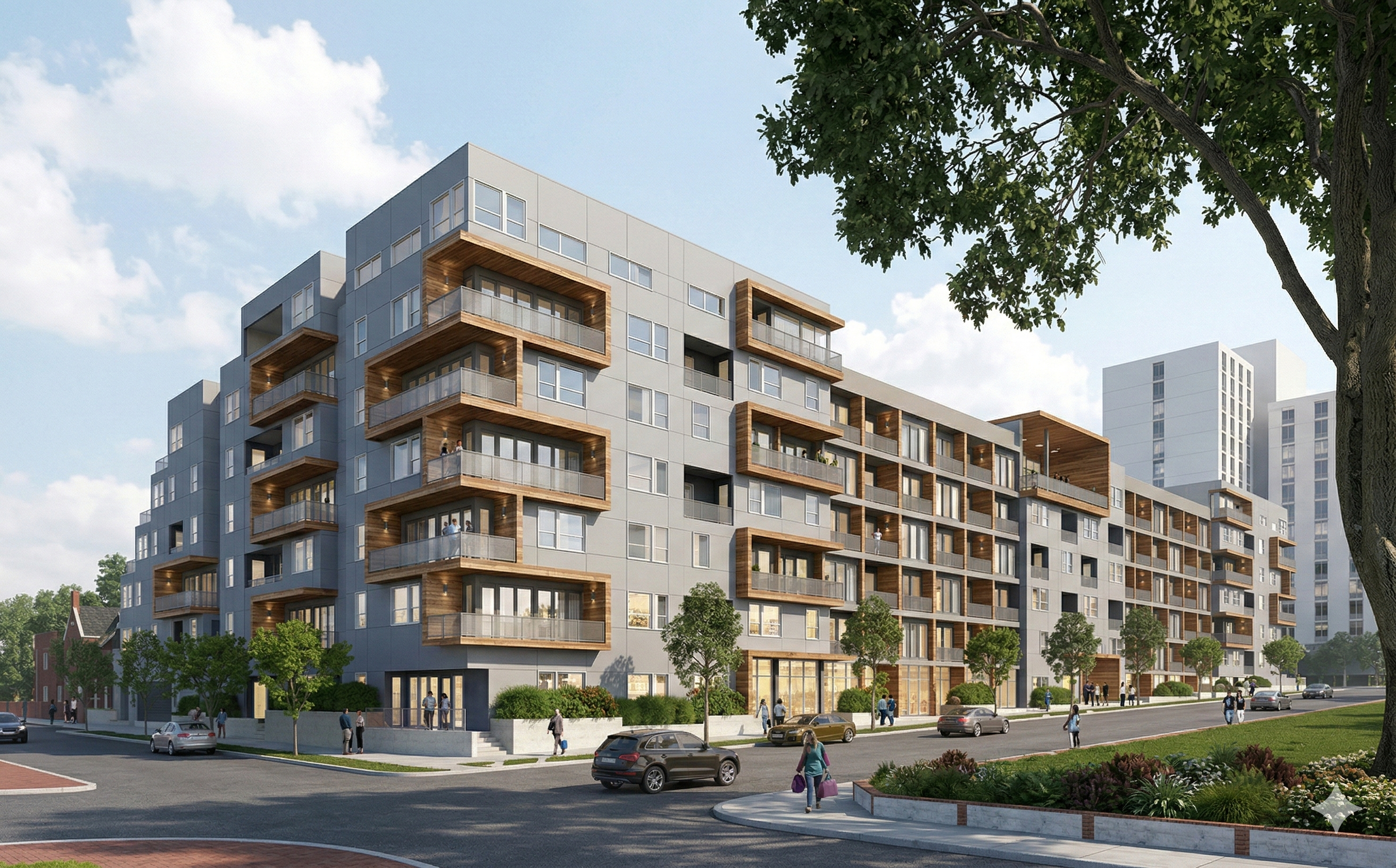
High-rise condos concentrate near Atlantic Station and the edges of the area closest to traditional Midtown. These tend to attract buyers who want walkability scores and building amenities (gym, concierge, rooftop) over square footage.
ADUs and income property exist throughout the area. Berkeley Park in particular has a notable stock of homes with detached guest houses or basement units — common in the Craftsman and bungalow stock — that some buyers purchase specifically for rental income or multigenerational living arrangements.
The Westside Provisions District and Why It Matters
Westside Provisions District (often abbreviated WSPD) is frequently credited with catalyzing West Midtown's transformation, and the credit is warranted. The development began in the late 1990s and occupies buildings that originally functioned as a meatpacking plant — the oldest structures date to the early 1910s. Jamestown and Clarion Partners acquired the property in 2016. Today it covers over 261,000 square feet of retail and dining space spread across two connected properties (formerly Westside Urban Market and White Provisions) linked by a pedestrian bridge over a still-functioning Norfolk Southern rail line.
The rail line is part of the neighborhood's character. You will hear and occasionally see trains. It's not something that registers for most residents after a few weeks, but buyers who are sensitive to that kind of ambient noise should visit the specific block they're considering at different times of day before committing.
What's at Westside Provisions:
Sid Mashburn — Arguably Atlanta's most beloved independent menswear store. Bespoke clothing, shoes, and accessories with an old-school sensibility. The women's side (Ann Mashburn) is equally well regarded. One of the stores that put Westside Provisions on the map.
JCT Kitchen — Ford Fry's Southern comfort restaurant directly adjacent to the train tracks — the "junction" reference in the name. One of the oldest and most enduring restaurants at WSPD.
The Optimist — Also Ford Fry, exceptional seafood in a landlocked city. The oysters are a draw. Upstairs at JCT Bar offers live music.
Marcel — Fry's French steakhouse. One of Atlanta's best bread courses — the kind of thing you specifically plan the evening around.
West Egg Café — Weekend brunch institution. Challah French toast, shrimp and grits, reliably excellent Bloody Marys. Expect a wait on Sunday mornings.
Flower Child — Healthy, seasonal fast casual. One of the better options in the area for lunch.
Taqueria del Sol — The Atlanta mini-chain has a presence at Westside Provisions. Consistently excellent.
Jeni's Ice Cream — The Columbus-based cult favorite. Worth the stop.
Five Daughters Bakery — Nashville-based pastry destination known for its 100-layer croissant donuts.
Star Provisions — European-style gourmet market with cheeses, meats, breads, and bakery items. Owned by the team behind Bacchanalia. Essential for stocking a kitchen.
Shopping: Anthropologie, Free People, Warby Parker, Framebridge, Serena & Lily, Room & Board. The physical stores here feel more interesting than mall versions — the warehouse spaces and industrial architecture elevate even familiar retail brands.
The Broader Dining and Culture Scene
Westside Provisions is the anchor, but West Midtown's food and culture extends well beyond it.
Bacchanalia — Consistently ranked among Atlanta's finest restaurants and one of the best in the South. Prix fixe menu featuring contemporary American cuisine with seasonal, organic ingredients, many from the chef-owners' own farm. A special occasion destination with a genuinely exceptional commitment to the craft.
Antico Pizza Napoletana — Atlanta's definitive Neapolitan pizza. The communal tables, the coal oven, the San Marzano tomatoes. Perpetual lines are warranted.
Nick's Westside — Neighborhood restaurant and bar focused on local ingredients with global influences. Reliable for a Thursday night out without a reservation.
Aziza — Israeli cuisine with modern Mediterranean influences. One of the more distinctive menus in the area.
Bone Garden Cantina — Day of the Dead décor, homestyle Mexican fare, strong margaritas. Not fine dining, but a genuine neighborhood institution.
Souper Jenny — Scratch-made soups, fresh salads, and sandwiches in a casual setting with a large garden on site. A genuine Atlanta original.
Chattahoochee Food Works / The Works — The 1295 Chattahoochee Avenue mixed-use development is one of West Midtown's newer additions: an adaptive reuse of a historic industrial site with a food hall, bars, retail, and entertainment in an indoor-outdoor setting. The Works complex also includes The Interlock next door, further adding to the corridor's walkable commercial density.
Terminal West at King Plow Arts Center — One of Atlanta's most beloved mid-sized music venues, housed within the historic King Plow Arts Center on the Marietta Street Artery. If you want to see a show in an intimate industrial setting, this is the venue.
The Goat Farm Arts Center — A sprawling adaptive reuse complex on a former industrial property that serves as a rotating venue for art exhibitions, performances, community events, and film productions. The Hunger Games: Catching Fire filmed here. It's one of those Atlanta spaces that feels like it belongs to a bigger, more eclectic city — in the best way.
Art galleries: West Midtown hosts a genuine contemporary art scene, including Saltworks Gallery, Sandler Hudson Gallery (representing contemporary artists since 1989), and the Jennifer Schwartz Gallery (fine art photography). These galleries sponsor a monthly art walk through the West Side Arts District on the third Saturday of every month.
Topgolf — The West Midtown location draws its own crowd and is easy to dismiss as a novelty, but for buyers with entertainment-forward lifestyles or who frequently host out-of-town guests, having Topgolf within a short drive is genuinely convenient.
The BeltLine and Shirley Clarke Franklin Park
BeltLine access is one of West Midtown's strongest selling points for the right buyer, and it's worth being specific about what that actually means here versus other BeltLine-adjacent neighborhoods.
The Westside BeltLine Connector is a 1.7-mile multi-use trail that connects the heart of West Midtown to the broader BeltLine system. New construction like Brock Built's West Town community sits directly on the Westside Trail — BeltLine frontage that is still rare in new development anywhere in Atlanta.
The broader BeltLine Westside Trail runs through the area, connecting to the Northside Trail and eventually to the trail network that encircles the city. As the Westside Trail completes more segments, West Midtown's connectivity to other intown neighborhoods via the trail system will only improve.
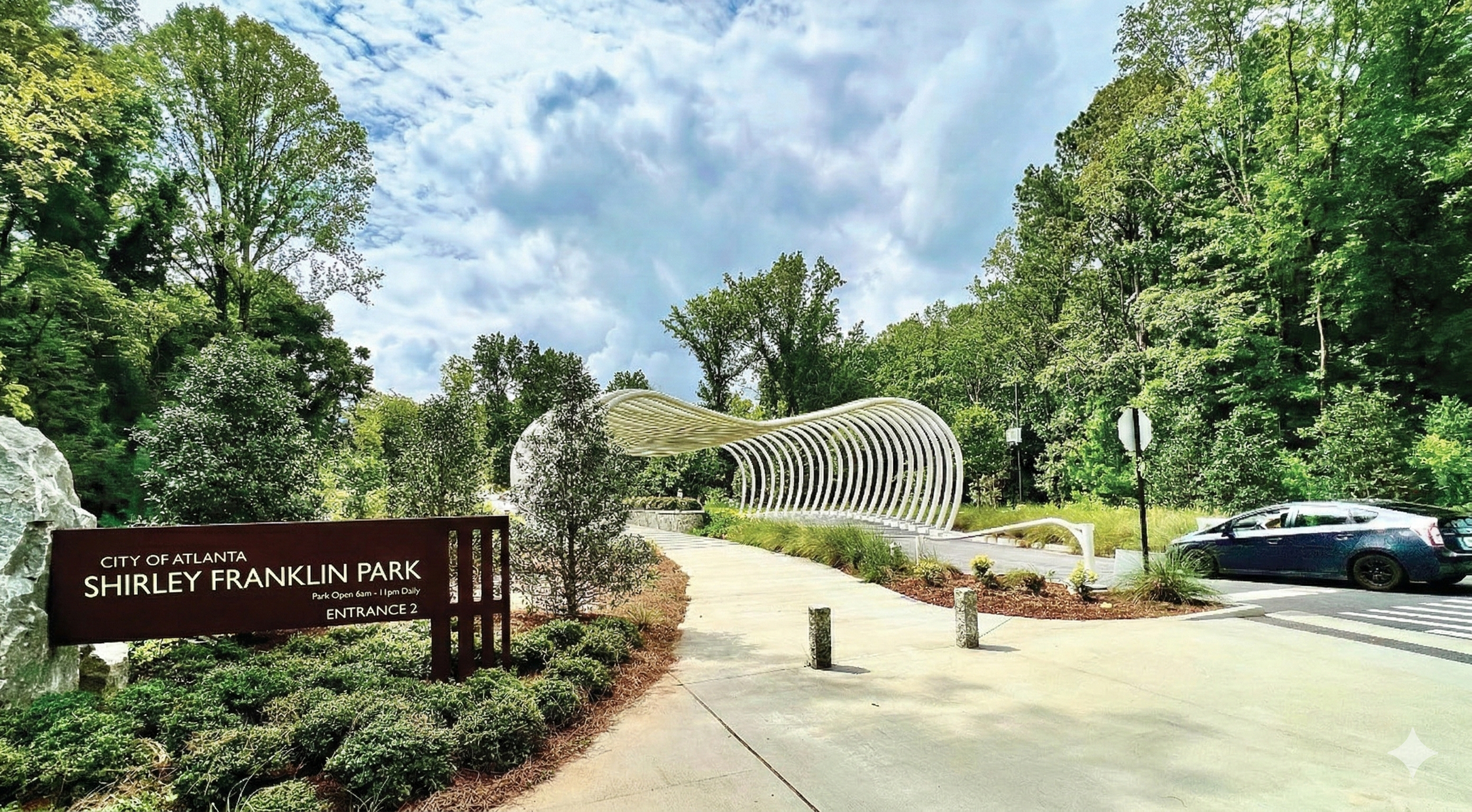
Shirley Clarke Franklin Park (formerly Westside Park at Bellwood Quarry — renamed February 3, 2025) is the landmark green space anchor for this part of the city. At 280+ acres, it is Atlanta's largest park — nearly twice the size of Piedmont Park. Built on the site of a former Bellwood Quarry, it features a 35-acre reservoir that holds over 2 billion gallons of emergency drinking water, dramatically increasing the city's resilience. The park includes five miles of paved ADA-accessible trails, meadows, a playground, two reservable pavilions, workout equipment, and some of the most dramatic skyline views anywhere in Atlanta.
Looking ahead: a dedicated bike park featuring mountain bike trails, a pump track, a bicycle playground, a skills course, and hiking trails is in development, funded in part by an $8 million donation from the Chestnut Family Foundation, with an $15 million total fundraising goal. Construction was planned to begin late 2025, pending final funding. This will eventually function as a regional draw for cyclists and outdoor recreation enthusiasts — adding another layer to the park's long-term appeal for nearby residents.
The park's future trail connections to the BeltLine Westside Trail northern extension and the Proctor Creek Greenway will further knit the Westside green space network together when complete.
Employment: Tech, Creative, and Corporate
West Midtown has become a legitimate employment hub alongside its identity as a lifestyle destination.
Georgia Tech borders Home Park — the largest sub-neighborhood within West Midtown — on its southern edge. For buyers affiliated with Georgia Tech (faculty, staff, researchers) or the constellation of tech companies that cluster around it, living in West Midtown means a walkable or very short commute. The R. Kirk Landon Learning Center at Georgia Tech even reserves 20% of enrollment spots for Home Park residents and offers discounted tuition to the community — a tangible benefit for families with young children.
Tech Square, Georgia Tech's innovation and research district, is just east of the main campus and has attracted corporate innovation offices for companies including Google, Panasonic, NCR, and others. This concentration of tech employment within easy reach of West Midtown residential neighborhoods is one reason the area has become a consistent relocation target for tech workers.
Perimeter employment (State Farm, IHG, and the broader Perimeter Center business district) is 20–25 minutes north on I-285 or via GA-400, making West Midtown workable for Perimeter workers who want intown living.
Major employers with West Midtown offices include companies like Adobe, Nike, Pindrop Security, Gordon Foods, and Porsche Digital — reflecting the neighborhood's appeal to creative, tech, and innovation industries specifically. The area has become Atlanta's unofficial "creative corridor."
Downtown and Midtown employers are 10–15 minutes by car from West Midtown, and MARTA connectivity (via Arts Center station on the Red/Gold Line, about a 10-minute Uber or quick bike ride from most of West Midtown) makes the broader transit network accessible.
Getting Around
Car: West Midtown has excellent highway access. I-75/85 is accessible from multiple on-ramps, connecting north to I-285 and GA-400 and south to downtown. Howell Mill Road is the primary north-south commercial corridor. Drive times: downtown Atlanta 10–15 minutes, Buckhead 12–18 minutes, Midtown 5–10 minutes, airport approximately 25–30 minutes via I-85.
MARTA: Direct rail access requires either a short drive/rideshare or bicycle ride to Arts Center Station on the Red/Gold Line (approximately 2 miles east). From Arts Center, the entire MARTA grid is accessible including downtown, Buckhead, Dunwoody/North Springs, and Hartsfield-Jackson Airport. The BeltLine Westside Connector also links the neighborhood to the broader trail system. West Midtown is not as transit-convenient as intown neighborhoods with stations walking distance from residential streets, but it's not disconnected either.
Walkability: Varies significantly by block. The area immediately around Westside Provisions District, The Works, and Chattahoochee Avenue has genuine walkability for dining, shopping, and entertainment. Residential blocks farther from those commercial corridors are less walkable for daily errands. Grocery access has improved with Publix at Westside Urban Market (Howell Mill Road), Kroger and Walmart on Howell Mill, Publix at Atlantic Station, and Target at Atlantic Station — but most residents drive for grocery runs.
Biking: Improving steadily. The BeltLine Westside Connector and the broader trail network make car-free recreational cycling genuinely pleasant. Commuter cycling to Georgia Tech, Tech Square, or Atlantic Station is realistic for most residents. Dedicated lane infrastructure on surface streets is growing but still inconsistent.
Schools
West Midtown spans multiple Atlanta Public Schools zones depending on specific address and sub-neighborhood. Verify exact school assignments for any specific property through Atlanta Public Schools directly before purchasing — boundaries in this area can be counter-intuitive.
Midtown High School (grades 9–12) — Formerly known as Henry W. Grady High School, renamed Midtown High School effective June 2021. This is the high school serving Home Park and much of West Midtown's residential core.
Enrollment: approximately 1,658 students
Student-teacher ratio: 16:1
Niche grade: A+
GreatSchools rating: 9/10
Graduation rate: 91%
Average GPA: 3.58
Average SAT: 1,240; Average ACT: 28
60% math proficiency, 66% reading proficiency
GreatSchools College Success Award recipient for 2023–24 (4 total since 2018–19)
AP courses available including music theory, literature and composition, calculus, computer science, physics, psychology, French, Latin, and Spanish
Gifted & Talented program
Notable alumni: S. Truett Cathy (Chick-fil-A founder), Yolanda King, George W. Woodruff (Coca-Cola). The campus has served as a film location for Spider-Man: Homecoming, Remember the Titans, and Ride Along.
For elementary school, much of Home Park feeds into the Centennial Place Elementary cluster (the Midtown High cluster also includes Mary Lin, Hope Hill, Morningside Elementary, and Springdale Park; middle school feeds through Inman Middle).
Private options accessible from West Midtown include The Lovett School (K–12, one of Atlanta's most academically rigorous private schools, located nearby in northwest Atlanta), The Howard School (specializing in learning differences), and Westminster Schools.
Research directive: Verify current enrollment eligibility and school assignment for any specific address directly with Atlanta Public Schools. Boundaries can change, and some streets in this area cross zone lines in ways that aren't intuitive from a map.
Who Buys in West Midtown
West Midtown tends to be the right fit for:
Young professionals and couples without children who want proximity to Atlanta's best dining, arts, and nightlife without paying Midtown or Buckhead prices
Remote workers who want intown energy and walkability for daily life without a required commute orientation
Georgia Tech-affiliated buyers (faculty, researchers, tech industry workers) who want a short commute within a neighborhood with genuine character
Design and creative professionals who are drawn to the aesthetic of the adaptive reuse industrial lofts and the broader design culture of the area
Buyers relocating from cities like New York, LA, or Chicago who are used to urban living and want to replicate that experience in Atlanta at a more accessible price point
Investors targeting the short-term rental or long-term rental market in a high-demand intown location
West Midtown is probably not your first choice if:
School district performance is a primary driver — Midtown High is genuinely strong (A+ Niche, 9/10 GreatSchools), but elementary zoning is more variable and you'll want to verify specific addresses. This is not the neighborhood buyers move to primarily for the school pipeline.
You want a quiet residential street with significant green space and a low-density neighborhood feel — Berkeley Park bungalows offer some of that, but the broader character of West Midtown is urban and activated
You need reliable MARTA rail walking distance — it exists in nearby Midtown and Atlantic Station, but most West Midtown residential addresses require a short ride to reach the rail line
You want large lot single-family inventory — this market is predominantly condos, lofts, and townhomes, with single-family bungalows a smaller slice of available inventory
How West Midtown Compares to Nearby Neighborhoods
West Midtown vs. Midtown (traditional): Traditional Midtown (east of Georgia Tech, near Piedmont Park) is more walkable, has direct MARTA station access, and carries higher prices for comparable space — particularly for condos. Midtown is the right choice if walkability and transit access are non-negotiable. West Midtown is the right choice if you want more space for the money, a more creative neighborhood identity, and BeltLine access.
West Midtown vs. Old Fourth Ward: O4W sits on the BeltLine Eastside Trail, which is more developed and more active than the Westside Trail currently. O4W has its own strong dining scene around Ponce City Market and the Krog District. Both neighborhoods are urban and creative, but O4W skews slightly higher in price and has more consistent walkability around its core. West Midtown has more green space (Shirley Clarke Franklin Park vs. smaller neighborhood parks in O4W) and arguably a stronger design and arts identity.
West Midtown vs. Inman Park: Inman Park is more established, more historic, more residential-feeling, and more expensive. The housing stock in Inman Park (Victorian cottages, craftsman bungalows) is architecturally distinct from West Midtown's industrial character. Inman Park buyers are typically further into their homeownership journey; West Midtown buyers often arrive earlier. Both have excellent dining access.
West Midtown vs. Berkeley Park/Underwood Hills (sub-neighborhoods within West Midtown): For buyers specifically drawn to the bungalow/single-family inventory, Berkeley Park and Underwood Hills offer the closest thing in the broader area to a traditional residential neighborhood feel while remaining within the West Midtown ecosystem. These sub-neighborhoods are worth researching as distinct micromarkets within the larger area.
Practical Details
ZIP code: 30318 (primarily)
County: Fulton County
City: City of Atlanta
Schools: Atlanta Public Schools (verify specific assignments by address)
MARTA: Closest station is Arts Center (Red/Gold Line), approximately 2 miles east; accessible via rideshare, bicycle, or BeltLine Connector. Ashby Station serves the southern portion.
Drive to downtown Atlanta: 10–15 minutes
Drive to Midtown: 5–10 minutes
Drive to Buckhead: 12–18 minutes
Drive to airport: approximately 25–30 minutes via I-85
Grocery: Publix at Westside Urban Market (Howell Mill), Kroger on Howell Mill, Walmart on Howell Mill, Publix and Target at Atlantic Station
Flooding: Verify specific addresses, particularly near Proctor Creek corridor and lower-elevation blocks
Hospitals: Piedmont Atlanta (Peachtree Road), Emory University Hospital Midtown (Peachtree Street), Grady Health System (downtown)
Westside BeltLine Connector: 1.7-mile multi-use trail connecting West Midtown to BeltLine Westside Trail
Shirley Clarke Franklin Park: 280+ acres, 35-acre reservoir, 5 miles of paved trails, playground, pavilions, Grand Overlook skyline view. Located at 1660 Johnson Road NW. Open 6 a.m.–11 p.m. daily. Dogs welcome. Parking available at 1600 and 1660 Johnson Road NW.
Ready to Look at West Midtown?
West Midtown rewards buyers who know exactly what they're looking for — and the range of product types here means the right buyer can find something genuinely compelling at almost any intown price point. I've helped buyers navigate the difference between a well-priced adaptive reuse loft and an older building with deferred maintenance, and I've helped buyers understand which specific blocks in Berkeley Park are the most sought-after. If you're seriously considering West Midtown, let's talk.
📞 [Your phone number] 📧 [Your email] 🌐 kristenjohnsonrealestate.com
Come as you are, come on home.
Related Neighborhood Guides:
Frequently Asked Questions About West Midtown, Atlanta
What is West Midtown Atlanta? West Midtown (also called "the Westside") is a colloquial area west of Georgia Tech and traditional Midtown, encompassing over a dozen distinct neighborhoods including Home Park, Berkeley Park, Blandtown, and the Marietta Street Artery. Once Atlanta's industrial corridor, it has been transformed since the late 1990s into a hub for dining, arts, creative industries, and residential development, anchored by Westside Provisions District and connected to the BeltLine Westside Trail.
What are home prices in West Midtown Atlanta? As of 2025, West Midtown prices range widely by product type: condos and lofts from approximately $275,000–$450,000; townhomes from $400,000–$600,000 resale and up to $900,000+ for new construction BeltLine-adjacent product; renovated single-family bungalows from $450,000–$750,000. Verify current pricing for your specific property type and sub-neighborhood with an agent using current comparable sales.
What is the best restaurant in West Midtown Atlanta? West Midtown has one of Atlanta's densest concentrations of chef-driven restaurants. Bacchanalia is consistently considered one of the finest restaurants in the city and the South. JCT Kitchen, Marcel, and The Optimist (all Ford Fry restaurants) are neighborhood anchors. Antico Pizza Napoletana is Atlanta's definitive Neapolitan pizza. West Egg Café is the brunch institution. The list is genuinely long.
Is West Midtown Atlanta walkable? Partially. The commercial corridors around Westside Provisions District, Chattahoochee Avenue, and The Works are walkable for dining, entertainment, and shopping. Most residential blocks require a car for daily grocery runs and errands. The BeltLine Westside Connector provides recreational trail access. Walk Score varies significantly by specific address within the broad area.
What high school serves West Midtown Atlanta? Most of West Midtown's residential core falls within the Midtown High School zone (formerly Henry W. Grady High School, renamed June 2021). Midtown High has a Niche grade of A+, a 9/10 GreatSchools rating, and a 91% graduation rate. Verify specific school assignment for any address directly with Atlanta Public Schools.
How close is West Midtown to the BeltLine? The Westside BeltLine Connector runs 1.7 miles through the area, connecting West Midtown to the broader BeltLine trail system. New construction like Brock Built's West Town community sits directly on the BeltLine Westside Trail. Trail connectivity will expand as the BeltLine completes additional Westside segments and connects to Shirley Clarke Franklin Park.