

BeltLine Adjacent vs. BeltLine Access: Know the Difference Before You Buy 2026
I have a conversation with buyers at least a few times every year that goes something like this: they've been searching online, they've found a listing that says "BeltLine adjacent" or "steps from the BeltLine," and they're excited — because they specifically said they wanted BeltLine access. Then we talk about the listing, and I have to explain that the two phrases don't mean the same thing, and in some cases don't mean much at all.
This post exists because that conversation shouldn't happen after you've already fallen in love with a house.
The Atlanta BeltLine is a 22-mile trail loop encircling the core of the city on former rail corridors. When it's complete, you'll be able to walk, run, or bike from any point on the loop to any other point. But it is not complete. It won't be complete for several more years. In the meantime, the trail exists in segments — some fully built and highly active, others partially constructed, others still in design or funding phases — and the gap between "your house is near a future BeltLine corridor" and "you can step out your front door and get on an active trail today" can mean anywhere from a 3-minute walk to a 45-minute detour to no meaningful trail access at all until 2027 or later.
Agents, developers, and listing copy use "BeltLine adjacent," "BeltLine access," "near the BeltLine," and "BeltLine community" loosely and sometimes interchangeably. Some of those descriptions are accurate. Some are aspirational. Some are technically true in the narrowest possible sense — yes, that street is geographically near a future BeltLine corridor — and practically misleading to a buyer who wants to use the trail regularly.
Here's the framework you need to evaluate any BeltLine claim on a listing or in a neighborhood description.
The Three Tiers You Actually Need to Know
Before looking at specific neighborhoods, get clear on what "BeltLine access" actually means in practice.
Tier 1: Direct, Walk-Out Access The trail runs through or immediately adjacent to the property's block. You exit your front or back door, walk fewer than 2 minutes, and you're on a paved, active, maintained BeltLine trail. No driving, no navigation, no detour through side streets. This is the gold standard — and it commands a meaningful price premium. New construction communities like Brock Built's West Town in West Midtown are specifically marketing this because it's genuinely rare and genuinely valuable.
Tier 2: Walking-Distance Access (5–15 minutes) There is an active, completed BeltLine trail segment within reasonable walking or biking distance from the property — typically under a mile. You walk through your neighborhood streets to a trailhead or access point. This is what most buyers imagine when they hear "BeltLine neighborhood." Inman Park, Reynoldstown, Old Fourth Ward, and parts of Grant Park offer this kind of access to the Eastside Trail or Southside Trail today.
Tier 3: Future or Indirect Access The property is near a BeltLine corridor that is in design, under construction, or connected only via a connector trail or detour route. This is where the language gets slippery. "BeltLine adjacent" applied to Tier 3 is technically accurate — the corridor exists on a map — but it doesn't give you what most buyers mean when they say they want BeltLine access.
When you see BeltLine language in a listing, ask which tier you're actually in, and verify it before you buy.
The Current State of the Trail: What's Actually Open
As of late 2025, here's an honest accounting of where the BeltLine trail system actually stands.
Fully open and active:
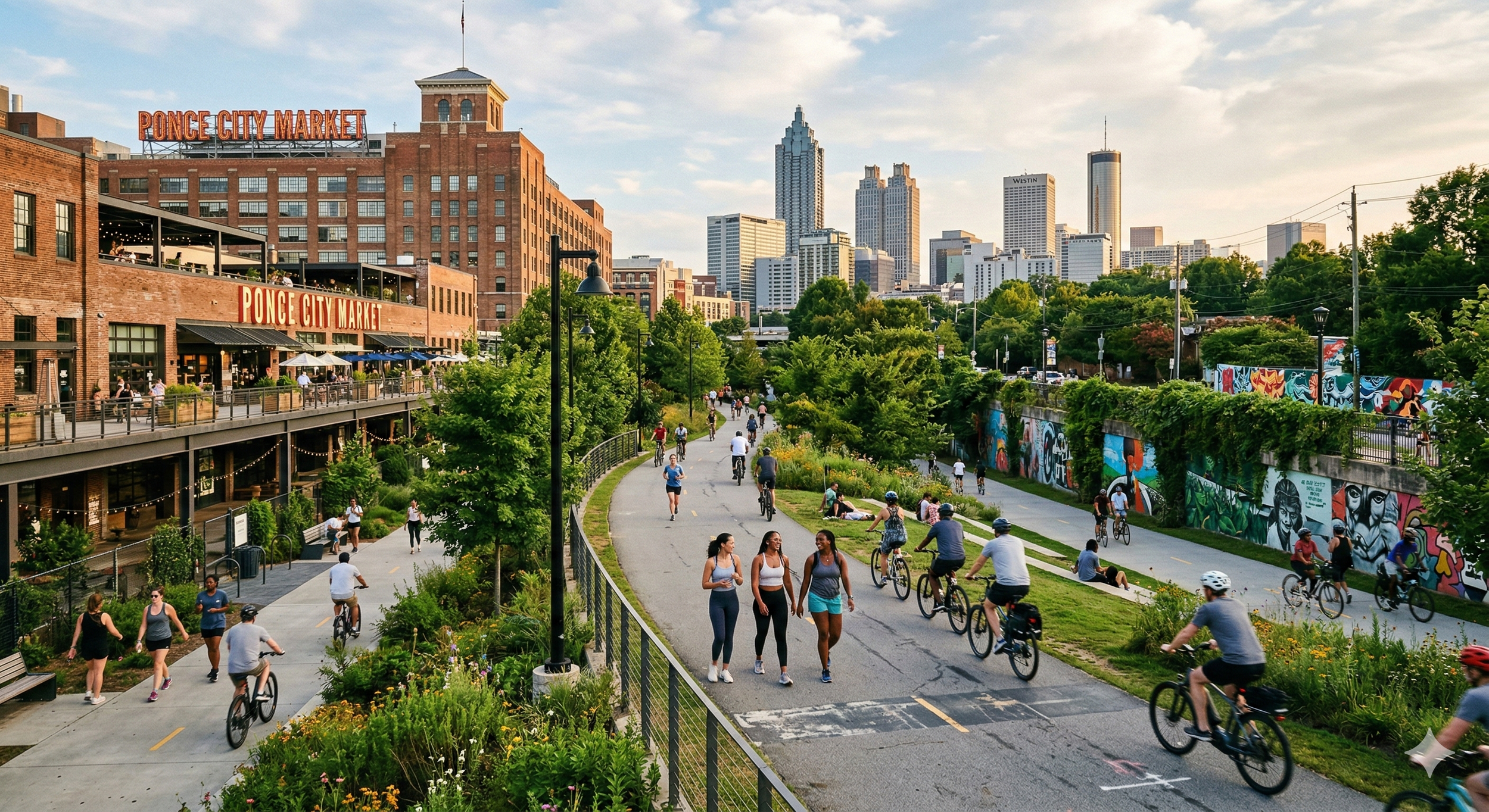
The Eastside Trail is the trail most people picture when they think of the Atlanta BeltLine. It runs 2.25 miles from Piedmont Park in the north through Ponce City Market, Inman Park, and Old Fourth Ward to Reynoldstown in the south. It is the most heavily used, most commercial, most activated segment of the entire system. This is where the food trucks are, where the murals are, where the weekend crowds are. A Ponce de Leon Avenue ramp providing an additional Eastside Trail access point near Ponce City Market opened in 2025.
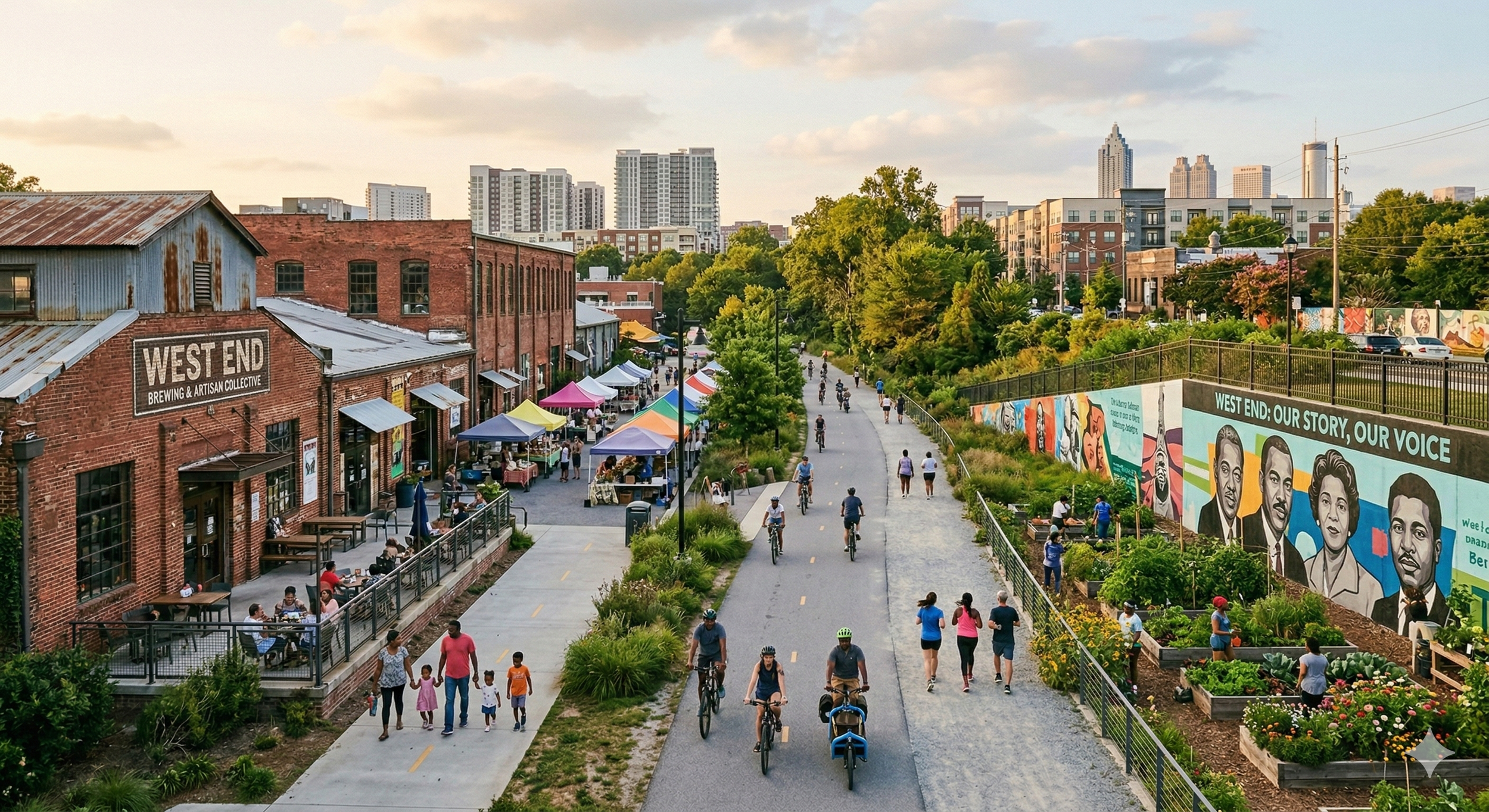
The Westside Trail runs 3.2 miles in the original rail corridor, from West Marietta Street south to I-20. Opened in 2017. Connects West End, Westview, and portions of the city's southwest quadrant. Additional segments are actively expanding: Westside Trail Segment 4 (1.3 miles from Lena Street north to Law Street, connecting to the Westside BeltLine Connector) was under construction through early 2025 and open in phases.
The West End Trail is a 2.4-mile trail that was actually the first BeltLine trail to open (2008), running alongside West End and Westview neighborhoods. It runs adjacent to city streets rather than in the original rail corridor and connects to the Westside Trail.
The Southside Trail is under active construction in multiple segments. Segments 2 and 3, covering 1.9 miles from west of I-75/85 to Boulevard, were released for construction in 2024. These segments are expected to be open and accessible during the FIFA World Cup in June 2026, with some construction potentially extending beyond that. Segment 6 (a pedestrian bridge over I-20 at Bill Kennedy Way, connecting Glenwood Park) is in design and construction will not start until after the World Cup.
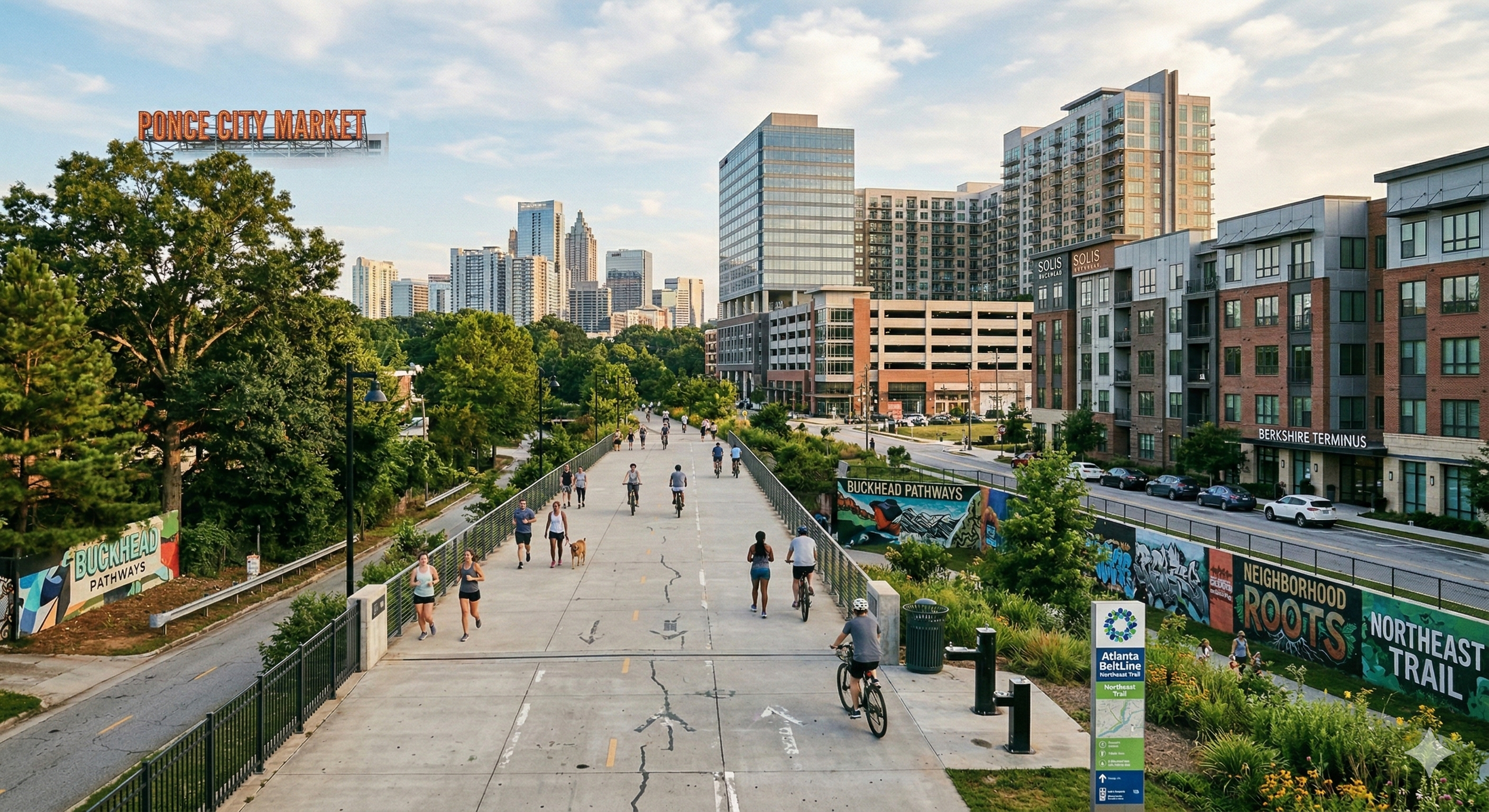
The Northeast Trail / Gravel Rail Trail opened with a groundbreaking in November 2024. This segment provides a gravel trail experience north of the Eastside Trail, extending toward the Northeast quadrant. It received permanent lighting and camera improvements in early 2026.
The Northwest Trail is under active construction across multiple segments. Northwest Trail Segment 3A (Trabert Avenue to Northside Drive, 1.2 miles total) opened in mid-2025. Segment 3B (Northside Drive to Tanyard Creek) has completed design and real estate acquisition was to be finalized by February 2026, with construction bid solicitation starting then and mobilization expected mid-2026. Segment 4 (English to Trabert, 0.9 miles) is in active construction. The Northwest Trail is the current leading edge of BeltLine expansion in the western quadrant of the city.
What's not yet connected: The full 22-mile loop is not closed. The Northside, Southeast, and portions of the Southwest and Northwest remain incomplete. Depending on where you're buying, "near the BeltLine" may mean near a trail that exists today, or near a corridor that will exist in several years, or — in rare cases — near a corridor that is still in planning or has funding uncertainty.
How This Plays Out Neighborhood by Neighborhood
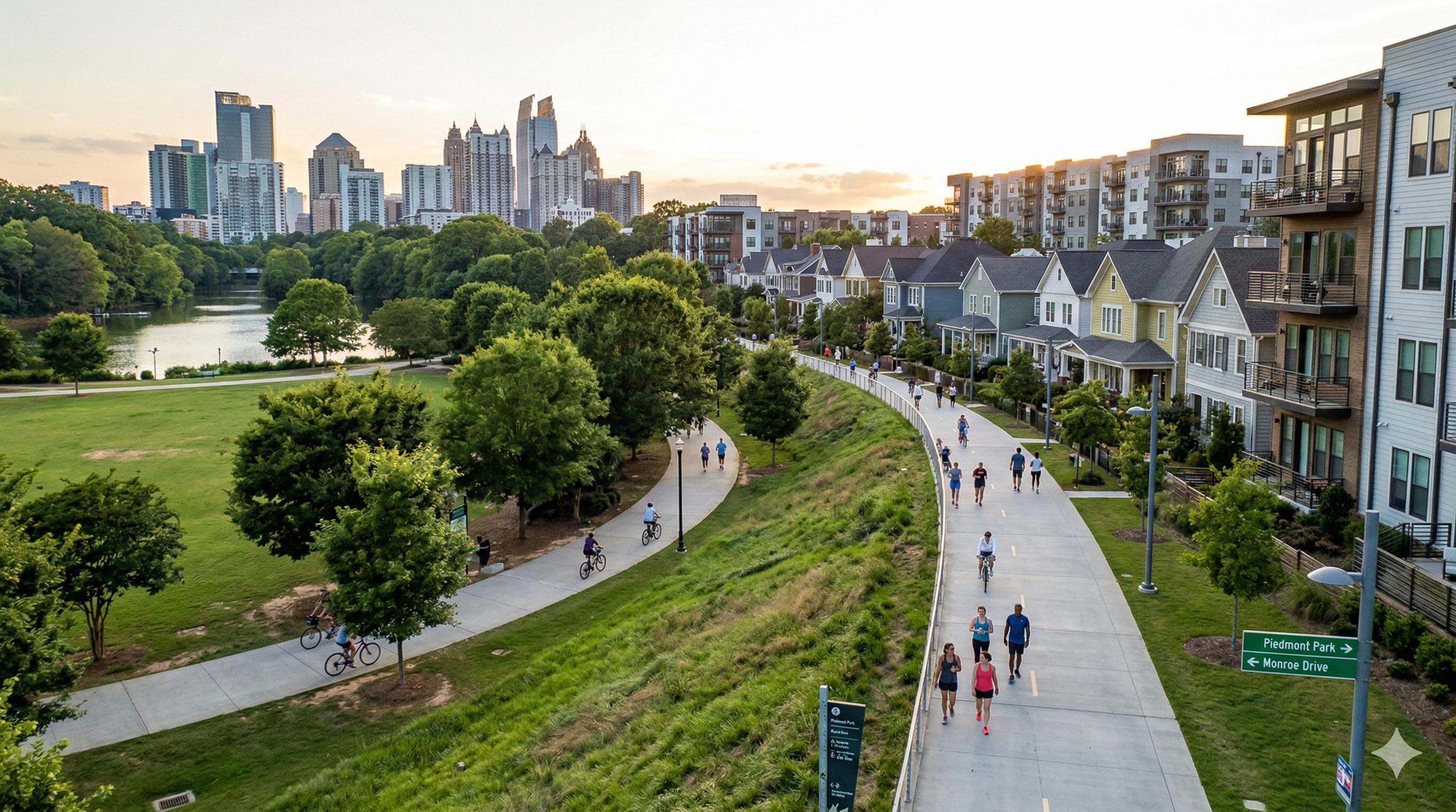
Old Fourth Ward and Inman Park — True Tier 1 and Tier 2 access. Direct Eastside Trail connectivity. The corridor that runs past Ponce City Market, through Krog Street Market, and south toward Reynoldstown is fully built and actively maintained. If you buy here and walk to the BeltLine, you're there in under 5 minutes from most addresses. This is what BeltLine access looks like at its best — and the prices reflect it.
Reynoldstown — Eastside Trail access is real. The Southeast Trail connector from Krog Street south through Reynoldstown is the same corridor and fully accessible. Buyers wanting this access should verify the specific address and which trail access point is closest — the neighborhood spans several blocks and access point distance varies.
Grant Park — I want to be careful here because this is one of the most common places buyers get tripped up. The Southside Trail runs through Grant Park, but it has been under construction. As of late 2025, construction on Segments 2 and 3 is underway with an anticipated opening window tied to the FIFA World Cup in June 2026. So "Grant Park has BeltLine access" is accurate — but a buyer purchasing in Grant Park today should understand they are buying in anticipation of trail access opening in 2026, not stepping onto a complete trail today. The distinction matters. If your decision hinges on the trail being usable now, verify current conditions before committing.
Kirkwood and East Atlanta Village — Both neighborhoods are located near planned BeltLine corridors, and both are often marketed with BeltLine language. EAV has access via the Southeast Trail connector near Reynoldstown, but it requires a longer walk or bike ride to get there from the core of EAV compared to Old Fourth Ward or Inman Park. Kirkwood has the Eastside Trolley Trail (a 1.9-mile multiuse path connecting through Edgewood to the BeltLine Eastside Trail) — which is genuinely useful and active, but is not the BeltLine itself. A buyer who wants to step out of their Kirkwood bungalow and be on the BeltLine proper in 5 minutes will be disappointed; one who is fine with a 15–20 minute ride or walk to access the broader trail system will be satisfied.
West Midtown (Westside) — The Westside BeltLine Connector (1.7 miles) links West Midtown to the Westside Trail. Some new construction — specifically Brock Built's West Town — sits directly on the Westside Trail. But most of West Midtown's residential addresses require using the connector trail to reach the main trail system. This is Tier 2 access for most addresses, Tier 1 for the specific BeltLine-frontage new construction. Know which you're buying.
Edgewood — The Eastside Trolley Trail, as noted above, provides genuine connectivity toward the BeltLine from Edgewood. This is a useful trail, but buyers should understand it's a connector path, not the BeltLine main loop itself.
Blandtown / Upper Westside — The Northwest Trail is coming, and segments are opening in 2025–2026. But if you're buying here today specifically for BeltLine access, verify the current open segments against the specific address. The corridor is actively expanding in this quadrant — Segment 3A opened in mid-2025, Segment 4 is under construction — but the trail is not yet continuous in the way the Eastside Trail is.
Candler Park and Lake Claire — These neighborhoods are frequently described as BeltLine-adjacent. The Eastside Trail's northern terminus is at Piedmont Park, and the NE trail extension is under active construction. Candler Park and Lake Claire are south and east of Druid Hills, with a distance from the current active Eastside Trail that makes "BeltLine access" a stretch for most current addresses. The trail will eventually be more accessible from these neighborhoods — that's part of their long-term value story — but buyers should not expect the same trail experience as Old Fourth Ward today.
The Language to Watch For
Here are the specific phrases that should prompt a follow-up question from any buyer:
"BeltLine adjacent" — Means the property is geographically near a BeltLine corridor. Does not specify whether that corridor is open, under construction, or in planning. Does not tell you how far the actual trail access point is. Always ask: which segment, is it currently open, and how far is the nearest trailhead from this specific address?
"Steps from the BeltLine" — One of the most commonly stretched phrases in Atlanta real estate. Technically, many properties are within several blocks of a BeltLine corridor. Whether those several blocks include an active trailhead is a different question.
"BeltLine community" — Often used by developers for new construction near a planned or future BeltLine corridor. Aspirational by design.
"BeltLine connector" — Honest and more precise language that acknowledges the trail connection is via a connector path, not the main BeltLine loop itself. The Westside BeltLine Connector and Eastside Trolley Trail are both real, useful trails — but they're connectors, not the main event.
"Future BeltLine access" — The most transparent version of the language. If a listing says this, the corridor isn't built yet. That may be fine — you may be buying for future upside — but you should know that's what you're doing.
What BeltLine Access Is Actually Worth
This is not an abstract question. BeltLine frontage and trail access are measurable in home prices, and the premium is real.
Properties with direct Eastside Trail access in Old Fourth Ward and Inman Park consistently sell at a premium over comparable homes in the same neighborhoods without it. The premium varies by specific location and property type, but it is reliably present in the data. Analysts have documented meaningful appreciation differentials for BeltLine-adjacent properties versus non-BeltLine properties in the same ZIP codes over the past decade.
This means two things for buyers:
First, you're paying for BeltLine access whether or not you value it. If trail access isn't important to your daily life, there are excellent intown neighborhoods where you can get comparable housing stock and walkability without paying the BeltLine premium — and the tradeoff may be worth it.
Second, if BeltLine access is your priority, the premium for Tier 1 access (direct trail frontage) versus Tier 2 (walking-distance access) is significant — often $50,000–$100,000+ on comparable homes. Whether that increment is worth it depends entirely on how central the trail is to how you actually intend to live.
Questions to Ask Before You Buy
If BeltLine access matters to your decision:
1. Which BeltLine segment is closest to this address, and is it currently open? Look it up on the Atlanta BeltLine website (beltline.org) before trusting any listing description. The monthly construction updates are genuinely detailed and publicly available.
2. What is the actual walk time from this front door to the nearest active trailhead? Not the drive. Not the map distance. The walking route, including any street crossings, grade changes, and whether the access point is formal (maintained, lit, marked) or informal (a gap in a fence someone uses).
3. If the nearby segment isn't open yet, what is the realistic completion timeline? Beltline construction timelines shift. What was supposed to open in 2024 may now be 2026. What's scheduled for 2026 may slip. Build in appropriate skepticism for construction completion dates and never buy assuming a timeline will hold.
4. Is the trail access I'm being shown the main BeltLine loop, a connector trail, or a greenway? All three are valuable. Only one is the BeltLine. Know which you're getting.
5. Does this property's trail access depend on a route through someone else's property or a private development? Some BeltLine access points route through developments or parcels that could theoretically be modified. Not common, but worth understanding for high-frontage properties.
The Honest Bottom Line
The BeltLine is one of Atlanta's most genuinely transformative infrastructure projects, and BeltLine access is a legitimate quality-of-life factor worth paying for — if you'll actually use it. The Eastside Trail is alive and activated in a way that changes how you live in a neighborhood. The Westside Trail is growing. The Southside and Northwest Trails are actively expanding.
But "adjacent" is not "access," and "future BeltLine" is not "BeltLine today." The gap between those phrases is sometimes a short walk. Sometimes it's a two-year construction timeline. Sometimes it's both.
I've worked with buyers who specifically moved to Inman Park for daily BeltLine runs and bought in the right place to make that happen. I've also worked with buyers who bought in neighborhoods marketed with BeltLine language and found themselves driving to a trailhead they could have reached from a house in a different zip code for less money.
The difference was knowing exactly what they were buying before they made the offer — not after.
Ready to Find Your BeltLine Neighborhood?
I know the intown Atlanta market, the current BeltLine trail network, and which neighborhoods deliver on the trail lifestyle versus which ones are selling you a future promise. If you want to talk through what BeltLine access actually looks like for your budget and lifestyle, let's connect.
📞 [Your phone number] 📧 [Your email] 🌐 kristenjohnsonrealestate.com
Come as you are, come on home.
Related Neighborhood Guides:
Frequently Asked Questions
What is the difference between BeltLine adjacent and BeltLine access? "BeltLine adjacent" means a property is geographically near a BeltLine corridor. "BeltLine access" means you can walk from that property to an active, open, maintained trail segment in a reasonable amount of time. A property can be adjacent to a corridor that is still under construction or in planning — in which case it has no current trail access regardless of the marketing language.
Which Atlanta neighborhoods have real BeltLine access right now? As of late 2025, Old Fourth Ward and Inman Park have the strongest, most direct access via the Eastside Trail. Reynoldstown connects to the Southeast Trail near Krog Street. West End and Westview have access via the Westside and West End Trails. Grant Park is opening Southside Trail access in 2026. The Northwest Trail is expanding through West Midtown and Blandtown with new segments opening in 2025–2026.
Is BeltLine access worth paying a premium for? It depends on how you plan to use it. The BeltLine premium on homes with direct Eastside Trail access in Old Fourth Ward and Inman Park is real and measurable — often $50,000–$100,000+ over comparable nearby homes. If you'll use the trail regularly, that premium may justify itself in lifestyle value. If trail access is secondary to your priorities, there are excellent intown neighborhoods without the premium.
Is the Atlanta BeltLine complete? No. The BeltLine is a 22-mile loop, and as of late 2025, several major segments are still under construction or in design. The Eastside Trail (2.25 miles) and Westside Trail (3.2 miles) are the most complete and active. The Southside Trail and Northwest Trail are in active construction. The full loop is projected to be complete in the coming years, but timelines have shifted before and should be treated with appropriate skepticism.
What does "BeltLine connector trail" mean? A connector trail links a neighborhood to the main BeltLine loop via a separate path. The Westside BeltLine Connector (1.7 miles through West Midtown) and the Eastside Trolley Trail (Edgewood/Kirkwood to the Eastside Trail) are both examples. These are real, maintained, useful trails — but they are not the BeltLine main loop, and the distinction matters for buyers evaluating trail access.