

Should You Take an iBuyer Offer or List Your Atlanta Home Traditionally in 2026?
If you've requested an offer from Opendoor or Offerpad in the last six months, you've probably noticed the number on the screen looked closer to your Zillow Zestimate than you expected. Then you read the offer breakdown. That's where the gap shows up: a 5% service charge, an estimated repair credit you don't see until after the in-home assessment, standard closing costs, and an offer price that's quietly built to absorb the iBuyer's holding costs and resale risk. By the time you net out, the convenience number doesn't look like a convenience anymore. It looks like a discount.
I work with sellers across Metro Atlanta, in the suburbs and intown, at first-time-seller price points and into the luxury market. The iBuyer question comes up at almost every listing consultation now, especially with sellers who are relocating, going through a life event, or watching the market data and wondering whether the speed and certainty are worth what they're being asked to give up.
Nearly a decade of helping Atlanta sellers means I've sat at enough kitchen tables to know two things. The first is that iBuyer offers are a real tool, and for the right situation, they are the right answer. The second is that most sellers who accept one didn't run the math against a traditional listing in their actual neighborhood, with their actual home, in their actual condition. They ran the math against a worst-case version of a traditional sale and a best-case version of the cash offer. That's how you leave thirty, forty, fifty thousand dollars on a kitchen table without realizing it.
This post is the honest comparison. What an iBuyer offer in Atlanta actually costs you, what a traditional listing actually nets you in this market, when each one wins, and how to decide between them with numbers instead of marketing copy.
Here's what you need to know.
What an iBuyer Actually Is (and What It Isn't)
An iBuyer, short for instant buyer, is a technology-driven company that uses algorithmic pricing to make near-instant cash offers on homes, then renovates and resells them on the open market. The two iBuyers actively buying in Metro Atlanta right now are Opendoor and Offerpad. Both operate in most of the markets I cover, including Fulton, DeKalb, Cobb, Gwinnett, Henry, Douglas, and the surrounding counties.
What an iBuyer is not: a traditional cash investor or a "we buy houses" wholesaler. Those companies typically pay 60% to 80% of after-repair value and target distressed properties. iBuyers target homes in good condition, built after 1950, generally under $1 million, on lots smaller than two acres. They want clean, marketable inventory they can resell within a few months. The offer they make is closer to market value than what a flipper pays, but the math behind it is built around three things they have to recover: the service charge, repair and prep costs, and the spread they need to absorb resale risk and holding costs while the home sits on their books.
The pitch is speed and simplicity. Skip showings, skip open houses, skip the months of uncertainty, choose your closing date, walk away. For a real subset of sellers, that is genuinely the right trade. The problem is when sellers who would have done well on the open market accept a cash offer because they were never shown the actual side-by-side numbers.
How Much an iBuyer Offer Actually Costs You in Atlanta
The cost of selling to an iBuyer breaks down into four parts. The headline service fee is what they advertise. The other three are where the real money lives.
The Service Charge
Opendoor's service charge has historically been around 5%, though as of 2026 the company describes it as variable and shown in your individual offer breakdown rather than a fixed percentage (it can come in higher than 5% on some homes). Offerpad charges a 5% service fee on its standard cash offer program, with some industry analyses showing effective service charges running between 5% and 8% depending on the home and program option. On a $440,000 Atlanta home (roughly the city of Atlanta median sale price as of early 2026, per Redfin), a 5% service charge is $22,000. At 7%, it's $30,800.
This fee replaces what you would have paid in agent commission on a traditional sale, but the comparison isn't apples to apples. With an agent, the commission is paid out of an open-market sale price that includes competitive bidding. With an iBuyer, the service charge is paid out of an offer that already absorbs the iBuyer's resale margin. You're paying a commission-equivalent fee on top of a price that already discounted what the home would have sold for on the MLS.
The Repair Credit (the Wildcard)
After you sign a purchase agreement, the iBuyer sends an inspector through the home. Whatever they identify as needing repair, replacement, or "condition adjustment" is deducted from your offer as a repair credit. You don't hire the contractor, you don't get to negotiate the scope, and you don't get to push back the way you would in a traditional buyer's repair amendment.
This is where the seller experience varies most. Sellers in industry analyses have reported repair credit deductions ranging from 1% to 5% of the offer price, with anecdotal cases at $20,000, $30,000, even $40,000 on homes the seller didn't believe needed that level of work. On a $440,000 home, a 3% repair credit is $13,200. A 5% repair credit is $22,000.
The mechanics matter here. If you list traditionally and a buyer's inspection turns up the same issues, you have leverage. You can offer to credit some items, refuse others, point to comps where similar homes sold without those repairs, and use the existence of backup interest to hold your line. With an iBuyer, the repair number is the iBuyer's number. You can either accept it, walk away, or try to renegotiate, but you don't have a competing buyer in the room.
Closing Costs
Standard closing costs in Georgia run roughly 1% to 3% of the sale price for sellers, covering title insurance, escrow or attorney fees, transfer taxes, prorated property taxes, and any HOA transfer fees. These exist in both an iBuyer transaction and a traditional sale, so they're a wash on the comparison, but they need to be in the math when you're calculating net proceeds.
The Discount Built Into the Offer
This is the part most sellers don't see. The iBuyer's offer price itself is set below what the home would sell for on the open market, because the iBuyer needs to absorb the cost of holding the home, renovating it, marketing it, and reselling it, plus a margin. Recent third-party analyses, including a study of more than 400 Opendoor transactions and another of more than 120 Offerpad transactions, found that iBuyers paid sellers an average of 9% to 14% less than what those same homes resold for on the open market within roughly a year. That's the spread, and it's not a small number. On a $500,000 home, that's a $45,000 to $70,000 gap, separate from the service fee, separate from the repair credit, separate from closing costs.
I want to be careful here, because the spread between iBuyer purchase price and resale price isn't pure profit to the iBuyer. It includes the cost of repairs and renovations the iBuyer pays for after closing, holding costs (taxes, insurance, utilities, HOA), market risk, and the iBuyer's overhead and margin. Sellers don't lose the full spread to the iBuyer's bottom line. But the spread does represent real market value the seller could have captured on a traditional listing, after their own selling costs, and didn't.
What All-In Costs Actually Look Like
Putting it together, sellers should expect total iBuyer costs (service fee plus repair credit plus closing costs, before the offer-price discount) to land in the 7% to 10% range of the offer amount, sometimes higher if the repair credit is significant. That's before you account for the gap between the iBuyer's offer and what the home would have sold for on the MLS.
| Cost Category | Typical Range | On a $440,000 Atlanta Home |
|---|---|---|
| Service Charge (Opendoor / Offerpad) | 5% (variable; can be higher) | $22,000 (at 5%) |
| Repair Credit (post-inspection) | 1% to 5% (sometimes higher) | $4,400 to $22,000 |
| Standard Closing Costs (seller side) | 1% to 3% | $4,400 to $13,200 |
| Total Direct Costs | 7% to 10%+ of offer | $30,800 to $57,200+ |
| Implicit Discount in Offer Price | Not on the breakdown; gap between offer and what the home would sell for on the open market | Variable; typically meaningful |
How Much a Traditional Listing Actually Costs You in Atlanta
The traditional listing has its own cost structure, and I'm going to be straight with you about it, because the only honest comparison is one where both sides are presented at full cost. Pretending a traditional sale is free is exactly the kind of math that makes iBuyer offers look better than they are.
Listing Agent and Buyer's Agent Commission
Atlanta's commission environment shifted in late 2024 after the NAR settlement changed how buyer's agent compensation gets handled. In practice across my market, sellers are still negotiating to cover the buyer's agent fee in most price points, because not offering it limits the buyer pool and signals weakness on a listing. Total commission on a typical Atlanta sale runs 5% to 6% of the sale price, with the listing-side and buyer-side fees negotiated separately. On a $440,000 sale, that's $22,000 to $26,400, comparable to or slightly higher than an iBuyer's 5% service charge.
Commission is negotiable. I have those conversations with every seller. But the headline number for budgeting purposes is 5% to 6% total, and any agent telling you otherwise is either undercutting service somewhere or hoping you don't ask.
Seller Closing Costs
Same 1% to 3% range as the iBuyer transaction. Title, attorney, transfer taxes, prorated property taxes, HOA transfer if applicable. Wash.
Pre-Listing Prep
This is the line item iBuyers love to highlight, because it's the most variable cost in a traditional sale and the one sellers underestimate most often. In Atlanta, prep typically includes professional cleaning, decluttering, minor repairs, paint touch-ups, landscaping, and (for the price points where it moves the needle) staging. Costs vary significantly by home, but for a $400,000 to $700,000 Atlanta home in good condition, I budget sellers $2,000 to $8,000 for prep. Homes that need more work, or homes at higher price points where staging is non-negotiable, can run $10,000 to $20,000.
The honest counter is this: the iBuyer is going to deduct repair and prep costs from your offer anyway, often at higher prices than you would pay your own contractor or vendor. The cost doesn't disappear when you sell to an iBuyer. It just moves from a line item you control to a line item the iBuyer controls.
Concessions and Repairs Negotiated With the Buyer
In the current Metro Atlanta market, with inventory up roughly 14% to 20% year over year and average days on market in the 60- to 80-day range depending on price point and submarket, buyers have leverage to ask for concessions. In recent national data, around 44% of sellers gave concessions to buyers, often in the form of closing-cost credits, rate buydown contributions, or repair credits coming out of inspection negotiations. On a $440,000 Atlanta home, a 1% to 2% concession is $4,400 to $8,800.
Whether your home faces concession pressure depends on price point, neighborhood, condition, and how it's priced relative to comps. Properties priced precisely and presented well in strong submarkets are still moving with limited concessions. Properties priced aggressively or sitting in slower submarkets are absorbing more.
Carrying Costs During the Marketing Period
If your home sits for 60 days, you continue to pay the mortgage, taxes, insurance, utilities, and HOA. For a $400,000 home with a $2,800 monthly housing payment all-in, two months of carrying costs is $5,600. This is the cost the iBuyer is offering to eliminate, and it's a real number.
What All-In Costs Actually Look Like for a Traditional Listing
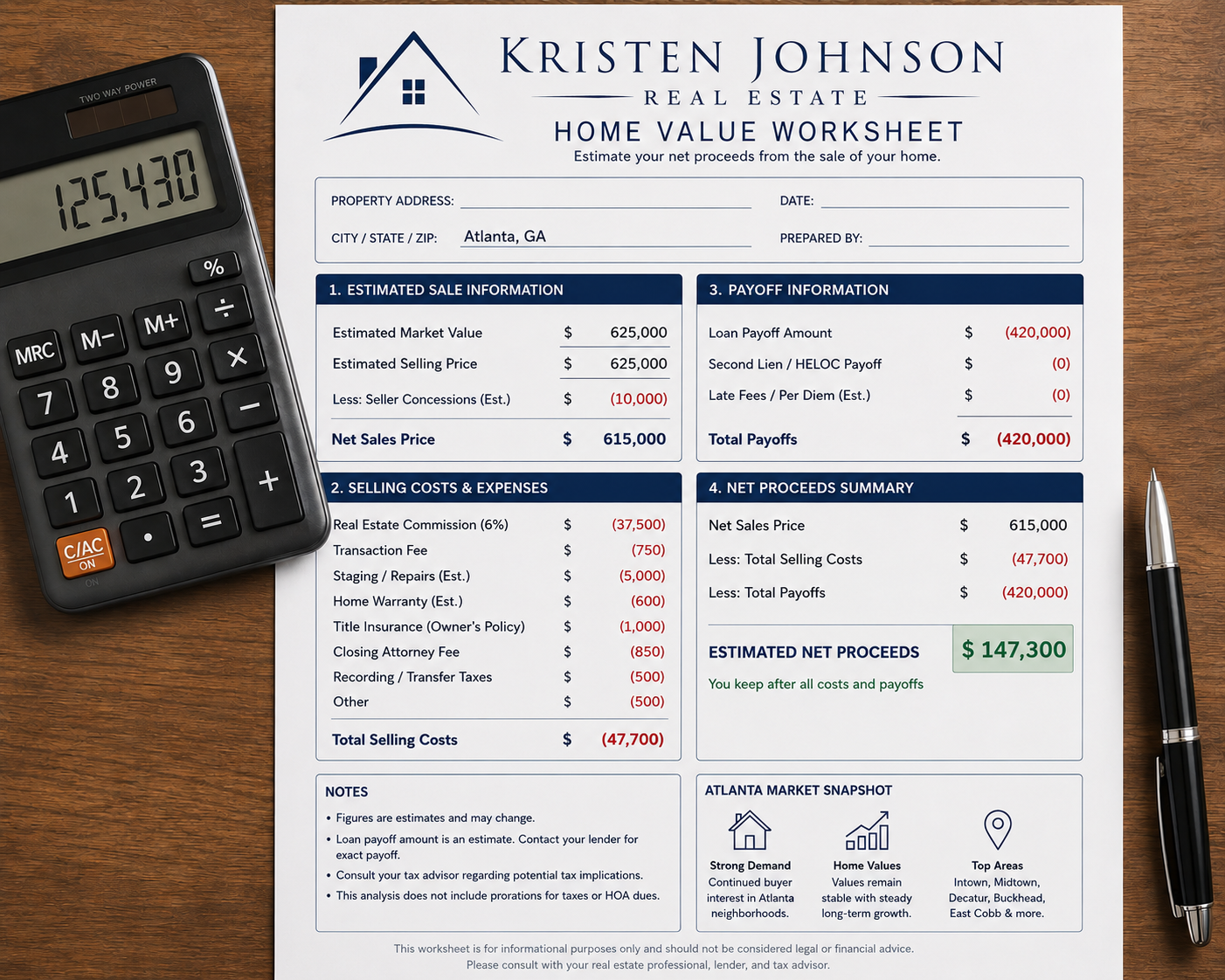
Adding it up, traditional listing costs typically run 8% to 12% of the sale price for a well-prepared home selling near asking, including commission, closing costs, prep, concessions, and a couple of months of carrying costs.
| Cost Category | Typical Range | On a $440,000 Atlanta Home |
|---|---|---|
| Total Real Estate Commission (listing + buyer side) | 5% to 6% (negotiable) | $22,000 to $26,400 |
| Standard Closing Costs (seller side) | 1% to 3% | $4,400 to $13,200 |
| Pre-Listing Prep (cleaning, paint, minor repairs, staging) | $2,000 to $8,000 (typical); $10,000+ at higher price points | $2,000 to $8,000 |
| Buyer Concessions (closing costs, repairs, rate buydown) | 0% to 2% in current market | $0 to $8,800 |
| Carrying Costs (60–90 day marketing period) | 2 to 3 months mortgage, tax, insurance, utilities, HOA | $5,000 to $9,000 |
| Total All-In Cost | 8% to 12% of sale price | $33,400 to $65,400 |
The math gets interesting when you compare the all-in cost of each path against the price the home actually sells for. Traditional listing costs are higher in dollar terms, but they're being applied to a higher sale price. iBuyer costs are lower in dollar terms but they're being applied to an offer price that's already discounted.
The Side-by-Side: What You Actually Net on a $500,000 Atlanta Home
Numbers are more useful than principles. Let me walk through a realistic comparison on a $500,000 Atlanta home in good condition, in a typical Metro Atlanta submarket, in the 2026 market environment.
| Line Item | iBuyer Cash Offer | Traditional Listing |
|---|---|---|
| Starting Price / Offer | $465,000 (offer roughly 7% below market) | $500,000 (sale price) |
| Commission / Service Charge | $23,250 (5% service charge) | $27,500 (5.5% commission) |
| Repair Credit / Concessions | $13,950 (3% post-inspection credit) | $5,000 (1% buyer concession) |
| Pre-Listing Prep | $0 | $5,000 |
| Closing Costs (seller) | $6,975 (1.5%) | $7,500 (1.5%) |
| Carrying Costs (marketing period) | $0 (close in ~30 days) | $5,500 (~70 days at $2,750/mo) |
| Estimated Net Proceeds | $420,825 | $449,500 |
| Difference | Traditional listing nets approximately $28,675 more on this baseline scenario. Wider gaps are common when iBuyer offers come in lower or repair credits run higher. | |
The takeaway: in a baseline scenario for a $500,000 home in good condition, the seller nets roughly $30,000 to $45,000 more on a traditional listing than on an iBuyer cash offer. The exact gap depends on the iBuyer's offer (which varies meaningfully by home), the repair credit (which is the biggest wildcard), and the strength of the open-market sale (which depends on pricing, prep, and submarket).
There are scenarios where the gap is smaller. There are scenarios where it's larger. There are also scenarios where the math reverses, and I want to be honest about those, because they exist and they're how you decide whether to even request an iBuyer offer.
When an iBuyer Offer Actually Wins
I've sent sellers to iBuyers. Not often, but I've done it. Here are the situations where the math actually favors the cash offer, and they're more specific than the marketing makes them sound.
You're in a Forced or Time-Constrained Sale
Job relocation with a hard report date in three weeks. Divorce with a mediated settlement requiring the home be sold by a specific date. Estate sale where the heirs want a clean, fast resolution and live out of state. Medical or financial situation requiring the equity to be liquidated quickly. In any of these cases, the cost of speed is genuinely worth paying, because the alternative isn't "list traditionally and net more." The alternative is "list traditionally, miss the deadline, take a fire-sale price on the open market with a desperate timeline that buyers can smell."
The iBuyer's price of certainty is worth what you'd otherwise lose to a forced fast-track listing.
Your Home Has Material Issues That Will Surface in Inspection
Foundation work. Older systems at end of life. A roof that's borderline. A structural quirk that's going to scare retail buyers. If your home has issues that are going to come up in a buyer's inspection and lead to either price renegotiation, big credits, or a deal falling apart, the iBuyer's repair credit may actually be cheaper than what the same issues will cost you in a traditional negotiation, because the iBuyer prices repairs into the algorithm and moves on rather than letting the negotiation become a fight.
This is a calculation, not a default. I've also seen homes with significant issues sell well on the open market when priced correctly and disclosed cleanly, because the right buyer walked in already knowing. But for sellers who don't want to manage that process, the iBuyer route can pencil out.
You've Already Bought the Next House and the Two-Mortgage Math Hurts
If you closed on your next home before listing your current one and you're carrying both mortgages, every month your old home doesn't sell is real cash out of your pocket. At a certain point, the carrying cost gap closes the price gap between an iBuyer and a traditional listing, especially if the home is going to take 90+ days to move at the price you want.
There are alternatives I work through with these sellers first (bridge loans, HELOCs on the new home, or pricing the old home aggressively to move it in 30 days), but if those don't work for the situation, the iBuyer offer becomes mathematically reasonable.
Your Home Is Genuinely Hard to Show or Market
Tenant-occupied with a difficult tenant. A property where physical access for showings is logistically painful. A home that needs significant work and you don't want to coordinate the prep. The friction of running a traditional listing in these scenarios is real, and the iBuyer's "skip the showings" pitch lands.
Note: these are scenarios where the iBuyer is solving a real problem you'd otherwise have to solve at cost. They are not scenarios where you're choosing convenience because the listing process sounds tiring.
The iBuyer's Offer Is, Genuinely, Close to Market Value
This happens. Algorithmic pricing isn't always wrong. In specific neighborhoods, at specific price points, on specific home profiles, an iBuyer's offer occasionally lands within 2% to 4% of what I'd expect the home to net on the open market. When that happens, the convenience is genuinely worth the small gap, and I tell sellers so.
The way to know is to run the listing analysis first. If I price your home at $475,000 and net you $435,000 after costs, and the iBuyer's offer nets you $420,000, that's a $15,000 gap to walk away in two weeks instead of 60 days. Some sellers take that trade and don't look back. That's a defensible decision when the numbers are actually that close.
When a Traditional Listing Is Almost Always the Right Call
The flip side. These are the situations where I push back hard on sellers considering an iBuyer offer, because the math is going to leave significant money on the table and the timeline pressure isn't real.
You Have 60 to 90 Days of Flexibility
If you can manage a normal Atlanta listing timeline, you almost certainly should. The market in 2026 is taking longer than 2021 (median DOM in Atlanta is in the 60- to 80-day range as of early 2026, depending on submarket), but a well-priced, well-prepared home in most Metro Atlanta submarkets is still moving in that window. The competitive bidding that produces above-asking offers happens less frequently than it did three years ago, but pricing precisely against current comps and presenting the home well still produces multiple-offer scenarios in the right submarkets.
Your Home Is in Good Condition and Doesn't Need Major Work
The iBuyer model is most punishing on homes that are actually market-ready. The repair credit eats into the offer regardless of condition, the algorithmic pricing doesn't reward the upgrades you've done the way the open market does, and the spread the iBuyer needs to recover is the same on a turnkey home as on one that needs work. Sellers with the cleanest, best-prepared homes are typically the ones leaving the most equity on the table when they accept iBuyer offers.
You're in a Submarket Where Buyer Demand Is Still Strong
Inman Park, Virginia-Highland, Morningside, Brookhaven, Decatur, Kirkwood, the better Buckhead pockets, parts of East Cobb and North Fulton: these submarkets are still seeing competitive activity for properly priced, well-presented homes. Average DOM in these areas runs shorter than the broader Metro Atlanta average, and well-positioned listings are still drawing multiple offers within the first two weeks. iBuyers don't price based on submarket strength the way the open market does. They price based on the algorithm's view of comps and condition, and the algorithm doesn't know that buyers in your specific neighborhood are still moving fast on the right house.
You've Made Improvements That Won't Show Up in an Algorithmic Offer
A renovated kitchen, updated bathrooms, a finished basement, a new roof, hardwood throughout, smart home systems, a pool, a screened porch, mature landscaping. Real buyers walking through a home see and feel these and pay for them. Algorithms see square footage, bed/bath count, and condition tier. iBuyers will give partial credit for confirmed upgrades when you submit photos and information, but the open market consistently pays more for renovation quality and finish level than the algorithm captures.
You're at a Price Point or Property Type the iBuyer Doesn't Specialize In
iBuyers want homes in the $250,000 to $1 million range, on standard lots, in good condition, in the metro markets where they have the most resale velocity. If you're above $1M, on a large lot, in a distinctive architectural style, in a niche neighborhood, or in a luxury submarket, the iBuyer's algorithm is going to undervalue you significantly because their resale playbook isn't built for your home. Atlanta's luxury market in 2026 is doing well at the upper end, with the highest price tiers actually outperforming the broader market, and a traditional listing with a luxury-experienced agent is going to capture meaningfully more value.

What the 2026 Atlanta Market Means for This Decision
Market context matters, because the iBuyer-versus-traditional math shifts with conditions.
The Metro Atlanta market in early 2026 has transitioned from the urgent seller's market of 2021 to 2022 into something more balanced. Per the most recent data I'm working with as of early 2026: median sale price in the city of Atlanta is around $440,000, down roughly 3.3% year over year (Redfin). Median sale price across the broader 11-county Metro Atlanta is roughly $380,000 to $415,000 depending on the data source and the month, with year-over-year changes ranging from flat to slightly negative. Inventory is up materially, somewhere between 14% and 20% year over year. Average days on market across the metro is in the 60- to 80-day range, with significant variation by submarket and price point. The strongest submarkets are still moving faster than that. Slower submarkets are stretching longer.
What this means for the iBuyer question:
iBuyers' algorithmic offers tend to be more conservative when the market is softening. The math they have to absorb (resale risk, holding costs while inventory sits longer, market risk on direction) gets larger in environments where prices are flat or down. So the gap between iBuyer offers and open-market sale prices has been wider in 2026 than it was in 2021 to 2022, when iBuyers were paying close to market value because they could resell quickly and into rising prices.
Traditional listings are taking longer but still selling. The "list and never sell" risk that some iBuyer marketing implies isn't real for properly priced homes in this market. Homes are taking 60 to 90 days instead of two weeks, but they're closing.
Concession pressure is real, and it eats into the traditional-listing advantage. Sellers giving 1% to 2% in concessions are giving back some of what they'd otherwise have netted. This narrows the gap between traditional and iBuyer outcomes, but doesn't close it.
The competitive bidding tailwind has cooled. In 2021, traditional listings consistently produced offers above asking. In 2026, well-positioned homes still produce multiple offers, but the over-asking premium is smaller and less universal. The math now favors precise pricing rather than aspirational pricing.
How to Run Your Own Comparison the Right Way
If you're seriously weighing both options, here's the process I take sellers through. The goal is to get to a real number on each path so you can make the decision with data, not vibes.
Step 1: Get an iBuyer offer. Both Opendoor and Offerpad let you request offers free, with no obligation. Submit current photos, accurate condition information, and any improvements you've made. Get the full offer breakdown: the offer amount, the service charge, the estimated standard costs, and the post-inspection repair credit estimate. Do this for both companies.
Step 2: Get a real listing analysis from a local agent. Not a Zillow Zestimate, not a Redfin estimate, not a generic CMA from an out-of-area agent. A current, neighborhood-specific analysis from someone who's actively transacting in your submarket. The right agent will give you a list price recommendation, a likely sale price range based on actual recent comps, an estimated days on market, and a realistic estimate of concessions and prep costs in current market conditions.
Step 3: Calculate net proceeds for each path. For the iBuyer: offer price, minus service charge, minus repair credit, minus closing costs. For the traditional listing: estimated sale price, minus 5% to 6% commission, minus closing costs, minus prep budget, minus realistic concession estimate, minus carrying costs during the marketing period.
Step 4: Account for the timeline difference honestly. If the iBuyer closes in 14 to 30 days and the traditional listing takes 60 to 90 days, the difference is one to two months of carrying costs and one to two months of decision uncertainty. Quantify the carrying costs (mortgage, tax, insurance, utilities, HOA). Decide what the uncertainty is actually worth to you in dollars.
Step 5: Look at the gap, not the headline numbers. The question isn't "which one nets more in absolute terms." The question is "is the iBuyer's gap small enough that the speed and certainty are worth it for my situation?" If the gap is $5,000 to $10,000 and you genuinely need to be out in three weeks, that may be worth it. If the gap is $40,000 to $60,000 and you have 90 days of flexibility, it almost certainly isn't.
This is the conversation I have with sellers at every listing consultation where iBuyer is on the table. Some of them go to the iBuyer afterward, with my blessing, because for their situation it's the right call. Most of them list traditionally, because once the numbers are on paper the answer becomes obvious.
The Hidden Costs Sellers Don't Calculate
A few things that don't show up on the offer breakdown but should be in your decision math.
Negotiation leverage. With an iBuyer, you have one buyer, and that buyer's terms are mostly non-negotiable. With a traditional listing, you may have multiple buyers, you can play offers against each other, you can negotiate price, terms, contingencies, repair credits, closing dates, and concessions. That leverage has dollar value, especially when inspection issues come up.
Pricing accuracy by the algorithm. iBuyer algorithms work best on homogeneous housing stock with deep recent comps. They work less well on distinctive homes, recent renovations, premium finishes, character properties, or anything off the standard template. Atlanta has a lot of housing that doesn't fit the standard template, and the algorithm tends to underprice those homes.
The "easy out" emotional pull. Selling a home is stressful, and the iBuyer offer is designed to reduce that stress. That's real value. But it's also designed to feel like the rational choice in a moment when sellers are often making decisions under time pressure and life-event stress. Build in time to actually run the math before signing the agreement, even if the iBuyer is pressuring you for a quick decision.
The post-acceptance repair shock. The biggest source of seller dissatisfaction with iBuyers is the post-inspection repair credit, which routinely comes in higher than sellers expected. Industry data and customer reviews consistently show this is the most common complaint, and the credit is taken from your proceeds, not negotiated against the offer price. Sellers who think they're netting one number sometimes net $10,000 to $30,000 less after the inspection.
The opportunity cost of time uncertainty. If you accept the iBuyer's offer and they reduce it after inspection, you may walk away and have lost three to four weeks of marketing time. That can matter if you're already on a deadline.
What I Actually Tell Sellers
When a seller asks me whether they should take the iBuyer offer, my answer is some version of this:
Get the iBuyer offer. Get a real listing analysis. Look at the gap. If the gap is under $10,000 and you need speed and certainty, take the cash offer. If the gap is more than $20,000 to $25,000 and you have a normal timeline, list traditionally. Anything in between is a judgment call about how much your time, certainty, and stress are worth.
And if you don't want to deal with the listing process at all, that's a real preference, and the iBuyer can be the right tool for it. But know that you're paying for that preference, not just paying for convenience.
The decision is yours. The math isn't.

FAQ: iBuyers vs Traditional Listings in Atlanta
Is an iBuyer offer worth it compared to listing your Atlanta home?
It depends on the gap between the iBuyer's net offer and your projected net from a traditional listing, and on your timeline constraints. In 2026, sellers in Metro Atlanta who run the comparison are typically seeing $25,000 to $60,000 more net proceeds from a traditional listing on a $500,000 home, before accounting for carrying costs during the marketing period. If you have 60 to 90 days of flexibility and a home in good condition, traditional listing usually wins on math. If you have a hard timeline, a property with significant issues, or both, the iBuyer's premium for speed can be worth paying.
What fees do iBuyers actually charge in Atlanta?
The headline service charge is 5% on Opendoor's standard offer (with some variation in 2026 as Opendoor moves toward variable pricing) and 5% on Offerpad's standard cash program. On top of that, expect 1% to 3% in standard closing costs and a post-inspection repair credit deducted from your proceeds, which can run anywhere from 1% to 5% of the offer price (sometimes higher on homes with significant issues). All-in costs typically land in the 7% to 10% range of the offer amount, before accounting for the gap between the iBuyer's offer and what the home would have sold for on the open market.
How much do you actually lose by selling to an iBuyer instead of listing?
Recent third-party analyses of hundreds of iBuyer transactions found that iBuyers paid sellers an average of 9% to 14% less than the same homes resold for on the open market within roughly a year. Not all of that spread is pure cost to the seller, because some of it covers repairs and renovations the iBuyer pays for after closing. But on a $500,000 home, the practical net-proceeds gap between an iBuyer cash offer and a traditional listing is typically $30,000 to $60,000 in the current Atlanta market, depending on the home, the submarket, and the iBuyer's specific offer.
When does an iBuyer offer actually make sense?
When you have a forced or time-constrained sale (relocation, divorce, estate, financial pressure), when your home has material issues that would create big problems in a traditional inspection negotiation, when you're carrying two mortgages and the holding cost gap is closing the price gap, when the home is genuinely hard to show or market, or when the iBuyer's offer happens to land within 2% to 4% of what a traditional listing would net (which does happen).
Are Opendoor and Offerpad actually buying homes in Atlanta in 2026?
Yes. Atlanta is one of the largest active markets for both Opendoor and Offerpad. Both companies have reduced their acquisition volumes significantly compared to 2021 to 2022, but Atlanta remains a core operating market for both. Whether your specific home qualifies depends on year built (typically post-1950), price (typically under $1 million), lot size (typically under two acres), and condition.
How does the iBuyer's repair credit work, and can I negotiate it?
After you sign the purchase agreement, the iBuyer sends an inspector through the home. Whatever they identify as needing repair or "condition adjustment" is deducted from your offer as a repair credit at closing. You don't hire the contractor and don't manage the work. You can attempt to renegotiate if the credit comes in much higher than expected, and you can walk away from the deal at most stages without penalty (Offerpad eliminated its 1% cancellation fee). But you do not have the same negotiating leverage you would in a traditional buyer's repair amendment, where you can use the existence of competing buyers to hold your line.
What's the typical timeline for selling to an iBuyer vs listing traditionally in Atlanta?
iBuyer: roughly 14 to 45 days from offer acceptance to closing, depending on inspection turnaround and your chosen close date. Traditional listing in current Atlanta market conditions: roughly 60 to 90 days from listing to closing for a properly priced, well-presented home in a typical submarket, with strong submarkets running shorter and slower submarkets running longer.
What if the iBuyer's initial offer is good but they reduce it after inspection?
This is one of the most common seller complaints with iBuyers and one of the biggest risks of the process. Build in a backup plan: keep the option of listing traditionally open, don't make irreversible commitments (like closing on a new home) based on the initial offer, and be prepared to walk away if the post-inspection number doesn't make sense. If you've already incurred the loss of two to four weeks of marketing time, you'll need to factor that into your traditional-listing strategy if you pivot.
Do iBuyer offers reflect home improvements I've made?
Partially. Both Opendoor and Offerpad allow you to submit information and photos of recent improvements, and the offer can be adjusted for verified upgrades. But the algorithmic pricing model captures less of the value of high-quality renovations, premium finishes, and distinctive features than the open market does. Sellers with significantly upgraded homes consistently see the largest gaps between iBuyer offers and what they would net on a traditional listing.
Can I get an iBuyer offer just to use as a benchmark?
Yes, and many sellers do. Both Opendoor and Offerpad provide free, no-obligation offers. Using the iBuyer's offer as a data point alongside a real listing analysis gives you a clean comparison and helps you decide whether to list traditionally, sell to the iBuyer, or negotiate with confidence in either direction. I generally recommend sellers do this as part of their pre-listing process even when they're already leaning toward a traditional sale.
What's the difference between an iBuyer and a "we buy houses" cash investor?
An iBuyer (Opendoor, Offerpad) targets homes in good condition, typically pays 85% to 95% of market value before fees, charges a transparent service fee, and resells the home retail. A traditional cash investor or wholesaler ("we buy houses for cash") targets distressed properties, typically pays 60% to 80% of after-repair value, and usually plans to flip or rent the property. The two are very different products, and iBuyer offers should not be compared directly to investor lowball offers.
Should I list with an iBuyer as my agent instead of selling them my home?
Both Opendoor and Offerpad offer hybrid programs where they list your home on the open market while also providing a backup cash offer. These programs come with their own fee structures and tradeoffs (typically a 5% to 6% commission similar to a traditional listing, plus various add-on fees). The agents working in those programs are real licensed agents, but they're operating within a corporate structure with specific incentives. I'd evaluate any iBuyer hybrid program against a traditional listing with a local agent on the same comparison framework: total all-in cost, expected sale price, marketing approach, and net proceeds.
What's the smart way to make this decision?
Get both numbers. Run the comparison. Don't decide based on the offer breakdown alone, and don't decide based on a hypothetical traditional-listing scenario. Get the iBuyer's actual offer with the actual repair credit estimate, and get a real listing analysis with a real expected sale price and real cost estimates. Look at the gap. Factor in your timeline. Decide.
The Bottom Line
iBuyer offers are a legitimate tool for sellers in specific situations. They are not, in 2026, the right answer for most Atlanta sellers with a home in good condition and a normal timeline. The math typically favors a traditional listing by a meaningful margin, and the convenience premium isn't usually worth what it costs.
The only way to know for your home, your situation, and your timeline is to run the comparison with real numbers. Get the iBuyer offer. Get the listing analysis. Look at the gap. Decide.
I work with sellers across Metro Atlanta and run this analysis at every listing consultation where iBuyer is on the table. If you want a real number against a real iBuyer offer, or you just want a clear-eyed assessment of where your home actually fits in the current market, let's talk.
Visit kristenjohnsonrealestate.com or reach out directly. Come as you are, come on home.
Looking for more on selling in Metro Atlanta? I've covered negotiating in the 2026 Atlanta market and what's happening in the broader Metro Atlanta market right now. Browse the full guide series at kristenjohnsonrealestate.com.