

Atlanta Suburbs with Highly Ranked Schools: What Buyers Need to Know in 2026
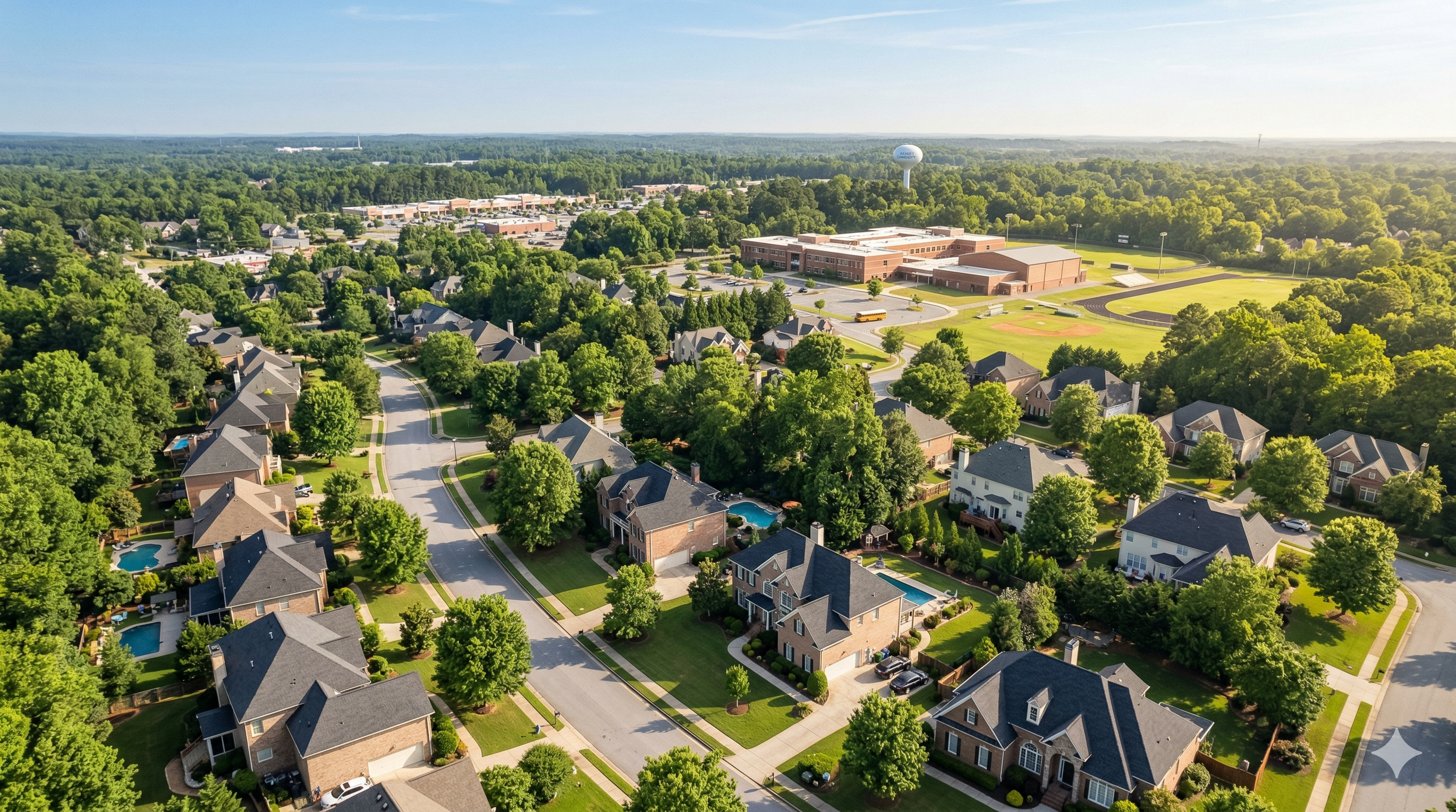
School district rankings are one of the most searched factors in Metro Atlanta real estate — and one of the most misunderstood. Buyers relocating from out of state often come in with a list of suburb names they've pulled from a ranking website, but they don't know what those rankings actually measure, what they don't capture, or what it costs to buy into a given district's attendance zone. And the gap between the name on the list and the reality on the ground is significant.
I work with buyers across Metro Atlanta — first-time buyers, corporate relocation buyers, move-up buyers — and school district questions come up in nearly every conversation where a buyer has a child. The question is almost never "where are the best schools in Atlanta?" The real questions are: "What does buying into that district actually cost? What does the school attendance zone look like? What do I actually get, and what am I giving up in terms of location, commute, and price?" Those are the questions worth answering.
Nearly a decade helping Atlanta buyers means I've seen what happens when people chase a ranking without understanding the full picture. They overpay, they land somewhere that doesn't fit their commute, or they buy into a zone thinking they've secured access to a specific school and later find out that zoning is more complicated than a district name suggests.
Here's what you need to know.
How School Rankings Actually Work — and What They Don't Tell You
Before we get into the specific suburbs, let's talk about the ranking systems buyers rely on, because they measure what they measure — and leave out quite a bit.
Niche.com's 2026 Best School Districts rankings are based on an analysis of data from the U.S. Department of Education, along with test scores, graduation rates, college readiness metrics, teacher quality ratings, and reviews from students and parents. Academics carry 50% of the weight, followed by teacher quality at 20%, district-wide performance at 15%, culture and diversity at 10%, and parent and student surveys at 5%.
U.S. News & World Report's high school rankings emphasize graduation rates, state test scores, and a college readiness index — which is heavily weighted toward AP course participation and performance. Schools with large Advanced Placement offerings tend to rank well on U.S. News almost by design.
GreatSchools uses a rating out of 10 that factors in test scores, student progress, and equity — meaning how well the school serves students across different groups, not just top performers.
What none of these rankings tell you: what the school is like for your child, specifically. They don't tell you about a particular teacher's classroom, the culture of a specific campus, the availability of particular programs, how a school handles learning differences, or whether the philosophy matches what your family values. A school rated 9/10 may or may not be the right fit.
The other thing rankings don't tell you: zoning. A suburb's district ranking is a county-level or district-level number. Within that district, individual schools vary. Not every neighborhood in East Cobb sends to Walton High School. Not every address in Forsyth County is zoned for South Forsyth. The specific property address determines the specific school assignment — and in a large district, that distinction matters a lot.
I tell every buyer the same thing: research and visit schools to determine fit for your family. Always verify zoning by specific property address before you make a purchase decision.
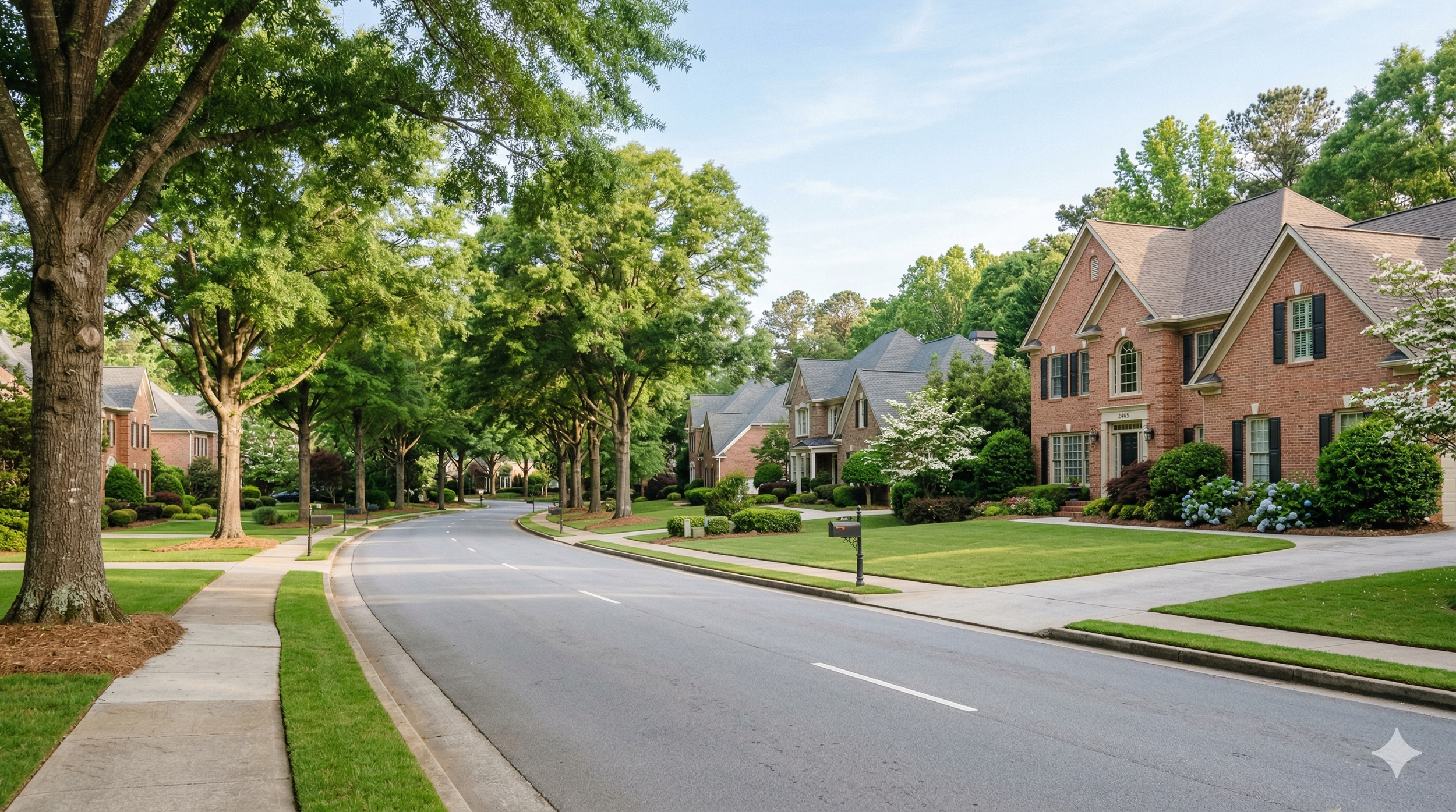
The Five Suburbs That Consistently Appear in Metro Atlanta School Rankings
These are the suburbs that show up most consistently at the top of Metro Atlanta school district rankings — along with honest data on what buying there actually costs and what you're trading off.
East Cobb, GA — Cobb County School District
East Cobb is the suburb people mean when they talk about Cobb County schools. Specifically, they mean Walton, Pope, and Lassiter High Schools, which have driven residential demand here for decades and are the primary driver of corporate relocation buyer interest in this part of the county.
Let me be clear about something first: East Cobb is not a city. It's not an incorporated municipality. It's a large unincorporated community of over 164,000 people spread across a substantial portion of Cobb County, and the experience of living there varies considerably depending on which part of East Cobb you're in — because different parts of East Cobb are zoned to different high schools.
School Data (Cobb County School District, 2025-26):
The Cobb County School District serves more than 112,000 students across 16 traditional high schools. For the 2025-26 school year, Cobb County public high schools have an average math proficiency of 44% and reading proficiency of 53% — both above the Georgia state averages of 35% and 42%, respectively. The district graduation rate is 87%, above the state average of 85%.
Within East Cobb specifically:
Walton High School — 2 Pinetree Drive, Marietta, GA 30062. Grades 9-12. Enrollment: approximately 2,685. Student-teacher ratio: 19:1. Ranked #1 in Cobb County and among the top 5 in Georgia by Niche for 2026. Ranked #4 in Georgia by U.S. News. Lassiter High School graduation rate: 98% (highest in Cobb County per Public School Review). AP participation rate above 70%.
Lassiter High School — 2601 Shallowford Road, Marietta, GA 30066. Grades 9-12. Enrollment: approximately 1,949. Student-teacher ratio: 18:1. Ranked #2 in Cobb County by Niche for 2026. Ranked #10-13 in Georgia by U.S. News in recent cycles. Known for a performing arts program recognized statewide, including award-winning band and theater.
Pope High School — 3001 Hembree Road, Marietta, GA 30062. Grades 9-12. Enrollment: approximately 1,800. Ranked in the top 25 high schools in Georgia by U.S. News. College preparatory course offerings are extensive, with AP and honors tracks available across subject areas.
Middle school feeder patterns matter here. Dodgen Middle School (1725 Bill Murdock Road) feeds to Pope (approximately 33%) and Walton (approximately 67%). Hightower Trail Middle School (3905 Post Oak Tritt Road) feeds to Pope. Mabry Middle School (2700 Jims Road) feeds to Lassiter. Simpson Middle School (3340 Trickum Road) feeds to Lassiter (approximately 60%) and Sprayberry (approximately 40%).
All 16 of Cobb County's traditional high schools have been named AP Honor Schools by the Georgia Department of Education.
Research and visit schools to determine fit for your family. Always verify zoning by specific property address.
Market Data:
The East Cobb real estate market is one of the most stable in Metro Atlanta. Median home prices across the East Cobb area generally range from $500,000 to $700,000, depending on which school zone, which side of Johnson Ferry Road or Roswell Road, and what vintage of construction. Entry-level homes in the area start around $375,000-$400,000 for smaller ranch-style or older construction, while larger homes in established neighborhoods like Sentinel Post, Woodlawn Hills, or Paper Mill Village run $600,000-$900,000+. New construction in East Cobb is limited — this is a mature market. Inventory is tighter in the Walton zone than in portions of the Pope and Lassiter zones.
Days on market have increased modestly compared to peak-market conditions, consistent with the broader Metro Atlanta recalibration through 2025. Buyers have more breathing room than they did in 2022, but well-priced homes in strong school zones still generate competitive offers.
Commute:
East Cobb sits northwest of the city, and commute times to Downtown and Midtown are honest — 35 to 55 minutes in morning rush hour depending on how far north you are and whether I-75 is moving. The closer you are to the Powers Ferry Road and Windy Hill Road corridors, the better the access. The further north toward Canton Road, the longer the drive. The Battery at Truist Park is 10-20 minutes, which matters for people working in the Cobb County employment corridor along I-285. MARTA doesn't serve East Cobb, so if you're a transit commuter, this isn't your suburb.
What You're Getting:
Established neighborhoods, mature tree canopy, good road infrastructure, proximity to The Battery and Truist Park, East Cobb Park, Roswell Road's restaurant corridor, and the Johnson Ferry and Sandy Plains commercial areas. Powers Ferry Road provides corridor access to Sandy Springs and Buckhead without going through the city.
What You're Trading Off:
Longer commutes to the city than intown options. Car-dependent living — there is no walkable urban core in most of East Cobb. And a price premium that reflects the school demand; you are paying for school zone access, and that cost is baked into the asking price.
Buford, GA — Buford City Schools
Buford is in a category by itself, and I want to be direct about why. Buford City Schools has been named the No. 1 school district in Georgia by Niche for eleven consecutive years as of 2026. Eleven years. That's not a flash ranking — that's a documented, sustained data track record.
The district is small by design: approximately 6,100 students across five campuses. Buford Elementary, Buford Academy, Buford Senior Academy, Buford Middle School, and Buford High School. It is a city school district — meaning it operates independently from Gwinnett County Public Schools and serves only students who live within the City of Buford's boundaries. This is important. If you buy in Gwinnett County outside the City of Buford limits, your children are zoned to Gwinnett County Public Schools, not Buford City Schools. The property has to be within city limits.
School Data (Buford City Schools, 2025-26):
Niche 2026 ratings: A+ in academics, teachers, administration, college prep, sports, and facilities. Average student-teacher ratio of 18:1. State test scores show 70% of students at or above proficiency in math (versus Georgia's 39% average) and 65% at or above proficiency in reading (versus Georgia's 40% average). Graduation rate: 93%.
Buford High School: approximately 1,923 students, student-teacher ratio 17:1. Ranked among the top public high schools in Georgia by U.S. News and Niche. Buford Academy (middle school): highly rated across all metrics. The district's average testing rank is in the top 5% of Georgia's 222 school districts.
Research and visit schools to determine fit for your family. Always verify zoning by specific property address — the city limits boundary is precise and determinative here.
Market Data:
Buford's housing market spans a wide range because the city itself spans a wide range of neighborhoods and construction vintages. The broader Buford area (including portions outside city limits served by Gwinnett County schools) shows listings ranging from the mid-$300,000s for townhomes and smaller single-family homes to $700,000+ for larger homes in newer subdivisions near Lake Lanier. Homes specifically within Buford City Schools boundaries and in good condition tend to carry a price premium reflecting the district's ranking.
Per our published guide on Buford, median prices in the Buford market area have run approximately $400,000-$650,000, with newer construction pushing toward the upper end of that range. Verify current numbers with me — this market has moved.
Days on market have extended in Gwinnett County broadly through late 2025, reflecting the countywide inventory increase and rate environment. Within Buford city limits, well-priced homes with school zone clarity move faster.
Commute:
Buford sits at the I-985/I-85 interchange, about 35 miles northeast of Downtown Atlanta. Rush-hour commute to Midtown: 50 to 70 minutes on a normal day, longer during heavy traffic. This is a real number and it matters — Buford is not for someone who needs to be in the city daily without tolerance for a significant commute. The commute to Gwinnett's own employment corridor along Highway 316 and Peachtree Industrial Boulevard is much shorter. Lake Lanier access and the Mall of Georgia retail corridor are essentially in your backyard.
What You're Getting:
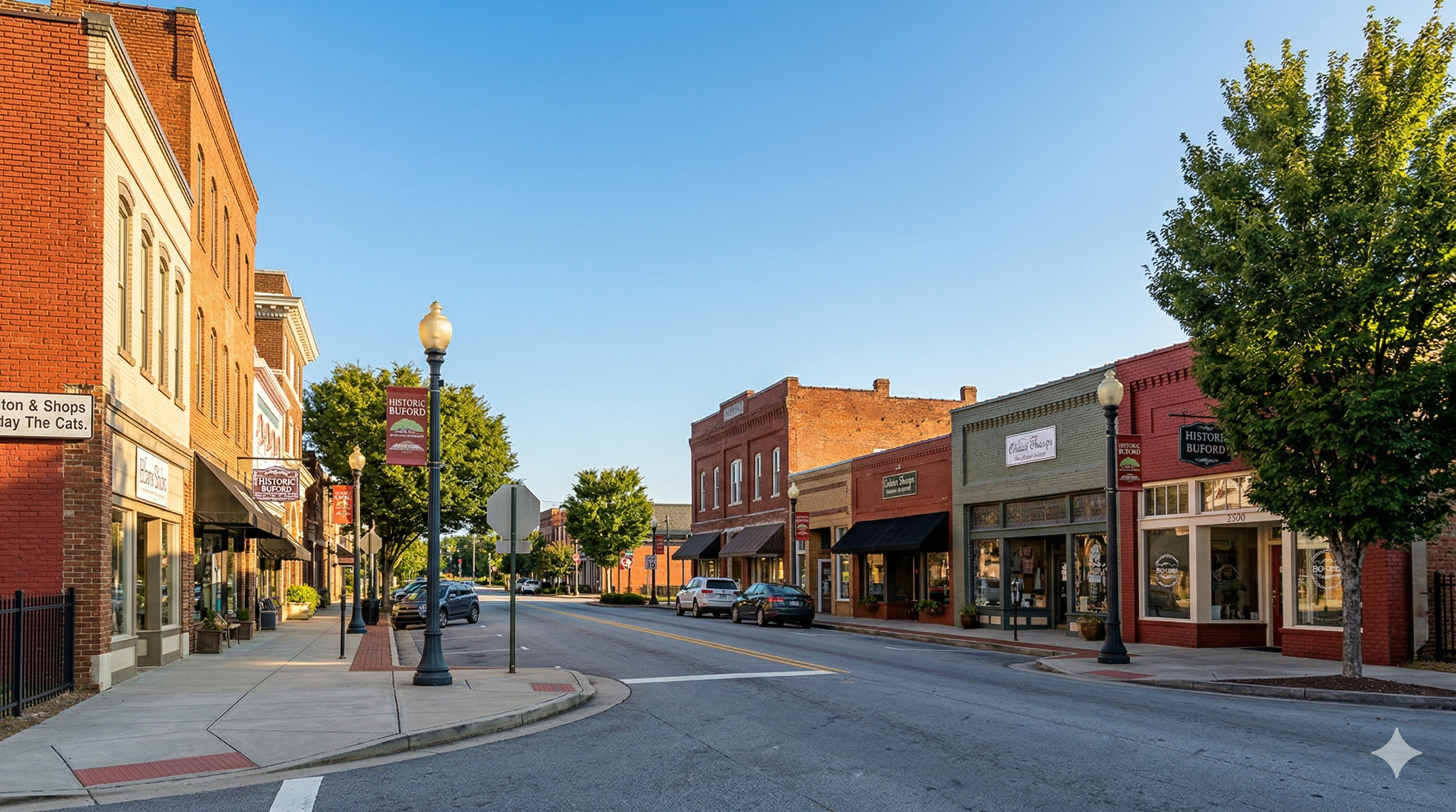
A small-city feel with a downtown that has been meaningfully developed over the past decade. The school district ranking is the headline, but the city also offers lower Gwinnett County taxes, proximity to Lake Lanier (boating, water recreation), and newer housing stock in many neighborhoods. Main Street in downtown Buford has locally owned restaurants and a community-oriented environment.
What You're Trading Off:
Distance from the city. If your work or social life centers on Midtown, Buckhead, or intown Atlanta, Buford requires a real commitment to the commute. There is no MARTA access. And the school district boundaries are an exact science — an address one block outside city limits changes the district entirely.
Forsyth County, GA — Forsyth County Schools
Forsyth County Schools ranked No. 2 in Metro Atlanta on Niche's 2026 Best School Districts list, with A+ grades in academics and college prep, and A grades for teachers and administration. The district serves approximately 54,984 students across 42 schools.
Forsyth County sits north of Cherokee County and Lake Lanier, with Cumming as the county seat and primary commercial hub. It is one of the fastest-growing counties in Georgia, and the housing market reflects that — newer construction dominates, lots tend to run larger than intown options, and HOA communities with amenity packages are common.
School Data (Forsyth County Schools, 2025-26):
Niche 2026: A+ in academics and college prep. A grades for teachers and administration. Student-teacher ratio: 19:1. State test scores: 67% of students at or above proficiency in math; 63% at or above proficiency in reading. Both figures are above the Georgia state averages of 39% and 40%, respectively.
Notable high schools in the district include:
South Forsyth High School — 585 Peachtree Parkway, Cumming, GA 30041. Grades 9-12. Enrollment approximately 2,508. Student-teacher ratio: 19:1. Consistently ranked among the top high schools in Georgia. Recognized nationally for academic performance.
Lambert High School — 805 Nichols Road, Suwanee, GA 30024. Grades 9-12. Enrollment approximately 3,000+. Ranked among the top high schools in Georgia. Located in the southern portion of Forsyth County near the Gwinnett County line.
Alliance Academy for Innovation — Grades 6-12. A STEM-focused school within Forsyth County Schools, recognized by Niche as one of the top specialty high schools in Georgia. Student-teacher ratio: 18:1. Approximately 1,141 students.
North Forsyth High School — 3635 Coal Mountain Drive, Cumming, GA 30028. Grades 9-12. Serves the northern portion of the county.
The Forsyth County Schools magnet and specialty program options give buyers additional choices beyond their neighborhood's zoned school. Research the specific programs and application processes directly with the district.
Research and visit schools to determine fit for your family. Always verify zoning by specific property address.
Market Data:
Forsyth County median sale prices sat around $600,000 in late 2025, with some softening — Redfin data shows a 4% year-over-year decrease in December 2025. Zillow's county-level data shows typical home values around $561,000-$580,000 depending on the time of measurement. The current median listing price is approximately $670,000, reflecting the newer and larger housing stock in the county.
The Forsyth County market has seen inventory increase meaningfully — up more than 26% year-over-year in some analyses — which gives buyers more options and more negotiating room than in prior years. Days on market have extended, with homes taking 60-90 days in many parts of the county versus the 20-30 day pace of 2022-2023. This is a genuine buyer's window in a market that was previously extremely competitive.
Price range by geography: southern Forsyth near Lambert High School and the Halcyon mixed-use development tends to run $450,000-$700,000 for typical single-family. Central Forsyth around the 400 corridor and Cumming's growing downtown district runs $400,000-$650,000 for established neighborhoods. Northern Forsyth has entry-level options starting in the $300,000s, with the tradeoff being a longer commute to everything.
Commute:
Forsyth County is served by GA-400, which runs directly south toward Buckhead, Midtown, and Downtown Atlanta. Off-peak, the drive from central Cumming to Midtown takes about 40 minutes. During morning rush hour (7-9 AM), budget 55 to 75 minutes. The GA-400 Express Lanes have improved predictability for toll commuters, but volume is consistently high on 400 during peak hours. There is Xpress Bus service from the Cumming/Forsyth County area to Midtown, which some commuters use, but it requires planning around schedules.
What You're Getting:
New and newer housing stock. Large lots available. Strong HOA communities with pools, tennis, and playground infrastructure. Proximity to Lake Lanier's northern shores. A downtown Cumming that has developed meaningfully with local and regional dining, breweries, and The Cumming Fairgrounds. Halcyon, a mixed-use development in southern Forsyth, brings a walkable retail and dining environment that didn't exist five years ago. Lower property taxes than Fulton County.
What You're Trading Off:
Distance from the city. Forsyth County is suburban living at full commitment — there's no urban core, no MARTA, and limited walkability outside of specific mixed-use developments. If you value proximity to intown Atlanta's culture, restaurant scene, or nightlife, Forsyth will feel far. For someone whose life is structured around the suburb — school, work in Alpharetta or the Ga-400 corridor, weekend activities in the county — it works very well.
Johns Creek, GA — Fulton County Schools
Johns Creek is a city in North Fulton County, incorporated in 2006, and it consistently ranks at or near the top of Metro Atlanta suburbs for school performance. Niche ranks it #4 among Atlanta-area suburbs with the best public schools for 2026, with an A+ overall grade. Niche has also previously named Johns Creek one of the best cities to live in across the United States.
The city is served by Fulton County Schools, with several schools within Johns Creek's boundaries that have sustained high rankings. The specific attendance zones within Johns Creek matter — not every address in the city is zoned to the same schools.
School Data (Fulton County Schools / Johns Creek area, 2025-26):
Johns Creek High School — 5575 State Bridge Road, Johns Creek, GA 30022. Grades 9-12. Enrollment approximately 1,859. Student-teacher ratio: 19:1. Ranked among the top public high schools in Georgia by Niche and U.S. News.
Northview High School — 10625 Parsons Road, Johns Creek, GA 30097. Grades 9-12. Consistently ranked among the top 5 public high schools in Georgia by U.S. News. One of the most academically competitive high schools in the state based on test scores and AP participation.
Chattahoochee High School — 5230 Taylor Road, Johns Creek, GA 30022. Grades 9-12. Also highly ranked within Fulton County Schools. Part of the Fulton County Schools system serving the Johns Creek area.
The Fulton County Schools district serves the Johns Creek area alongside other North Fulton cities including Alpharetta and Milton. Each city has distinct attendance zones, and some neighborhoods are zoned to schools in adjacent cities.
Research and visit schools to determine fit for your family. Always verify zoning by specific property address.
Market Data:
Johns Creek is the most expensive suburb in this guide. Median home prices in early 2025 were approximately $708,000, up 6.3% year-over-year per Rocket Homes data. The market runs from around $450,000 for townhomes and smaller single-family homes to well over $1 million for custom construction in established neighborhoods near the Chattahoochee River or in the city's northern precincts.
Johns Creek's inventory has remained tighter than some Forsyth County and East Cobb submarkets, which has kept prices more stable. Homes in strong attendance zones and good condition still move competitively. Days on market have increased from the peak, but well-priced homes in Northview's zone in particular see continued demand.
Commute:
Johns Creek sits in the northeast corner of Fulton County, bordered by Gwinnett County to the east and the Chattahoochee River to the south and west. Access to the city core of Atlanta requires either SR-141 (Peachtree Parkway) south through Duluth, or various routes through Alpharetta to GA-400. Rush-hour commute to Midtown: 45 to 65 minutes depending on route and conditions. Commute to the Alpharetta tech corridor along the GA-400 exchange: 20-35 minutes. There is no MARTA service in Johns Creek.
The city has prioritized trails and parks — the Autrey Mill Nature Preserve, the Newtown Park complex, and the IronHill Disc Golf Course are within city limits — but Johns Creek is car-dependent for daily errands and commuting.
What You're Getting:
Established, well-maintained neighborhoods. Strong city governance and a focus on public amenities. Access to Chattahoochee River recreation. Close proximity to Alpharetta's tech employment corridor and the Avalon development. Lower Fulton County tax rates relative to the city of Atlanta (though Fulton County outside the city does carry a different tax structure than counties like Cobb or Forsyth). Newer commercial development along State Bridge Road and Medlock Bridge Road.
What You're Trading Off:
Price. Johns Creek is one of the most expensive places to buy in Metro Atlanta. The entry point is higher here than in Forsyth County or East Cobb, and the price reflects both the school performance data and the city's overall quality of life metrics. If you're working with a tighter budget, you may find more home for the money in Forsyth or East Cobb while still being in strong district territory.
Peachtree City, GA — Fayette County Schools
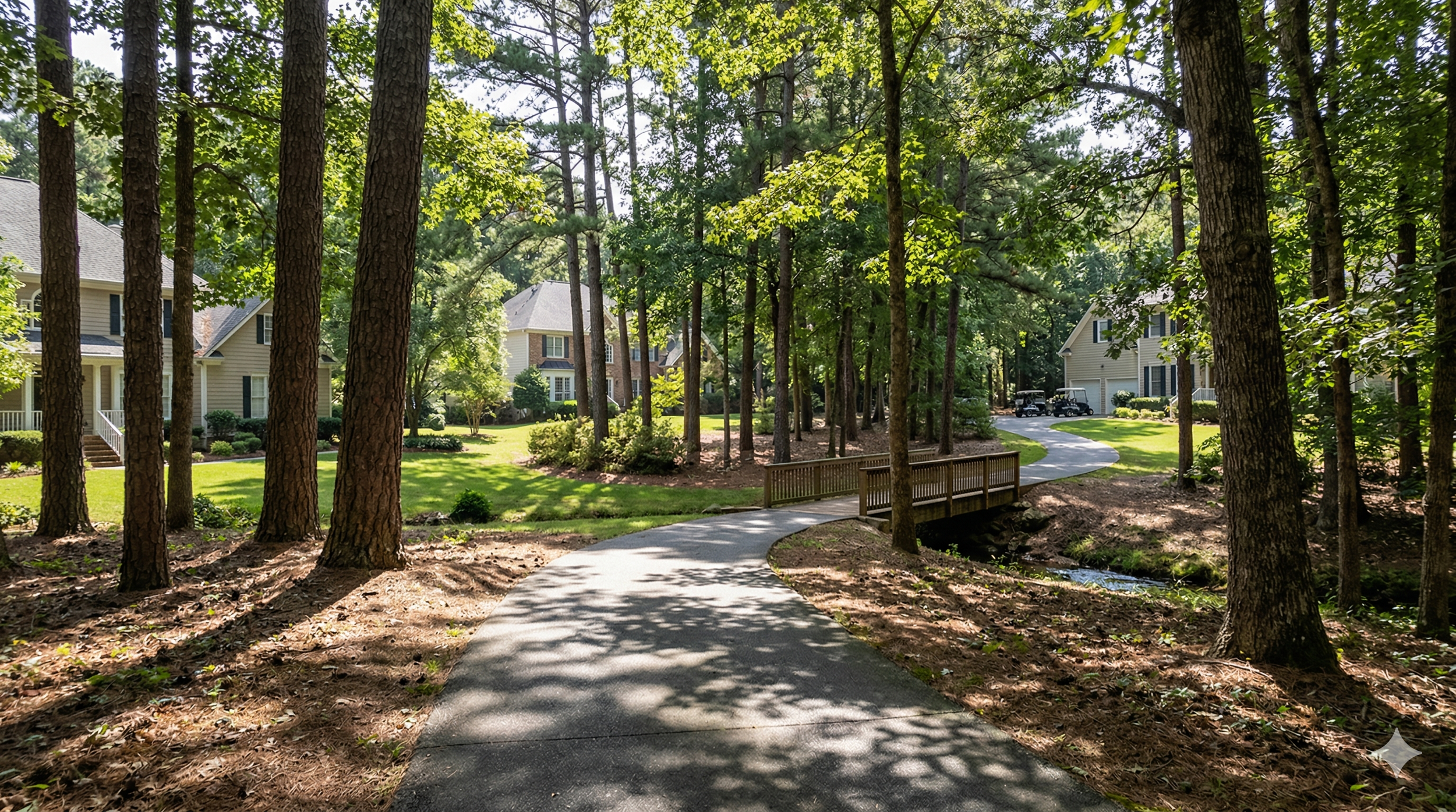
Peachtree City is a different kind of suburb — and I mean that literally. It's a planned community built around an interconnected golf cart path system that now spans over 100 miles, connecting neighborhoods to shopping, schools, parks, and restaurants without ever having to get on a road. It's not a marketing line. It's the actual infrastructure of the city.
Fayette County Schools ranked No. 3 in Metro Atlanta on Niche's 2026 Best School Districts list, with an A grade overall and specific recognition for academics, diversity, college prep, and extracurricular activities. The district serves approximately 19,869 students across 24 schools with a student-teacher ratio of 16:1.
School Data (Fayette County Schools / Peachtree City area, 2025-26):
State test scores: 59% of students at or above proficiency in math; 62% at or above proficiency in reading. Both above Georgia state averages. Graduation rate consistently above the state average.
McIntosh High School — 201 Walt Banks Road, Peachtree City, GA 30269. Grades 9-12. One of the most recognized high schools in Fayette County, with strong AP program participation and consistent Niche ratings. Described by Niche as one of the best schools in the Peachtree City area.
Starr's Mill High School — 68 Panther Path, Tyrone/Fayette County area. Grades 9-12. Consistently ranked among the top high schools in Fayette County and among the best in Georgia by multiple sources. Niche has named both McIntosh and Starr's Mill among the best schools in the area.
J.C. Booth Middle School — Serves a portion of Peachtree City. Feeds to high schools based on attendance zone.
Elementary schools in Peachtree City include Braelinn Elementary, Kedron Elementary, Oak Grove Elementary, and Crabapple Lane Elementary, among others. Fayette County Schools also has nine elementary schools and five middle schools serving the county.
Research and visit schools to determine fit for your family. Always verify zoning by specific property address.
Market Data:
Peachtree City sits south of Atlanta — about 30 miles from Downtown via I-85/US-19. Median home prices have ranged from approximately $555,000-$610,000 in recent data, with Redfin showing $590,000 as of early 2026 (down modestly from prior year). Zillow has shown average home values around $559,000. The market runs from around $300,000 for smaller homes and condos to well over $1 million for lakefront properties on Lake Kedron or Lake McIntosh.
Peachtree City's market has slowed from peak conditions — homes are taking longer to sell (65-70 days on average in early 2026 data), and a meaningful portion are selling under asking price. This represents a real buyer's opportunity compared to the ultra-competitive conditions of 2022-2023.
The city has more than 40 parks, green spaces, and recreation centers, including Drake Field on Peachtree Lake, and the Flat Creek Country Club, Planterra Club, and Braelinn Golf Club for members.
Commute:
This is where buyers have to be honest with themselves. Peachtree City is approximately 30 miles south of Downtown Atlanta via I-85 to US-19/GA-74. Off-peak, that's 35-45 minutes. During morning rush hour, 50-70 minutes is realistic, and on bad traffic days it can be longer. The I-85 southside corridor serves this area and can be unpredictable.
Peachtree City is also adjacent to Hartsfield-Jackson Atlanta International Airport — roughly 15-20 miles north — which is one of its genuine advantages for frequent business travelers. If you fly often, Peachtree City is one of the more airport-convenient suburbs in the entire metro.
What You're Getting:
A true planned community with 100+ miles of multi-use cart paths connecting the entire city. Golf cart culture is real and functional — residents use carts for school, errands, and recreation. The Gathering Place amphitheater at Kedron Pavilion hosts concerts and community events. The Avenue at Peachtree City is the primary retail and dining corridor. If you want suburban living with community infrastructure that's genuinely different from a standard subdivision, Peachtree City has a built environment unlike anywhere else in Metro Atlanta.
What You're Trading Off:
Distance. Peachtree City is the furthest from the city of any suburb in this guide. If your work or social life is centered on Atlanta, you need to be at peace with that commute. The city is also more car-dependent for access to Atlanta's broader cultural and employment base, even with the cart path network handling local transportation. New construction options in Peachtree City are limited; most of what's available is resale in established neighborhoods.
Side-by-Side Comparison: What to Expect by Suburb
The table below uses confirmed data from Niche 2026, Redfin, Zillow, and Public School Review as of early 2026. Verify all figures with current sources before making a purchase decision.
| Suburb / District | Niche 2026 Grade | Approx. Median Price | Rush-Hour Commute to Midtown | MARTA Access |
|---|---|---|---|---|
| East Cobb (Cobb County Schools) | A+ | $500K–$700K | 35–55 min | No |
| Buford (Buford City Schools) | A+ (#1 in GA) | $400K–$650K | 50–70 min | No |
| Forsyth County (Forsyth County Schools) | A+ (#2 in Metro ATL) | $500K–$670K | 55–75 min | No (Xpress Bus) |
| Johns Creek (Fulton County Schools) | A+ | $450K–$900K+ | 45–65 min | No |
| Peachtree City (Fayette County Schools) | A (#3 in Metro ATL) | $350K–$700K+ | 50–70 min | No |
The Things Buyers Get Wrong Most Often
Assuming the district name guarantees a specific school. A large district like Cobb County Schools or Forsyth County Schools has dozens of schools with varying attendance zones. The only thing that determines your child's school assignment is the specific property address. I've worked with buyers who purchased in East Cobb assuming Walton zoning and later discovered their address fed to a different high school. Verify before you close.
Treating the Zillow "school rating" as authoritative. Zillow aggregates school data, but its display doesn't always reflect current attendance zones, current school assignments, or the most recent performance data. Use the specific school district's address lookup tool, and then cross-reference with GreatSchools, Niche, and U.S. News for multiple data points.
Ignoring the commute until after they're under contract. I ask buyers to drive their prospective commute at rush hour before they get serious about a neighborhood. A 38-minute Google Maps time at 11 AM on a Saturday is not the same as the 65-minute drive they'll make at 7:45 AM Monday through Friday. Drive the route. Do it at the actual time. Then decide.
Equating price with district quality. Johns Creek is more expensive than Buford, but Buford City Schools has ranked higher than Fulton County Schools overall for eleven consecutive years. Price reflects many factors, and school district ranking is only one of them. The most expensive suburb is not always the highest-performing district.
Forgetting about charter and magnet options. Several of the districts covered here have specialized programs — Alliance Academy for Innovation in Forsyth, gifted programs at various schools, dual enrollment options — that exist alongside zoned neighborhood schools. If your child has specific academic interests or needs, investigate what the district offers beyond the standard school assignment.
What This Means for Your Home Search
Here's what I tell buyers who come to me with school district rankings in hand: the ranking is a starting point, not a destination. Once you've identified the districts you want to research, the real work begins — understanding the specific attendance zones within that district, the individual schools your target neighborhoods are zoned to, and how the school assignment picture interacts with the price range you're working with.
And here's the practical reality: in every one of these suburbs, demand is shaped significantly by school zone access. That demand is priced into the market. Buying in a high-ranking attendance zone costs more than buying in an adjacent area zoned to a different school. That premium can be worth it. It can also be overstated. The right answer depends on your specific situation — your price ceiling, your commute tolerance, what your child actually needs from a school environment, and whether you'd pay an extra $80,000-$100,000 for a specific school assignment versus finding value slightly outside that zone.
I work with buyers across all five of these areas. I know the attendance zones, the specific streets where the zone boundaries fall, and what the price differences look like in real time. If you want to talk through where your search actually makes sense given your priorities, that's the conversation worth having.
Frequently Asked Questions
What is the highest-ranked school district in Metro Atlanta in 2026? Buford City Schools has ranked No. 1 in Georgia on Niche's Best School Districts list for eleven consecutive years as of 2026, earning A+ grades in academics, teachers, administration, college prep, sports, and facilities. State test scores show 70% of Buford students at or above proficiency in math and 65% in reading — both significantly above Georgia's state averages.
How do I find out which school my child would attend at a specific address? Every school district covered in this post has an address-based school locator on their official website. Use those tools. Cobb County Schools: cobbk12.org. Buford City Schools: bufordcityschools.org. Forsyth County Schools: forsyth.k12.ga.us. Fulton County Schools: fultonschools.org. Fayette County Schools: fcboe.org. Do not rely on Zillow, third-party real estate sites, or neighborhood descriptions to determine school assignment — the only authoritative answer is the district's own zoning lookup tool, verified by address.
Does buying in an area with a highly ranked district guarantee my child will attend the best schools in that district? No. Large districts have multiple high schools and middle schools with different attendance zones. Within Cobb County Schools, for example, different parts of East Cobb send to Walton, Lassiter, Pope, Wheeler, Sprayberry, or Kell — depending on the specific address. Research the individual school assignment, not just the district.
What is the price difference between these suburbs? Johns Creek is generally the most expensive, with median prices around $700,000+. East Cobb, Forsyth County, and Peachtree City cluster in the $500,000-$650,000 range at the median. Buford offers the widest range, with options from the mid-$300,000s to $700,000+ depending on whether the address is within Buford City Schools boundaries and what the construction vintage looks like. All figures are approximate and change with market conditions — contact me for current numbers.
Which of these suburbs has the shortest commute to Downtown Atlanta? East Cobb is closest in commute time to Downtown and Midtown, roughly 35-55 minutes during morning rush, depending on which part of East Cobb. Johns Creek is next at 45-65 minutes. Buford and Peachtree City typically run 50-70 minutes during rush hour, with Forsyth County ranging from 55-75 minutes. None of these suburbs has MARTA access, so all commutes are car-dependent.
Is Peachtree City actually different from other Atlanta suburbs? Yes, in a specific and meaningful way: the city has over 100 miles of multi-use cart paths that function as an alternative transportation network connecting neighborhoods to schools, shopping, parks, and restaurants. Golf carts are registered vehicles in Peachtree City and used daily for local trips. This is a genuine infrastructure feature, not a marketing concept. It's most useful for local movement within the city; commuting to Atlanta still requires a car on I-85.
Do school district rankings account for charter or magnet options? Rankings typically reflect the overall district rather than individual specialty or magnet schools within it. Several districts covered here have notable specialty programs — Alliance Academy for Innovation in Forsyth County is one example, with a STEM focus and separate admissions process. These options exist alongside zoned neighborhood schools and require separate research and often an application process. Ask the specific district's enrollment office about specialty program options and eligibility.
Are school districts the only factor that affects property values in these suburbs? No. School district ranking is one driver of demand and pricing, but commute access, infrastructure, employment proximity, overall quality of life, new development, and HOA structures all factor in. In some of these areas — Forsyth County especially — rising inventory and softening prices are creating opportunities for buyers even as the school rankings remain strong. The market is not static.
Can I buy just outside a school district's boundaries to get a lower price? Sometimes, but the tradeoff is real. If you buy one street outside Buford City Schools' boundary, you're in Gwinnett County Public Schools, which is a different district with different schools. In East Cobb, buying in a neighborhood that feeds to Wheeler rather than Walton may save you $50,000-$80,000 — whether that tradeoff is worth it depends on your specific priorities. These are exactly the conversations I help buyers work through.
How often do school attendance zones change? District-wide rezoning happens periodically and can shift attendance zones without notice to homeowners. Forsyth County and other fast-growing districts have undergone rezoning as new schools open to accommodate population growth. If you are buying with school zone assignment as a primary factor, research whether the district has upcoming rezoning plans and build that into your decision.
What should I do if I have questions about a specific school, not just rankings? Contact the school directly. Visit the campus. Talk to parents in the neighborhood. Attend a school board meeting if major decisions are pending. Rankings give you a data baseline; direct observation tells you whether a school is a fit for your child. Research and visit schools to determine fit for your family.
I work with buyers throughout Metro Atlanta navigating exactly this — the gap between what ranking lists show and what buying into a specific district and school zone actually looks like. If you're at the early stage of figuring out which suburb makes sense, or if you're further along and need to understand exactly what your budget buys in a specific attendance zone, let's talk.
Visit kristenjohnsonrealestate.com or reach out directly.
Come as you are, come on home.
Looking for neighborhood-level guides to some of these areas? I've covered East Cobb, Buford, Marietta, Smyrna, and Vinings in depth. Browse the full guide series at kristenjohnsonrealestate.com.