

House Hacking Atlanta GA: Multi-Family, ADU & FHA Strategies to Buy With 3.5% Down in 2026
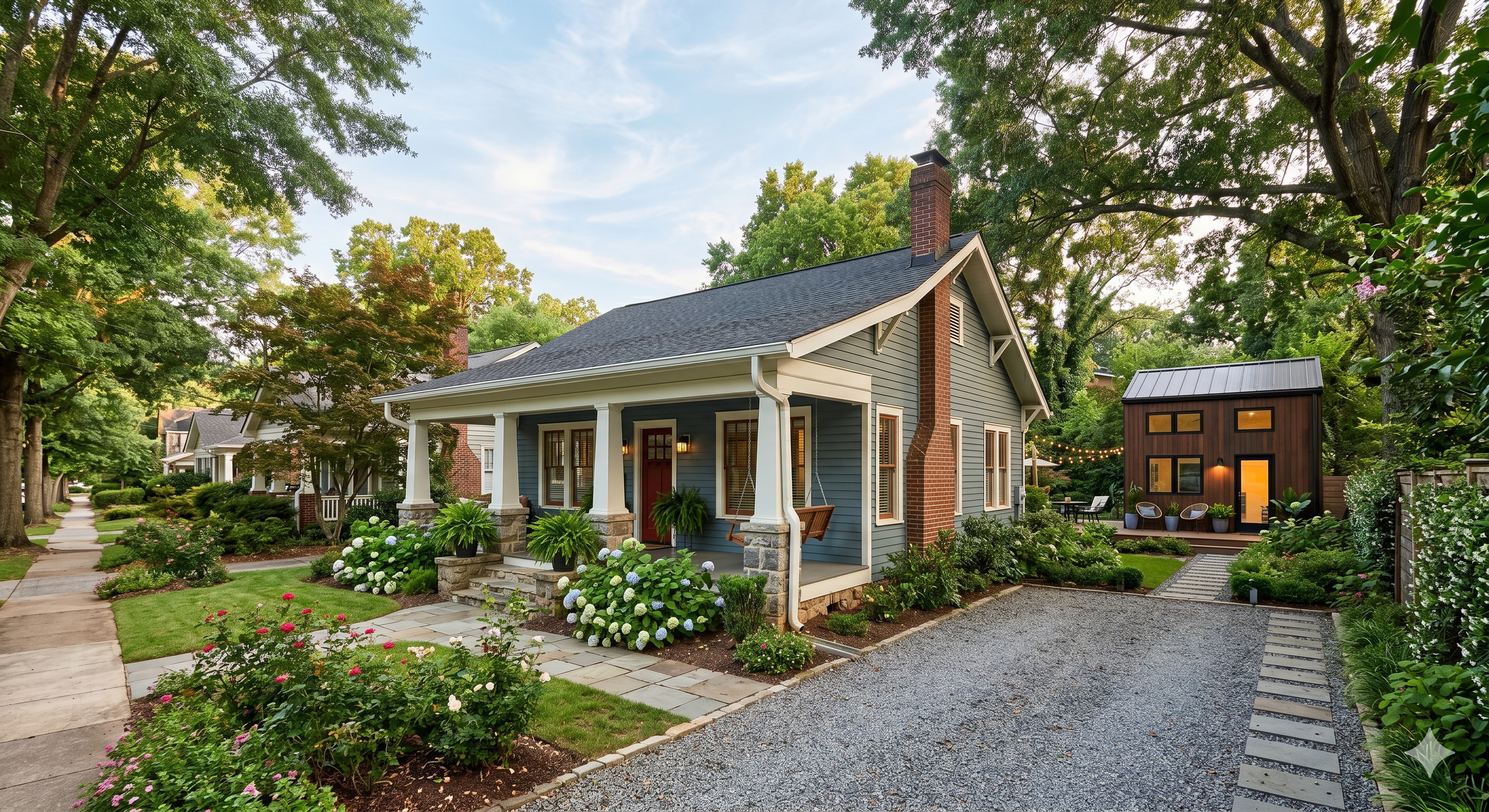
If you're trying to buy your first home in Metro Atlanta and the math isn't working, this is the strategy I want you to understand before you give up. House hacking — buying a property where the rent from another unit covers most of your mortgage — is the single most underused path into Atlanta homeownership for buyers between $400K and $700K. I'm not talking about a theoretical investor strategy. I'm talking about a 3.5% down FHA loan on a duplex in Reynoldstown, a single-family home with a basement apartment in Kirkwood, or a primary residence with a detached ADU in Edgewood that rents for $1,500 a month while you live in the main house.
I work with first-time buyers across Metro Atlanta, and the conversation has shifted hard over the last 18 months. With median rent in the city sitting around $1,773, a one-bedroom in a desirable intown neighborhood pushing past $2,000, and home prices well above what most first-time buyers thought they could afford, house hacking is no longer a niche move. For some buyers, it's the only path that pencils out.
Nearly a decade helping Atlanta buyers means I've worked with people who used this strategy to buy homes they otherwise couldn't have touched, and I've watched a few make significant mistakes that cost them money. The strategy works. The execution matters.
Here's what you need to know.
What House Hacking Actually Means in Metro Atlanta
House hacking is owner-occupied real estate investing. You buy a property as your primary residence, you live in it, and you rent out part of it to offset your mortgage. The key word is primary. You're not an investor in the eyes of your lender, which is why this strategy works financially. You qualify for owner-occupant loan programs with low down payments and the lowest available interest rates, which are dramatically better than what investors get.
In Metro Atlanta, house hacking takes four common forms.
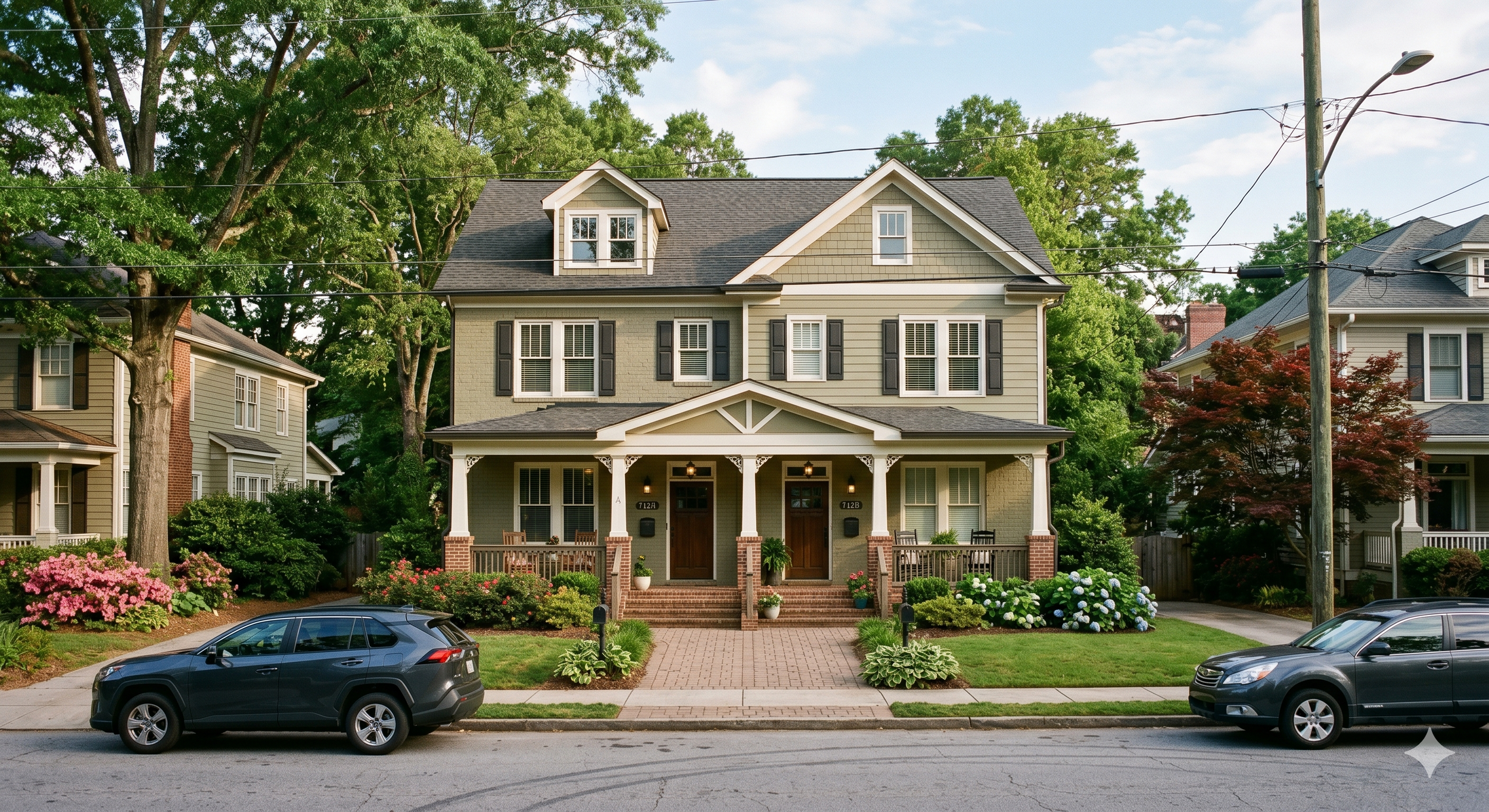
Buying a 2-4 unit multi-family property. You buy a duplex, triplex, or fourplex, live in one unit, and rent the rest. This is the classic house hack and the one that produces the strongest cash flow.
Buying a single-family home with a basement apartment, in-law suite, or carriage house. You live upstairs, rent the lower unit. Atlanta has an unusual amount of housing stock that fits this profile, especially in older intown neighborhoods.
Buying a property with an existing detached ADU. Accessory dwelling units, sometimes called granny flats or backyard cottages, are increasingly common in Atlanta after the city's 2018 zoning changes made them legal in most residential zones. You live in the main house, rent the ADU.
Buying a property where you build the ADU after closing. This is the longer play. You buy a single-family home in a qualifying zone, then build a 750-square-foot ADU in the backyard. It's a bigger commitment up front, but the long-term math is often better than buying a duplex outright.
Each strategy has different financing options, different neighborhood considerations, and different risk profiles. Let me walk through what works in this market.
The FHA Multi-Family Loan: The Single Most Important Tool for Atlanta House Hackers
If you take one thing away from this post, this is it. The FHA loan program allows you to buy a 2-4 unit property as your primary residence with 3.5% down.
Read that again. On a $500,000 duplex in East Atlanta, your down payment is $17,500. Not $100,000. Not $125,000. Seventeen thousand five hundred dollars. The federal government insures the loan against default, which is why lenders accept the low down payment and offer interest rates competitive with single-family financing.
The rules are clear and enforceable.
You must occupy one of the units as your primary residence for at least 12 months. After 12 months, you can move out, rent that unit too, and keep the loan in place as an investment property. Most house hackers do exactly that — move out at month 13 and buy another house hack with another FHA loan, repeating the strategy.
You can finance up to four units. Five-plus units are commercial real estate and require a different loan entirely.
For 3-4 unit properties, the property must pass the FHA self-sufficiency test, meaning 75% of the projected rental income from all units (including the unit you'll live in, valued at market rent) must equal or exceed the full mortgage payment. This rule keeps FHA from being used to overleverage. In practice, it means triplexes and fourplexes need to actually pencil as rentals, not just look good on paper.
Lenders can use up to 75% of projected rental income from the other units to qualify you for the loan. This is a significant number. If a duplex has another unit that will rent for $1,800, the lender can count $1,350 of that toward your qualifying income. That's why house hackers can often afford properties their salary alone wouldn't qualify them for.
FHA loan limits vary by county. For Fulton, DeKalb, Cobb, Gwinnett, and most of Metro Atlanta in 2026, the limits are high enough that almost any Metro Atlanta house hack will fit comfortably under them.
| Property type | 2026 FHA loan limit (Metro Atlanta) | Down payment at 3.5% |
|---|---|---|
| Duplex (2 units) | ~$668,050 | ~$23,400 |
| Triplex (3 units) | ~$807,700 | ~$28,300 |
| Fourplex (4 units) | ~$1,003,950 | ~$35,200 |
Verify exact current limits with your lender — these adjust periodically.
The trade-off is the FHA mortgage insurance premium. You'll pay 1.75% of the loan amount upfront (usually rolled into the loan) and 0.55% annually for the life of the loan if you put less than 10% down. That MIP doesn't go away automatically. The standard play is to refinance into a conventional loan once you have 20-25% equity, which can take three to six years depending on appreciation and how aggressively you pay down principal.
Conventional vs VA: The Other Two Financing Paths
FHA isn't the only path. In late 2023, Fannie Mae and Freddie Mac changed the rules on conventional financing for owner-occupied 2-4 unit properties. Before that update, you needed 15-25% down. Now you can buy with as little as 5% down. And for veterans and active-duty service members, the VA loan remains the strongest tool of all.
Here's how the three programs compare side by side.
| Feature | FHA | Conventional | VA |
|---|---|---|---|
| Minimum down payment | 3.5% | 5% | 0% |
| Minimum credit score | 580 (500 with 10% down) | 620 (best rates 740+) | 580-620 (lender dependent) |
| Mortgage insurance | 1.75% upfront + 0.55% annual (life of loan) | PMI required, drops at 20% equity | None (one-time funding fee instead) |
| Reserve requirement | None (typically) | 6 months PITI | None |
| Self-sufficiency test | Required for 3-4 units | Not required | Not required |
| Owner occupancy | 12 months minimum | 12 months minimum | 12 months minimum |
| Best fit for | Lower credit, limited reserves, maximum leverage | Strong credit, savings cushion, long-term hold | Eligible veterans (almost always the winner) |
For house hackers with strong credit and some cash reserves, conventional 5% down is often the better long-term move because you avoid FHA's lifetime mortgage insurance. For first-time buyers with lower credit scores or limited reserves, FHA 3.5% down is the right tool. For veterans and active-duty service members, VA is almost always the winner — zero down, no mortgage insurance, and typically the lowest rates available.
I've worked with several veteran clients who house hacked their way into Metro Atlanta with no money down, and the math was substantially better than what their FHA-using friends could pull off. Run all three options with your lender. The right answer depends on your specific situation, the property, and the rate environment at the time you lock.
What Multi-Family Property Costs in Metro Atlanta in 2026
This is the part most online house hacking guides skip — the actual numbers in this specific market.
There are currently around 112 multi-family properties listed for sale in Atlanta proper, with a median listing price of $498,000. Days on market for multi-family runs around 67 days, longer than single-family. The 67-day average tells you something important: the multi-family market moves slower, which usually means more room to negotiate.
Here's the price-by-neighborhood reality for duplexes and triplexes in Metro Atlanta as of early 2026.
| Price tier | Where you'll find it | What you get |
|---|---|---|
| $300K-$450K Lower tier | Lakewood Heights, Pittsburgh, Mechanicsville, parts of West End, College Park, East Point, pockets of South Atlanta | Older shotgun duplexes, 1920s brick four-squares, smaller mid-century buildings. Strong cash flow potential, often need renovation. |
| $450K-$700K Middle tier (most active) | Reynoldstown, Cabbagetown, East Atlanta, Edgewood, Kirkwood, Old Fourth Ward, Grant Park, Capitol View, parts of Decatur | Renovated 1920s-1940s duplexes, two units of 1-2 bedrooms each. Per-unit rents $1,400-$2,200. The most active price band right now. |
| $700K-$1.2M+ Upper tier | Established intown, Buckhead-adjacent areas, turnkey investment-grade properties | Renovated triplexes and quadplexes. Strongest cash flow per dollar but FHA self-sufficiency test starts to bite. Northeast Atlanta median ~$1.2M, 112 days on market. |
The middle tier is where most successful Atlanta house hacks happen. A $550,000 duplex with two units renting for $1,800 each generates $43,200 in gross annual rent. Living in one yourself, the other unit's $1,800 rent often covers more than half your full mortgage payment.
A note on the lower tier: the opportunity is significant cash flow potential because rents in some of these neighborhoods have risen faster than purchase prices. The risk is that some properties need substantial renovation, and not every block has stabilized enough to attract reliable long-term tenants. This is where having an agent who knows the block-by-block reality matters more than the listing photos.
What's Selling vs. What's Sitting
The multi-family deals that move fastest in Atlanta right now are turnkey, fully renovated, with tenants already in place at market rents. The deals that sit are typically partially renovated, have one vacant unit that needs work, or have tenants paying below-market rents who are protected by lease terms. Both can be good buys depending on your situation, but they require different strategies.
If you can do some of the work yourself, an underpriced duplex with one rough unit can be a phenomenal house hack. You move into the rough unit, fix it up while you live there, then rent it for top dollar after 12 months when you move next door or upstairs and renovate the other side. I've seen clients do this and create $50,000-$80,000 of equity in 18-24 months.
The Best Atlanta Neighborhoods for House Hacking
Not every neighborhood has the housing stock or rental demand to make house hacking work. Here are the areas that consistently produce the right combination of inventory, rental demand, and price points.
| Neighborhood | Typical duplex price | Per-unit rent range | Why it works |
|---|---|---|---|
| Edgewood & Kirkwood | $475K-$700K | $1,500-$2,200 | Vintage duplexes and homes with basement apartments. Walking distance to MARTA, Eastside BeltLine, Pullman Yards. |
| Reynoldstown & Cabbagetown | $525K-$725K | $1,800-$2,400 | Shotgun duplexes and mill housing near BeltLine and Krog Street Market. Reynoldstown 1BR average ~$2,233 — strong rental demand signal. |
| Grant Park & East Atlanta | $500K-$675K | $1,500-$2,000 | Historic duplexes plus single-family with carriage houses. East Atlanta multi-family averages 30 days on market — fastest-moving segment in the city. |
| West End, Adair Park, Pittsburgh | $375K-$525K | $1,300-$1,750 | BeltLine Westside Trail adjacent. Pricing well below intown comparables with continued appreciation upside. |
| Decatur & East Lake | $550K-$800K (Decatur), $400K-$575K (East Lake) | $1,600-$2,300 | City of Decatur is competitive and pricier (school zones drive demand). East Lake has more inventory at lower prices with strong rental demand. |
| Smyrna & Marietta | $475K-$700K | $1,500-$2,100 | Cobb County multi-family is harder to find. Older Marietta near the Square and Smyrna along Atlanta Road. School zones (Walton, Pope, Lassiter) drive tenant quality. |
| East Point & College Park | $250K-$400K | $1,100-$1,500 | Most affordable entry points in Metro Atlanta. Solid rental demand near MARTA and Hartsfield-Jackson. Property condition varies block to block. |
BeltLine-adjacent neighborhoods consistently produce the strongest combination of appreciation and rental demand. The Memorial Drive corridor between Grant Park and East Atlanta Village has been a significant house hacking corridor for the last several years and continues to be one of my most-recommended search areas for new buyers.
The ADU Strategy: Atlanta's Hidden House Hacking Playbook
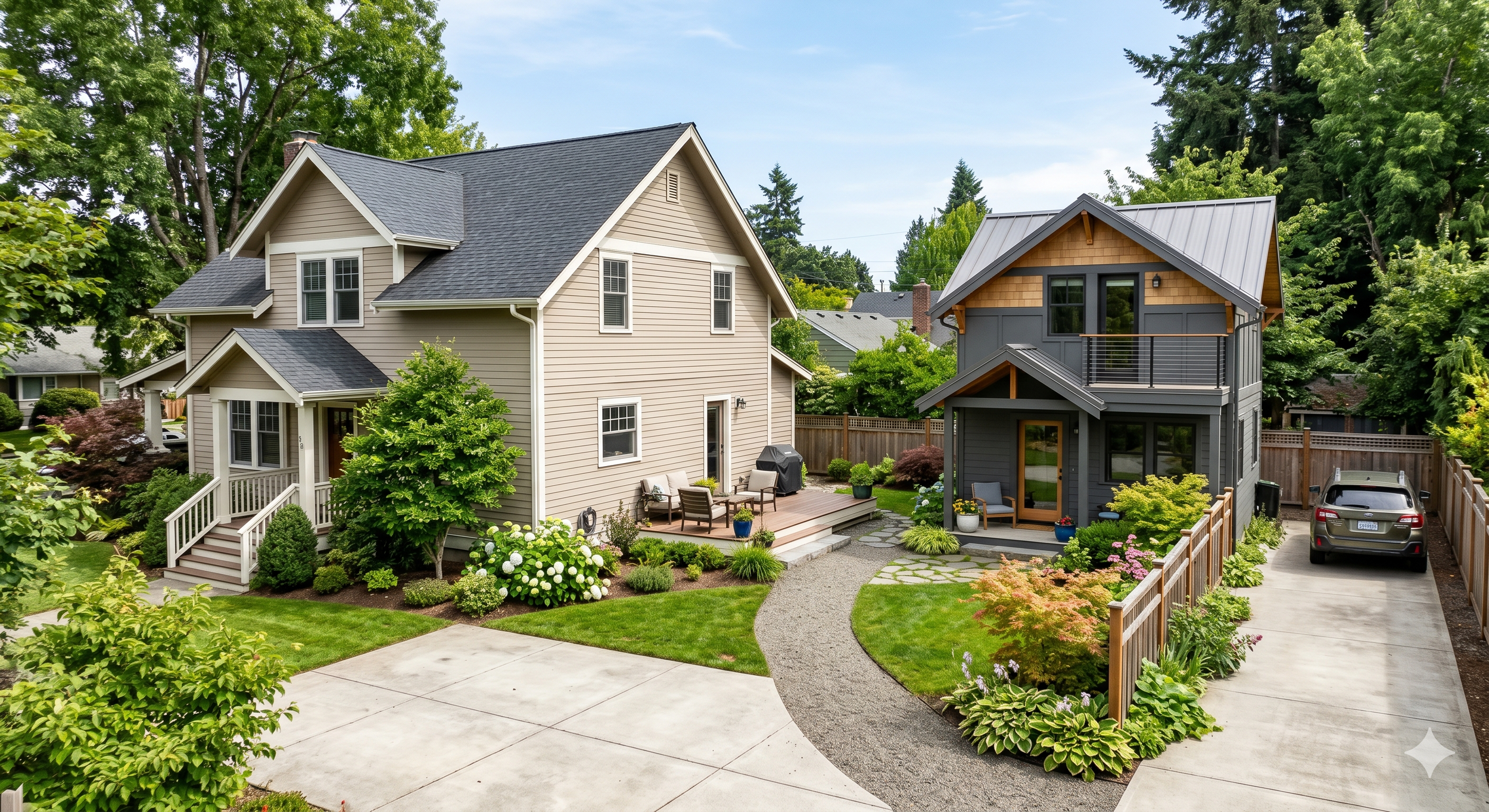
Atlanta is one of the more ADU-friendly cities in the Southeast, and most buyers don't realize this. The 2018 zoning changes legalized accessory dwelling units in R-4, R-4A, and R-5 residential zones — which collectively cover more than 60% of the city's residential land area. If you buy a single-family home in those zones, you're allowed to build a detached ADU up to 750 square feet, two stories, 20 feet tall, by right. No zoning variance, no special permission required.
The numbers on this strategy are worth understanding carefully.
What an Atlanta ADU Costs to Build vs. What It Rents For
Cost ranges depend heavily on lot conditions, finish quality, and how complicated the utility connections are. Here are the typical numbers for the City of Atlanta in 2026, with corresponding rent expectations.
| Build type | Typical all-in cost | Long-term rent (intown) |
|---|---|---|
| Basic detached ADU (modular or pre-designed, ~550-650 sf) | $180,000-$240,000 | $1,400-$2,200/mo (1BR) |
| Custom-designed detached ADU (up to 750 sf) | $230,000-$320,000 | $2,400-$2,800/mo (2BR) |
| Garage conversion | $80,000-$140,000 | $1,200-$1,800/mo |
| Basement conversion (where allowed) | $60,000-$120,000 | $1,200-$1,800/mo |
The variability is real. Sloped lots, mature tree protection, sewer pump requirements, and overlay districts can push costs significantly higher. Get a feasibility study and a contractor estimate before you assume any specific number. Short-term rental (Airbnb) numbers run higher than the long-term rates above but require owner-occupancy of the primary residence in the City of Atlanta and are subject to ongoing regulatory tightening.
The Math on Building vs. Buying
This is where I want you to think carefully. Let's compare two scenarios for a buyer with around $30,000 to deploy.
| Line item | Scenario A: Buy a duplex | Scenario B: Buy SFH + build ADU later |
|---|---|---|
| Purchase price | $500,000 duplex | $450,000 single-family home |
| FHA down payment (3.5%) | $17,500 | $15,750 |
| Closing costs | ~$12,000 | ~$11,000 |
| Initial monthly PITI | ~$3,800 | ~$3,400 |
| ADU build (year 1-2, financed via HELOC) | N/A | $200,000 (~$1,500/mo) |
| Total monthly payment after build | $3,800 | $4,900 |
| Rental income (other unit / ADU) | $1,800/mo | $1,800/mo |
| Net monthly housing cost | ~$2,000 | ~$3,100 |
| Appreciation pace | Multi-family rate (slower) | Single-family rate (typically faster) |
| Resale buyer pool | Investors + house hackers (smaller) | Multigenerational families + investors (larger) |
On the surface, the duplex looks better. Lower monthly cost, immediate cash flow. But run it forward five years.
In Scenario A, the duplex appreciates with the multi-family market — typically slower than single-family. You build equity primarily through paydown.
In Scenario B, you've created an asset where the single-family home appreciates at the (typically higher) single-family rate, the ADU has added significant value to the property, and you have far more flexibility. If you decide to move out and rent both, your rental income jumps because single-family + ADU often rents for more than a comparable duplex. If you decide to sell, you can sell to a buyer who wants a multigenerational home — a much larger pool than buyers who want a duplex.
The ADU strategy is a longer play that produces better long-term wealth. The duplex strategy is a faster path to lower monthly housing costs. Both are correct answers depending on your goals.
Atlanta ADU Rules You Need to Understand Before Buying
The rules are specific. Get them wrong and you've bought a house that can't legally be house hacked. The most important variables are zoning, owner-occupancy requirements, and which municipality the property sits in.
| Jurisdiction | ADU allowed? | Owner-occupancy required? | Key constraints |
|---|---|---|---|
| City of Atlanta | By right in R-4, R-4A, R-5 zones (~60% of residential land). Not allowed in R-1, R-2, R-3. | No for long-term rental. Yes for short-term (Airbnb). | 750 sf max, 20 ft height, 50% FAR. Setbacks: 4 ft side/rear in R-5; 7 ft side, 15 ft rear in R-4/R-4A. |
| DeKalb County (unincorporated) | Allowed in some zones, separate rules from Atlanta. | Yes — owner must occupy primary or accessory unit. | Verify directly with DeKalb County Planning & Sustainability before making plans. |
| City of Decatur | Allowed in select districts. | Yes — owner must occupy. | Detached ADU must be at rear of lot. Impervious surface limits often restrict buildable space. |
| Cobb, Gwinnett, other counties | Varies by jurisdiction. Many do not allow ADUs by right. | Typically yes where allowed. | Verify with local planning department before purchase. Don't assume Atlanta rules apply. |
A few additional points that matter on every Atlanta build:
Lot size and FAR matter. Floor Area Ratio limits combined building square footage to 50% of lot area on most lots, with adjustments on smaller lots. If your existing house already maxes out FAR, you cannot add an ADU. Most existing houses do not max out FAR, but verify before you buy.
R-5 is the most flexible zone. R-5 allows up to three units total on the lot under certain conditions — a duplex plus an ADU, or a single-family home plus two ADUs. R-4 and R-4A allow one ADU per lot.
Permitting takes time. From feasibility through permit issuance typically runs three to four months. From initial consultation to a finished, move-in ready ADU runs 10 to 14 months on most projects. Build that timeline into your house hacking plan.
Single-Family Home With an Existing Basement Apartment: The Unsung Strategy
This is the strategy I've seen work most often for first-time buyers in established Atlanta neighborhoods, and it gets less attention than it deserves.
Many older homes in Kirkwood, East Atlanta, Lake Claire, Edgewood, Decatur, and Grant Park have full basements that were finished years ago as in-law suites, rental units, or au pair quarters. They have a separate entrance, a kitchen, a bathroom, a living area, and one or two bedrooms. They're not legally classified as duplexes — the property is still zoned single-family — but they function as a rentable second unit.
The financing advantage is significant. You buy a single-family home, which is easier to finance, has a lower interest rate than multi-family, and qualifies for every down payment assistance program available. You move in upstairs, rent the basement for $1,200-$1,800 a month, and your effective housing cost drops dramatically.
The legal question is more nuanced. If the basement apartment has a separate kitchen and is being rented as a separate dwelling unit, technically that may violate single-family zoning depending on the property's specific zoning designation and code enforcement history. Code enforcement on this is inconsistent. Many homes have operated this way for decades without issue. Some have run into problems. Before buying any property where this is part of your plan, talk to a real estate attorney about the specific zoning, any prior code violations on the property, and whether the basement unit could be legalized through the ADU process.
When this strategy works, it's the cleanest of all the house hacking approaches. Single-family financing terms, single-family appreciation, and rental income that effectively cuts your housing cost in half.
What to Look for in an Atlanta House Hack Property
After working with house hackers across this market, here's the checklist I run every time. Skip these at your peril — most of the worst house hack outcomes I've seen come from buyers who fell in love with the listing photos and overlooked one of these.
| What to check | Why it matters |
|---|---|
| Separate utilities | Each unit needs its own electric meter at minimum. Separate gas and water are bonuses. Shared utilities mean either including utilities in rent (limits what you can charge) or sub-metering. |
| Separate entrances | Tenants expect their own front door. Side or back entry that's fully separate from yours commands higher rent and attracts better tenants. |
| Off-street parking | In intown Atlanta, parking is genuinely difficult. Two off-street spaces is good, four is excellent. BeltLine-adjacent tenants pay a premium for guaranteed parking. |
| Sound separation | Older duplexes (pre-1950) often have terrible sound separation. Walk it and listen. If heel clicks echo between units, expect to spend money on insulation. |
| Independent HVAC | Each unit should have its own system. Shared HVAC means you control tenant climate (and complaints) and can't charge market rent. |
| Roof, foundation, plumbing, electrical | Inspect like your financial life depends on it, because it does. A $30,000 roof problem turns a great deal into a struggle. FHA appraisals are stricter on these systems and will require repairs before closing. |
| Existing tenant situation | If currently leased, check who, what they pay, lease terms, and whether they're at market. A tenant locked in at $1,200 in a $1,800 market reduces what the property is worth to you. You can't simply raise rent on day one. |
Financing the Renovation: FHA 203(k) and Conventional Renovation Loans
Some of the best house hacking deals in Atlanta need work. The FHA 203(k) loan is built for this exact situation.
The 203(k) lets you finance both the purchase price and the renovation costs in a single loan with 3.5% down on the total amount. You find a $320,000 duplex that needs $80,000 in work. You take a 203(k) loan for $400,000. Your down payment is 3.5% of $400,000, or $14,000. The renovation funds are held in escrow and released to approved contractors as work is completed.
The constraints are real. You need licensed, approved contractors. Work must be completed within six months. Cosmetic-only updates don't qualify — the work has to be substantial enough to justify the program. The paperwork is heavier than a standard FHA loan. The closing process takes longer.
But for the right property, this loan is the difference between buying a great house hack and buying nothing. I've seen this work especially well on duplexes where one unit is move-in ready and the other needs full renovation. You move into the renovated side, the renovation funds rebuild the other side, and 90 days later you have a fully leased duplex.
The conventional equivalent is the Fannie Mae HomeStyle Renovation Loan. Same general concept, different rules, similar trade-offs.
The 12-Month Rule and What Happens After
Every owner-occupant loan program — FHA, conventional, VA — requires you to occupy the property for at least 12 months as your primary residence. This is enforced.
What happens at month 13 is where the strategy compounds.
You can stay and continue house hacking the same property indefinitely. The mortgage stays in place. You keep renting the other units. Some of my clients have done this for 5+ years.
You can move out and rent the unit you were living in. The mortgage stays in place. You're now an investor, but with an owner-occupied loan rate, which is significantly better than what investors typically get.
You can buy another house hack with another FHA loan. FHA generally allows only one outstanding FHA loan at a time, but exceptions exist for relocation, family size changes, and other documented life events. The cleaner play is to refinance the first property to conventional financing, freeing up your FHA eligibility for the next house hack. Some experienced house hackers move every 12-24 months and stack three or four house hacks before settling into a long-term home.
You can sell. If you sell within two of the last five years and meet the primary residence test, the first $250,000 of gain (or $500,000 for married couples) is exempt from capital gains tax under IRS Section 121. This is a massive advantage that pure investors don't get.
The Risks and Realities You Need to Understand
I'm going to be honest with you about what doesn't get said in most house hacking content.
Tenant management is real work. Living next door to your tenants means hearing their complaints in real time. The hot water heater fails on a Saturday and you're the one fielding the call. You're the landlord, and you're also the neighbor. Some people are wired for that. Others find it constantly stressful and end up regretting the strategy.
Vacancy is expensive. If your tenant moves out and the unit sits vacant for two months, that's $3,600-$4,400 in lost rent on a typical Atlanta house hack. You need cash reserves to absorb vacancy without panic.
Repairs always cost more than you expect. A "small" plumbing issue in a 1925 duplex isn't small. Old housing stock is part of why these deals exist at the price points they exist at, but it comes with maintenance costs that need to be factored into your numbers.
You're not living alone. This is the practical thing most online guides minimize. You're sharing a building with strangers. If you value complete privacy and quiet, house hacking may not be the right strategy for your life, even if the math is excellent. Be honest with yourself.
Property management eventually matters. When you move out and the property becomes a full rental, you'll either manage it yourself or hire a property manager (typically 8-10% of rent). Build that cost into your long-term math from day one.
Insurance and taxes go up. Property tax assessments often increase after you add an ADU. Insurance for multi-family is more expensive than single-family. Get quotes during due diligence — don't assume the seller's policy will translate to your costs.
Down Payment Assistance That Stacks With House Hacking
This is the part most aspiring Atlanta house hackers don't realize: several down payment assistance programs work with FHA multi-family loans, which means you may be able to buy a duplex with significantly less than 3.5% of your own money.
| Program | Typical assistance | Who it's for |
|---|---|---|
| Georgia Dream Homeownership | Up to $10,000 | First-time buyers meeting state income limits. Combinable with FHA on owner-occupied properties. |
| Invest Atlanta — HomeAtlanta | Up to $14,000 | Buyers within City of Atlanta limits, income and education requirements apply. |
| Atlanta Housing programs | Varies by program | Buyers in specific neighborhoods. Some grants don't require repayment if you stay in the property for a defined period. |
| City of Atlanta DPA | Up to $20,000 | Qualified first-time buyers in certain areas. Stacks with FHA on multi-family. |
These programs change frequently and have specific income limits, location requirements, and education requirements. Talk to a lender experienced with both FHA multi-family loans and Atlanta-area DPA programs. Not every lender knows how to layer these. The ones who do can put you into a duplex with $5,000-$7,000 of your own money.
Frequently Asked Questions About House Hacking in Atlanta
Can I house hack with an FHA loan in Atlanta?
Yes. FHA loans allow you to buy a 2-4 unit property with 3.5% down as long as you occupy one unit as your primary residence for at least 12 months. FHA loan limits in Metro Atlanta counties (Fulton, DeKalb, Cobb, Gwinnett) for 2026 run around $668,050 for a duplex, $807,700 for a triplex, and $1,003,950 for a fourplex — high enough to cover essentially every house hack opportunity in the metro.
How much do duplexes cost in Atlanta in 2026?
Atlanta multi-family properties currently have a median listing price around $498,000, with most house-hackable duplexes in the $400,000-$700,000 range depending on neighborhood and condition. Lower-tier duplexes in Lakewood Heights, Pittsburgh, College Park, and East Point start around $300,000. Renovated intown duplexes in Reynoldstown, Edgewood, and Kirkwood typically run $500,000-$700,000.
What are the best Atlanta neighborhoods for house hacking?
The neighborhoods with the right combination of multi-family inventory, rental demand, and price points for house hacking are Edgewood, Kirkwood, Reynoldstown, Cabbagetown, East Atlanta, Grant Park, Adair Park, West End, East Lake, parts of Decatur, East Point, College Park, and older sections of Marietta. BeltLine-adjacent neighborhoods consistently produce the strongest combination of appreciation and rental demand.
Can I build an ADU on my Atlanta property?
If your property is in the City of Atlanta and zoned R-4, R-4A, or R-5, you can build a detached ADU up to 750 square feet by right. About 60% of Atlanta's residential land is in those zones. R-1, R-2, and R-3 zones do not allow ADUs. Properties in DeKalb County, Decatur, Cobb County, and other municipalities have separate rules — verify with the local planning department.
How much does it cost to build an ADU in Atlanta?
A typical 750-square-foot detached ADU in the City of Atlanta costs $180,000-$320,000 all-in, depending on lot conditions, finish quality, and design complexity. Garage conversions run $80,000-$140,000. Basement conversions, where allowed, run $60,000-$120,000. Sloped lots, sewer pump requirements, and overlay districts can push costs higher.
How much can I rent an Atlanta ADU for?
Long-term rental rates for a 550-650 square foot one-bedroom ADU in established intown Atlanta neighborhoods run $1,400-$2,200 per month. Two-bedroom ADUs (around 750 square feet) reach $2,400-$2,800 in strong markets. Short-term rental (Airbnb) rates are higher but require owner-occupancy of the primary residence in the City of Atlanta.
Can I rent both my main house and my ADU in Atlanta?
In the City of Atlanta, yes — long-term. You can rent both the primary residence and the ADU to long-term tenants without owner-occupancy. To operate either unit as a short-term rental (Airbnb), the city requires the owner to live on-site. DeKalb County, Decatur, and surrounding municipalities have stricter owner-occupancy rules.
What credit score do I need to house hack in Atlanta?
For FHA multi-family financing, the minimum credit score is 580 with 3.5% down (500-579 with 10% down). Most lenders prefer 620+ for multi-family FHA loans even though FHA technically allows 580. For conventional 5% down multi-family loans, expect to need 620 minimum, with the best rates above 740. Strong credit makes a measurable difference in interest rate and total cost over the life of the loan.
How long do I have to live in my house hack?
FHA, conventional, and VA owner-occupant loans all require at least 12 months of primary residency. After 12 months, you can move out, rent the unit you occupied, and convert the property to a full rental. The mortgage stays in place. Many house hackers repeat the strategy by buying another house hack at month 13.
Can I use rental income from the other units to qualify for the loan?
Yes. FHA allows lenders to count up to 75% of projected rental income from the additional units toward your qualifying income. This is why house hackers often qualify for properties their salary alone would not. For 3-4 unit properties, the property must also pass the FHA self-sufficiency test.
Should I buy a duplex or build an ADU?
Both work. Buying a duplex is faster and produces stronger immediate cash flow. Building an ADU on a single-family home is a longer play that often produces better long-term wealth because single-family homes appreciate faster than multi-family, and the ADU adds value to a property in a larger resale pool. Your decision should be based on timeline, total capital available, and your tolerance for living next to a tenant versus living in a separate building from one.
What's the FHA self-sufficiency test?
For 3-4 unit properties financed with an FHA loan, the property must generate enough projected rental income that 75% of that income (across all units, including the one you'll occupy at market rent) covers the full monthly mortgage payment including taxes and insurance. Two-unit duplexes do not have this test — only triplexes and fourplexes. The test eliminates properties where the math doesn't work, which is its purpose.
Can I house hack with a VA loan?
Yes, with major advantages. VA loans for owner-occupied 2-4 unit properties require 0% down, no mortgage insurance, and typically offer lower interest rates than FHA. The 12-month occupancy rule still applies. If you qualify for VA financing, this is almost always the strongest house hacking option available in Metro Atlanta.
What are the risks of house hacking?
The main risks are vacancy (lost rental income while units sit empty), tenant management stress (you live next door to your tenants), maintenance and repair costs (especially in older Atlanta housing stock), reduced privacy, and assessment increases on property tax. Build cash reserves of 3-6 months of full mortgage payment plus expected vacancy before closing.
Is now a good time to house hack in Atlanta?
Multi-family inventory has loosened over the last 18 months and days on market for duplexes is around 67 days, longer than single-family's typical pace. That generally means more room to negotiate. Rental demand remains strong, with intown one-bedroom rents pushing $2,000+ in walkable neighborhoods. The combination of negotiable purchase prices and strong rental demand creates favorable conditions for house hackers right now, especially for buyers willing to do some level of renovation work.
How do I find a house hack property in Atlanta?
Multi-family doesn't always show up in standard buyer searches because filters get applied differently. Work with an agent who specifically searches multi-family inventory for you, watches off-market deals, and understands which neighborhoods have the right combination of inventory and rental demand. The best house hacks frequently aren't the ones listed on Zillow as "duplex" — sometimes they're listed as "single-family with separate apartment" or "investment property" and require local knowledge to find.
What This Strategy Does for Your Long-Term Wealth
I want to close with the actual financial picture, because this is what most online house hacking content fails to articulate clearly.
A typical Atlanta house hacker buying a $500,000 duplex with FHA 3.5% down today, with the other unit renting for $1,800, has a net out-of-pocket housing cost of around $2,000 per month. The Atlanta one-bedroom apartment they would otherwise rent costs around $1,800-$2,200. They are housing themselves at market rate while:
Building equity through principal paydown ($600-$800/month from year one).
Capturing appreciation on a $500,000 asset (Metro Atlanta has averaged 5-7% annual appreciation over the long run, though recent years have varied).
Accumulating depreciation deductions on the rental portion of the property.
Building a track record of rental property ownership that opens up future financing options.
Five years in, the typical house hacker has $50,000-$120,000 in equity in a property that costs them roughly the same per month as renting. The renter has $0.
That's the strategy. It's not magic. It requires work, capital, tolerance for tenant management, and the willingness to take on more responsibility than the average first-time buyer. But the financial outcome is dramatically different.
I work with buyers throughout Metro Atlanta and have helped multiple clients execute every variation of this strategy — duplex purchases, single-family with basement apartments, single-family plus future ADU. If you're trying to figure out whether house hacking could work for your situation, the right neighborhood, the right financing approach, and the right property profile for your goals, let's talk.
Visit kristenjohnsonrealestate.com or reach out directly. Come as you are, come on home.
Looking for more Metro Atlanta buyer education? I've covered related topics including How Much House Can I Afford in Atlanta, FHA vs Conventional Loan: Which Is Better in Atlanta, What Credit Score Do I Need to Buy a House in Atlanta, and First-Time Home Buyer Mistakes to Avoid in Atlanta. For neighborhood-specific information, see my guides on Kirkwood, East Atlanta, Grant Park, Reynoldstown, West End, and Adair Park. Browse the full guide series at kristenjohnsonrealestate.com.