

What Are Closing Costs for Buyers in Georgia? A Complete 2026 Guide
Closing costs are one of those things nobody tells you about until you're deep in the buying process. By then, you're already attached to the house, the neighborhood, and the idea of yourself in that kitchen. Then your lender hands you a Loan Estimate and suddenly there are three pages of fees you've never heard of.
I've been walking Atlanta-area buyers through this exact moment for nearly ten years. The confusion is real. The fees are real. And most of them are not negotiable, but some of them are, and that distinction matters a lot depending on what market you're in and how your deal is structured.
So let's get into it. Here's a complete breakdown of what Georgia buyers actually pay at closing: what the fees are, who they go to, where Georgia is different from other states, and what first-time buyers need to know about assistance programs that can help. Here's what you need to know.
What Are Closing Costs, Exactly?
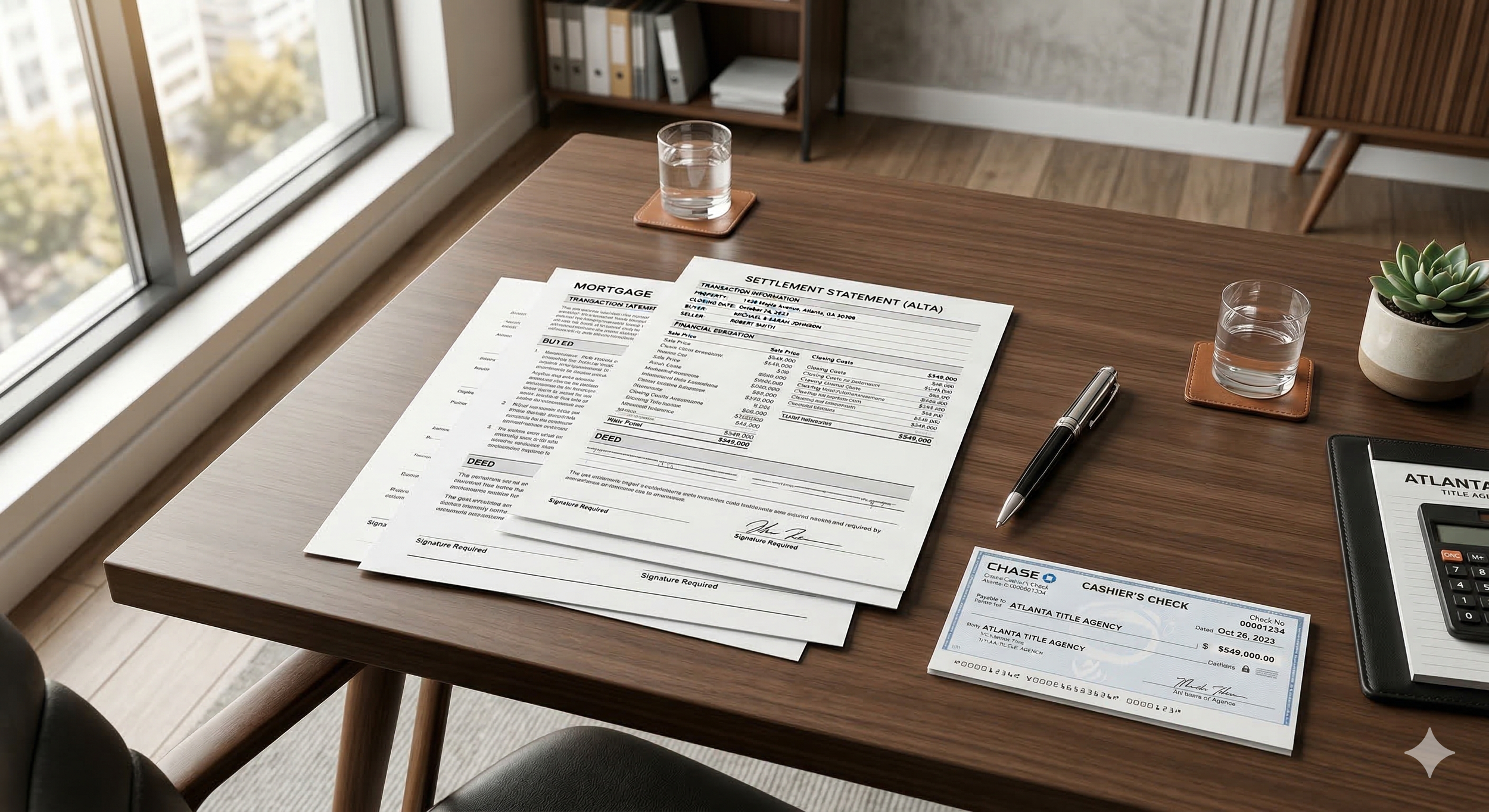
Closing costs are the fees and prepaid expenses you pay on or before the day you take ownership of a home. They are separate from your down payment, though both are typically due at the same time, usually in the form of a cashier's check or wire transfer.
The term is a catch-all. Inside "closing costs" you'll find lender fees, title fees, government recording fees, insurance premiums, and prepaid expenses like property taxes and homeowners insurance. Some of those line items go to your lender. Some go to a title company or attorney. Some go directly to the local government. Each one has a different purpose, and understanding where each dollar goes makes the whole document less overwhelming.
In Georgia, buyers typically pay between 2% and 5% of the home's purchase price in closing costs, not including the down payment. On a $400,000 home, that's $8,000 to $20,000 in fees you need to be prepared to bring to the table. The exact number depends on your lender, your loan type, your property location, and what's been negotiated in your contract.
That range is wide, and intentionally so, because the real number depends on a lot of variables. This post will walk you through all of them.

The Big Thing That Makes Georgia Different: Attorney-Closing State
Before we get into the individual line items, you need to understand one thing about Georgia that sets it apart from the majority of states: in Georgia, a licensed attorney is legally required to oversee every residential real estate closing.
This is not a suggestion or a common practice. It's the law. The Georgia Supreme Court has held consistently that real estate closings constitute the practice of law under O.C.G.A. § 15-19-51, and Senate Bills 331 and 365, which took effect in 2012, reinforced this by establishing criminal and civil liability for anyone other than a licensed Georgia attorney or the lender who attempts to conduct a closing.
In most states, including Florida, Texas, Colorado, and California, title companies or escrow officers handle the closing process. There is no attorney requirement. A non-attorney can prepare the documents, manage the funds, and transfer the title. In Georgia, that is not legal.
What this means practically: the closing attorney prepares and reviews the deed, promissory note, and all legal closing documents; conducts or reviews the title search; manages the escrow account; disburses funds to all parties; and records the deed and security deed with the county superior court after closing. They are required to be physically present and "in control of the closing process from beginning to end," a standard the Georgia Supreme Court has specifically enforced.
The attorney at your closing technically represents the lender, not you personally. There will be a closing attorney present at every Georgia residential closing, and their fees will appear on your settlement statement.
Attorney fees in Georgia typically run $500 to $1,500 for a standard residential purchase closing, depending on transaction complexity, purchase price, and location. This is in addition to title insurance, title search, and recording fees, which the attorney's office typically collects and passes through to third parties.
Is this more expensive than states where title companies handle closings? Sometimes slightly. But the legal oversight is substantive. You are getting a licensed professional reviewing documents and managing funds, which provides real protection against errors, fraud, and title defects. Most of my buyers who have come from out of state actually appreciate it once they understand what they're getting.

Complete Breakdown of Georgia Buyer Closing Costs
Here is a category-by-category breakdown of what you can expect to see on your Closing Disclosure as a buyer in Georgia.
Lender Fees
These are fees charged by your mortgage lender to originate and process your loan. They vary significantly by lender, which is why comparing Loan Estimates from at least two or three lenders is one of the most financially impactful things you can do early in the buying process.
Loan Origination Fee This is the primary fee your lender charges for processing your mortgage application and underwriting your loan. It typically runs 0.5% to 1% of the loan amount. On a $360,000 loan (the amount borrowed on a $400,000 home with 10% down), that's $1,800 to $3,600. Some lenders advertise "no origination fee" loans but offset that with higher interest rates. It's not necessarily a bad deal. Just make sure you're comparing the total cost of the loan, not just the fee.
Credit Report Fee A small fee, usually $25 to $75, your lender charges to pull your credit report during the application process.
Underwriting Fee Some lenders charge a separate underwriting fee to review and approve your loan. This typically runs $300 to $700 and may appear as its own line item or be folded into the origination fee, depending on the lender.
Application Fee Not all lenders charge this. If they do, it typically runs $100 to $400. It's worth asking upfront whether this fee is refundable if your loan doesn't close.
Discount Points (Optional) Points are optional prepaid interest you pay at closing to permanently lower your interest rate. One point equals 1% of the loan amount, and typically reduces your rate by 0.25%. Whether buying points makes financial sense depends on how long you plan to stay in the home. If you're planning to be there a decade or more and have the cash at closing, it can make sense. If you're a shorter-term buyer or stretched thin at closing, it usually doesn't.
Title Fees
These fees cover the legal work of verifying and insuring clear ownership of the property you're purchasing.
Title Search Fee Before closing, the title attorney or a title examiner reviews the public record (deed history, liens, judgments, unpaid taxes) going back as far as is legally required to certify that the seller has clear, marketable title. This typically costs $100 to $300 in Georgia and is usually ordered by the closing attorney's office.
Owner's Title Insurance This is a one-time premium that protects you as the buyer against any defects in the title that weren't discovered during the search. Examples: a previous owner's lien that wasn't properly released, a forged signature on a past deed, an unknown heir with a claim to the property. If something like that surfaces after you close, your owner's title policy covers legal fees and financial losses.
In Georgia, buyers typically pay for both the lender's title insurance policy and the owner's policy, though this is negotiable and sometimes paid by the seller. Owner's title insurance typically runs $500 to $1,500 depending on the purchase price. It is a one-time fee that covers you for as long as you own the home.
Lender's Title Insurance Separate from the owner's policy, this is required by virtually every mortgage lender. It protects only the lender's interest, not yours, in the event of a title problem. This typically runs $200 to $500.
Title Closing/Settlement Fee This is the attorney's fee for managing the actual closing: coordinating the transaction, preparing and reviewing documents, holding and disbursing funds, and recording the deed. As noted above, this typically runs $500 to $1,500 in Georgia.
Government and Recording Fees
Recording Fees After closing, the deed and security deed (Georgia's equivalent of a mortgage lien document) must be officially recorded with the clerk of the superior court in the county where the property is located. Recording fees vary by county but are generally modest, typically $10 to $40 per document.
Transfer Tax Georgia charges a real estate transfer tax (also called an intangible tax or conveyance tax) of $1 per $1,000 of the purchase price ($0.10 per $100). On a $400,000 home, that's $400. This tax is typically paid by the seller in Georgia, but it is negotiable and worth confirming in your purchase and sale agreement. There is also a separate mortgage intangible tax charged on new mortgages at a rate of $1.50 per $500 of the loan amount (0.3%), which is a buyer cost.
To illustrate: on a $360,000 loan, the mortgage intangible tax would be approximately $1,080. This is a Georgia-specific cost that surprises buyers coming from states that don't have an equivalent.
Prepaid Expenses
Prepaids are not fees for services rendered. They are expenses you are paying in advance to ensure ongoing obligations are funded. They go into an escrow account managed by your lender.
Homeowners Insurance Prepaid Your lender will require you to pay the first year of your homeowners insurance premium at or before closing. The annual premium for a Georgia home varies significantly based on coverage amount, property type, location, and your insurance history, but plan on roughly $1,200 to $2,500 per year for most Metro Atlanta properties.
Property Tax Escrow Prepaids Your lender will collect several months of property taxes upfront to seed your escrow account, typically two to three months' worth. This ensures there are sufficient funds in escrow to cover your next tax payment when it comes due. Georgia property taxes vary considerably by county; the statewide average effective rate is around 0.74%, but rates in Metro Atlanta counties can range from roughly 0.6% to 1.2% or more depending on the county, municipality, and school district millage rates.
Prepaid Interest You'll pay interest that accrues on your loan from your closing date through the last day of that month. If you close on the 25th, you're paying 5 or 6 days of interest. If you close on the 5th, you're paying 25 or 26 days. This is why some buyers prefer to close toward the end of the month, which minimizes the prepaid interest amount. It is a relatively small figure but it does affect what you need to bring to closing.
Mortgage Insurance Premiums (if applicable) If you're putting less than 20% down on a conventional loan, your lender will require private mortgage insurance (PMI). Depending on your lender, you may be required to prepay several months of PMI at closing. FHA loans include an upfront mortgage insurance premium (UFMIP) equal to 1.75% of the loan amount, which can be rolled into the loan, plus an ongoing annual premium. If you're using an FHA loan, make sure you understand both the upfront and ongoing MIP costs.
Home Inspection and Appraisal Fees
These fees are typically paid outside of closing, before you get to the settlement table, but they are part of your total cost to purchase.
Home Inspection A general home inspection in Metro Atlanta typically runs $450 to $750 for a standard single-family home. Larger homes cost more. Additional specialty inspections (radon testing, sewer scope, mold assessment, chimney inspection, pool inspection) each carry their own fees, typically $100 to $400 each. I recommend buyers budget $500 to $1,500 total for inspections, more if the property has a pool, septic system, or known issues.
Home inspection fees are due directly to the inspector, usually at the time of the inspection. If the deal falls through after inspection, you don't typically get this money back.
Appraisal Your lender will order an appraisal to verify that the home is worth at least the amount they're lending you. This protects the lender in the event you default. In Metro Atlanta, appraisals typically cost $400 to $700 for a standard single-family home. The appraisal fee is usually paid upfront when the appraisal is ordered, or it may appear on your Loan Estimate to be collected at closing. Confirm with your lender.
HOA-Related Fees (When Applicable)
If the property you're purchasing is in a homeowners association, you may encounter several HOA-related costs at closing:
HOA Transfer Fee: A fee charged by the HOA or its management company to update their ownership records. Typically $100 to $500.
HOA Capital Contribution or Move-In Fee: Some HOAs charge a one-time fee upon transfer of ownership. This can range from a few hundred dollars to several thousand in higher-end communities.
Prorated HOA Dues: You'll pay your portion of the current month's or quarter's dues, prorated from your closing date.
Always request the HOA documents (the budget, reserve study, and meeting minutes) before closing. These are required to be provided to you under Georgia law, and reading them before you commit can reveal financial problems or upcoming special assessments that would affect your decision.

What Does This All Add Up To? Real Numbers for Georgia Buyers
Here's how these costs shake out at different price points. These are estimates. Your actual numbers will vary based on lender, loan type, county, and specific transaction terms.
$300,000 home purchase, 10% down, $270,000 loan:
Lender fees (origination, underwriting, credit): $1,500–$3,000
Title insurance (owner's + lender's): $800–$1,400
Attorney/closing fee: $600–$1,000
Recording fees: $75–$150
Mortgage intangible tax: ~$810
Prepaid homeowners insurance: $1,200–$1,800
Prepaid property tax escrow (2–3 months): $500–$1,200
Prepaid interest: $200–$400
Estimated total closing costs: $5,700–$9,700 (not including down payment or inspections)
$450,000 home purchase, 10% down, $405,000 loan:
Lender fees: $2,000–$4,500
Title insurance: $1,000–$1,800
Attorney/closing fee: $700–$1,200
Recording fees: $75–$150
Mortgage intangible tax: ~$1,215
Prepaid homeowners insurance: $1,500–$2,500
Prepaid property tax escrow: $800–$1,800
Prepaid interest: $300–$600
Estimated total closing costs: $7,600–$13,700
$600,000 home purchase, 20% down, $480,000 loan:
Lender fees: $2,400–$5,500
Title insurance: $1,200–$2,200
Attorney/closing fee: $900–$1,500
Recording fees: $75–$150
Mortgage intangible tax: ~$1,440
Prepaid homeowners insurance: $1,800–$3,000
Prepaid property tax escrow: $1,000–$2,500
Prepaid interest: $350–$700
Estimated total closing costs: $9,200–$17,000
These ranges are wide because lender fees vary significantly. Comparing Loan Estimates from two or three lenders is not just a suggested step. It's where substantial money can be saved or lost.

Georgia vs. Other States: What's Different Here
If you're relocating from out of state, a few things will look different on your settlement statement.
The attorney requirement. As covered above, you will have an attorney at your closing. If you moved from Texas, California, Colorado, or most other states, this may be new to you. It adds a line item to your closing costs but also adds legal oversight that title companies can't provide.
The mortgage intangible tax. Georgia charges 0.3% of the loan amount (specifically $1.50 per $500 of principal) as a one-time mortgage intangible tax. This is a buyer cost, and it's specific to Georgia. Many states don't have an equivalent. On a $400,000 loan, that's $1,200 you need to account for.
Transfer tax responsibility. In Georgia, it is customary for the seller to pay the state transfer tax ($1 per $1,000 of purchase price). In states like New York and Connecticut, transfer taxes can be significant buyer costs. In Georgia, this is typically not your bill, but verify in your contract.
Who pays what is more negotiable here. Georgia's Purchase and Sale Agreement allows for flexibility in who pays various costs. Sellers can offer to pay a portion of the buyer's closing costs as a concession. This is particularly common in new construction, slower markets, or when a property has been sitting. When I'm negotiating for buyers, I'm always looking at whether a seller concession toward closing costs makes more sense than a price reduction, depending on the loan type and the buyer's cash position.
Seller Concessions: How Buyers Can Get Help With Closing Costs
One of the most useful tools in a buyer's negotiation is the seller concession, which is a credit from the seller toward your closing costs, paid at closing.
How it works: instead of reducing the purchase price by $10,000, the seller agrees to credit you $10,000 at closing to apply toward your closing costs. For buyers who are stretched thin on cash (down payment plus closing costs is a lot of money to have liquid all at once), this can be more practically useful than a lower price.
There are limits. Conventional loan seller concessions are capped at 3% of the purchase price if your down payment is less than 10%, 6% if your down payment is 10–25%, and 9% if your down payment exceeds 25%. FHA loans cap seller concessions at 6%. VA loans cap at 4% plus reasonable closing costs. Exceed those caps and the excess typically has to be credited back or renegotiated.
In a competitive market with multiple offers, asking for seller concessions may weaken your offer. In a buyer's market, or with a property that has been sitting, it's often a reasonable ask. This is something I help buyers think through strategically based on the specific property, the seller's situation, and the current market dynamics for that area.
Lender Credits: Trading Rate for Cash
The inverse of buying discount points. With lender credits, you accept a slightly higher interest rate in exchange for a credit at closing that offsets your upfront costs.
This can be a useful tool if you're short on cash at closing and want to reduce what you bring to the table. The tradeoff: a higher rate means higher monthly payments for the life of the loan. Whether that math works in your favor depends on your rate environment, your expected hold period, and your cash flow.
Lender credits should show up as a credit on your Loan Estimate and Closing Disclosure. If you're considering them, ask your lender to model out the break-even: how long would you need to stay in the home for the lower closing costs to be worth the higher rate?

First-Time Buyer Assistance Programs in Georgia
Georgia has active state and local programs designed to help first-time buyers with both down payment and closing cost assistance. These are real money that eligible buyers leave on the table by not asking.
Georgia Dream Homeownership Program
The primary statewide program, administered by the Georgia Department of Community Affairs (DCA). As of July 2025, the program includes several mortgage products, with the standard Georgia Dream Loan offering eligible buyers a 30-year fixed-rate loan (conventional, FHA, USDA, or VA) paired with down payment assistance.
Standard assistance: The lesser of 5% of the purchase price or $10,000 in a 0% interest deferred second mortgage with no monthly payments. Repayment is due when you sell, refinance, or no longer use the home as your primary residence.
Protectors, Educators, and Nurses (PEN): Public protectors, educators, healthcare providers, and active-duty military may qualify for the lesser of 6% of the purchase price or $12,500 in assistance.
Eligibility basics:
Must be a first-time homebuyer (defined as not having owned a home in the past three years) or be purchasing in a targeted area
Income limits apply: up to $130,290 for 1–2 person households, $149,833 for 3+ person households (standard program)
Minimum 640 FICO credit score
Liquid assets cannot exceed $20,000 or 20% of the sales price, whichever is greater
Must contribute at least $1,000 of own funds toward the purchase
Homebuyer education course required
Maximum purchase price (standard program): Up to $550,000.
Georgia Dream Peach Advantage Loan Program
Launched July 1, 2025, this is an expansion of the Georgia Dream initiative targeting buyers who may not qualify for the traditional program. It offers expanded down payment assistance options from 2% up to 5% of the purchase price, with a zero percent down payment option with a reduced first mortgage rate. This program operates as a conventional loan and is available to both first-time and repeat buyers.
Maximum purchase price for Atlanta MSA counties is $650,000 under this program.
Local and County-Level Programs
Beyond the state programs, several Metro Atlanta jurisdictions run their own assistance:
Invest Atlanta (City of Atlanta): Multiple programs for Atlanta city limit buyers. The Perry Bolton TAD program offers up to $10,000 in forgivable assistance for buyers at or below 120% AMI. The Vine City program offers interest-free loans for buyers intending to stay at least five years. Check with Invest Atlanta directly for current program availability.
Fulton County Homeownership Program: Eligible first-time buyers can receive 7.5% of purchase price, up to $15,000, as a 0% interest deferred loan forgivable after 6 to 11 years depending on assistance amount.
Gwinnett County Homestretch Program: Up to $10,000 toward down payment for qualified Gwinnett County buyers.
DeKalb County: The WE DeKalb program is designed as an employer-linked incentive to support homeownership for workers whose employers participate. Check with DeKalb County directly for current program availability.
Clayton County: Down payment assistance up to $7,500 for eligible first-time buyers, up to $10,000 for eligible veterans, public safety workers, healthcare workers, and educators. Maximum purchase price of $270,000.
These programs have eligibility requirements, income limits, and approved lender requirements. Not every lender participates in every program. If you think you might qualify, the earlier in the process you ask, the better. Some programs have funding that can run out.
The Loan Estimate and Closing Disclosure: What to Read and When
The Loan Estimate arrives within three business days of submitting a mortgage application. It is a three-page standardized document that shows your estimated loan terms, monthly payment, and projected closing costs. Federal law requires lenders to provide it. Compare Loan Estimates from different lenders using the same loan amount and property type. That comparison is the most direct way to identify the better deal.
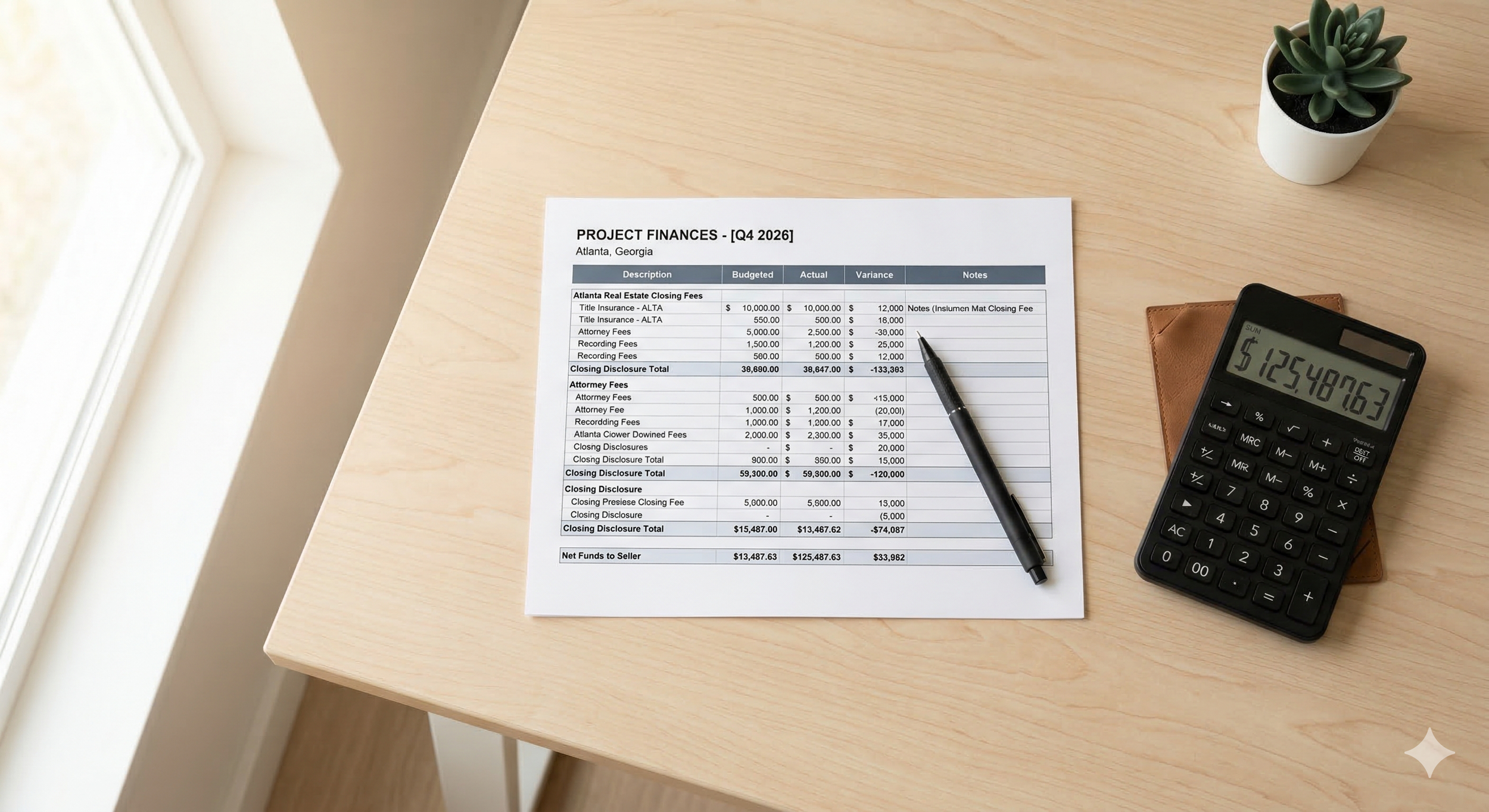
The Closing Disclosure arrives at least three business days before closing. It is the final, actual version of your closing costs: the real numbers, not estimates. When you receive it, compare it line-by-line to your Loan Estimate. Certain fees cannot increase at all between the estimate and final disclosure (lender fees, title charges if you used the lender's recommended provider). Others can increase within limits. If something looks dramatically different, ask immediately.
The things I see buyers miss most often on the Closing Disclosure:
Prepaid expenses lumped with closing costs. Prepaids are not really "fees." They're money going into your escrow account. They increase the cash you need at closing but they're not lost money; they're funding future expenses you'd pay anyway. Understand the difference before you react to the total.
Fees outside of closing. Inspection fees, appraisal fees, and rate lock fees may have already been paid. They might not appear on the Closing Disclosure or may appear as credits. Know what you've already paid so you're not confused about the total.
HOA fees and docs. If the seller's HOA has fees at closing, they'll appear here. Make sure you know what they are.
Can You Roll Closing Costs Into Your Loan?
Sometimes, and only partially.
Some loan programs allow certain closing costs to be financed, meaning added to your loan balance rather than paid at closing. This reduces what you need to bring to the table but increases your loan amount, your monthly payment, and the total interest you'll pay over the life of the loan.
FHA loans allow the upfront mortgage insurance premium (1.75% of the loan) to be rolled in. VA loans allow certain fees to be financed. Some conventional loans allow specific costs to be included under certain conditions.
What you cannot finance: your down payment, prepaid expenses, and most lender fees on conventional loans. You also cannot simply elect to roll everything in. It has to be structured into the loan from the beginning, and the property still has to appraise at a value that supports the increased loan amount.
This is a lender conversation, not a real estate conversation. Ask your loan officer specifically: which costs can I finance, what does that do to my rate and monthly payment, and is it worth it given my situation?
How Much Cash Do You Actually Need to Close?
Here is the honest answer most people don't get until the week before closing:
Your cash to close = down payment + closing costs − any seller concessions or lender credits.
If you're putting 5% down on a $400,000 home, that's $20,000 in down payment. Add $10,000 to $16,000 in closing costs. You might need $28,000 to $36,000 in total cash to close, before any credits.
That number gets smaller if you've negotiated seller concessions, received assistance from a state or local program, or structured lender credits into your rate. But you need to know the gross number first so you understand what each reduction is worth.
The other thing worth knowing: this cash generally cannot come from a personal loan or credit card. Lenders require documentation of where your closing funds are coming from, and borrowed funds create underwriting problems. Gift funds from a family member are often allowable under specific documentation requirements. Ask your lender about the requirements for your specific loan type.
Who Chooses the Closing Attorney in Georgia?
In Georgia, the buyer typically selects the closing attorney. Attorney fees and practices vary, so you have the right to ask who the closing attorney is before closing. Your agent can help you identify a reliable closing attorney if you don't already have one in mind.
You also have the right to review documents before closing day. Ask for the closing package at least 24 hours in advance. The three-business-day window after receiving your Closing Disclosure exists specifically so you can review everything before you're sitting at the table. Use that time.
How to Reduce Your Closing Costs: What Actually Works
Not everything on your Closing Disclosure is negotiable, but more than buyers realize can be worked.
Compare lenders. This is the single highest-impact action. Lender origination fees, underwriting fees, and rate structure vary significantly. Getting Loan Estimates from three lenders on the same product and comparing them line by line is not extra work. It can save thousands of dollars.
Negotiate the sale contract. Seller concessions, as discussed above, can directly offset your closing costs. This is especially worth requesting in slower markets, with motivated sellers, or on properties that have been sitting.
Ask about assistance programs early. State and local assistance programs can cover a meaningful portion of closing costs. Waiting until you're under contract to ask about eligibility often means the lender hasn't structured the loan to accommodate the program.
Shop for title insurance. In Georgia, buyers can typically choose their own title insurance provider, separate from the closing attorney. Getting a competing quote doesn't always save money. Title rates in Georgia are filed with the state, so premiums are somewhat standardized, but it's worth understanding what you're being charged.
Time your closing strategically. Closing at the end of the month minimizes prepaid interest. It also means you won't owe your first mortgage payment for nearly six weeks, which helps cash flow, but be aware that end-of-month closings are more common and scheduling can get tight.
Don't skip the home inspection to save money. I've seen buyers try to skip inspections to reduce upfront costs, and it almost never ends well. An inspection is one of the only costs in this process that directly protects you. The $400 you spend is the cheapest form of due diligence available.
Georgia Closing Costs vs. Other States: A Direct Comparison
Understanding where Georgia falls relative to other states helps relocating buyers frame their expectations.
States with no attorney requirement (title company states): Most of the country, including Florida, Texas, California, Colorado, and the majority of the Southeast. Closing costs in these states can be lower because attorney fees are replaced by title company/escrow fees, which are often less expensive. However, buyers in these states also receive no independent legal review of the closing documents.
States with high transfer taxes: New York, Maryland, and Connecticut charge substantial transfer taxes that can represent thousands of dollars in additional closing costs for buyers. Georgia's transfer tax ($1 per $1,000 of purchase price, typically paid by the seller) is comparatively modest.
States with high title insurance premiums: Some states, including Texas and Florida, have state-regulated title insurance rates that are higher than Georgia's. Georgia's title insurance premiums are generally in the moderate range.
The mortgage intangible tax. This is the Georgia-specific cost that most catches out-of-state buyers. At 0.3% of the loan amount, it adds roughly $900 to $1,500 on a typical Metro Atlanta purchase. Most states don't have an equivalent.
Net comparison: Georgia buyers typically pay slightly more in attorney-related closing costs than buyers in non-attorney states, and the mortgage intangible tax is a meaningful Georgia-specific line item. On balance, total Georgia buyer closing costs are in the moderate range nationally, generally lower than New York or New Jersey, broadly comparable to the Southeast.
The Most Common Closing Cost Questions I Get
Can the seller pay my closing costs? Yes, through seller concessions, negotiated in your purchase contract. There are caps by loan type (3–6% for conventional, 6% for FHA, 4% + reasonable costs for VA). Whether a seller will agree depends on market conditions and how much leverage you have.
Are closing costs paid upfront or at closing? Most are paid at the closing table, via cashier's check or wire transfer. A few costs (inspection fees, appraisal fee, credit report fee) are typically paid before closing when the service is rendered.
What happens if I don't have enough money to close? This is a situation you want to catch before closing day, not at the table. Your Closing Disclosure gives you at least three days of notice. If you're short, options include negotiating a seller credit, requesting a lender credit (in exchange for a higher rate), or in some cases delaying closing to allow time to gather funds. Walking away from a deal over a few hundred dollars in unexpected fees is often not necessary, but it requires communication well before closing day.
Do I need a real estate attorney in Georgia? There will be a licensed closing attorney present at every residential closing in Georgia. This is required by law. Your buyer's agent helps guide you through the process, and the closing attorney manages the legal and financial mechanics of the transaction.
What's the difference between earnest money and closing costs? Earnest money is a deposit paid when you go under contract that demonstrates your intent to purchase. It is not a fee. If the deal closes, your earnest money is credited toward your down payment or closing costs at the settlement table. Closing costs are the fees and prepaid expenses paid to complete the transaction. They are separate items.
Can closing costs be negotiated in Georgia? Some can. Lender fees are negotiable between you and your lender. Seller concessions are negotiable in the purchase contract. Government fees, recording fees, and transfer taxes are fixed. Title insurance rates in Georgia are state-regulated and largely standardized. Attorney fees vary by firm and complexity. The most impactful negotiation happens at the lender level and the contract level, not by shopping line items on the disclosure.
How long does the closing process take? The actual closing appointment typically takes one to two hours. The process leading up to it (loan processing, appraisal, title work, final underwriting) typically takes 30 to 45 days from the time you go under contract, though some loan types and lenders can move faster or slower. Cash purchases can close in as few as seven to ten days.
What if the appraisal comes in low? If the appraised value is lower than the purchase price, your lender will only lend based on the appraised value. You have a few options: renegotiate the price with the seller, pay the difference between appraised value and purchase price in cash (known as an "appraisal gap"), request a reconsideration of value from the appraiser with supporting comps, or, depending on your contract language, exercise an appraisal contingency and exit the deal. This is a common situation in competitive markets. Understanding your contract language on this before you're in the situation matters.
Is the closing disclosure the same as the HUD-1? No. The HUD-1 Settlement Statement was replaced by the Closing Disclosure in 2015 for most loan transactions as part of federal TRID (TILA-RESPA Integrated Disclosure) rule changes. You may still hear older agents or sellers reference the HUD-1, but the document you'll receive is the Closing Disclosure. Cash transactions may still use a simpler settlement statement rather than a full Closing Disclosure.
Ready to Buy in Georgia?
The closing table is not where you want to learn what closing costs are. Understanding them early, before you've written your first offer, means you can budget accurately, compare lenders intelligently, and negotiate from a position of knowledge rather than surprise.
Nearly ten years helping Metro Atlanta buyers means I've sat at a lot of closing tables and walked through a lot of Closing Disclosures. If you have questions about what your specific situation looks like (first-time buyer, relocation, investment property, down payment assistance), let's talk through it.
Visit kristenjohnsonrealestate.com or reach out directly. Come as you are, come on home.
Buying a home in Metro Atlanta? I've put together neighborhood guides covering the full region, including East Cobb, Marietta, Smyrna, and Vinings. Browse the full guide series at kristenjohnsonrealestate.com.