

Why Do City-Wide Stats and My Neighborhood Comps Tell Different Stories? What Metro Atlanta's 2026 Numbers Really Mean

City-wide stats and your neighborhood comps tell different stories because they measure two different things. A metro-wide median price is the midpoint of everything that closed across an eleven-county region in a single month, blended together regardless of location, size, age, condition, or property type. Your neighborhood comps are a tight set of recent sales matched to your specific home: your submarket, your block, your price tier, your square footage. One describes a region of more than six million people. The other describes your house.
So when you read that "Atlanta home prices fell 1.6% year over year" and then your agent pulls comps showing homes like yours selling for the same or more than they did last year, that is not a contradiction. That is two instruments measuring two different things and reporting exactly what each was built to report.
I work with buyers and sellers across Metro Atlanta, and this is one of the most common sources of confusion I see. A seller reads a national headline and panics. A buyer reads a metro median and assumes that is what a home in Morningside should cost. Both are anchoring to a number that was never meant to describe their specific situation.
Nearly a decade.
That is roughly how long I have spent pricing homes, reading comps, and explaining to people why the number in the news rarely matches the number on their street. The gap between the two is not a flaw in the data. It is the difference between a regional average and a real estate transaction.
Here's what you need to know.

What is the difference between city-wide stats and neighborhood comps?
A city-wide stat answers the question, "What is happening across the entire market on average?" A neighborhood comp answers the question, "What is a home like this one, in this exact location, worth right now?" Those are not the same question, and they almost never produce the same number.
City-wide stats are aggregate figures. They take every closed sale in a defined area over a defined period, line them up, and report a midpoint (the median) or an average. They are useful for spotting direction: is the market broadly heating up, cooling down, or holding steady. They are terrible at telling you what your individual home is worth, because they fold thousands of dissimilar properties into one figure.
Neighborhood comps are the opposite. A comp is a recently closed sale of a property that is genuinely comparable to yours: similar size, similar age, similar condition, similar lot, in the same submarket, ideally within the last three to six months. Appraisers and agents start with those raw sales and then adjust for differences (an extra bedroom, a renovated kitchen, a smaller lot, a busier street) to arrive at a supported value for one specific home. Comps are precise because they are narrow. City-wide stats are broad because they are not trying to be precise about any single property.
The table below lays out how differently the two are built and what each one is actually good for.
| Factor | City-Wide Stats | Your Neighborhood Comps |
|---|---|---|
| What it measures | The midpoint of every sale across a region | The value of one specific home like yours |
| Geographic scope | Up to 11 counties, millions of people | Your submarket, often a few blocks |
| Sample | Whatever happened to sell that month | A curated set of genuinely similar homes |
| Property types | All types blended together | Matched to your exact type |
| Adjusts for condition and features | No | Yes, line by line |
| Best used for | Reading market direction and leverage | Pricing a listing or writing an offer |
| Reliable for valuing your home | No | Yes |
The takeaway: if you are trying to understand the mood of the regional market, city-wide stats are your tool. If you are trying to price a listing, write an offer, or decide whether to appeal a tax assessment, comps are the only number that matters. Using the wrong one for the job is how people overprice, underbid, or talk themselves out of a sound decision.
Why do Zillow, FMLS, and Georgia MLS all report a different Atlanta median price?
They report different numbers because they are not measuring the same Atlanta, they are not pulling from the same set of sales, and they are not using the same method. "Metro Atlanta median price" sounds like one fixed fact. It is not. It is several different calculations wearing the same name.
Here is what I mean. In early 2026, the official Atlanta REALTORS Association market brief, compiled by First Multiple Listing Service across eleven counties, put the median sales price around $418,000. Georgia MLS, drawing from its own pool of listings, reported a metro median closer to $389,000 over a similar stretch. Zillow's home value index for the city of Atlanta sat near $380,000. Homes.com, using the Census-defined metro statistical area, landed around $395,000. Same region, same general moment, four different headline numbers spread across nearly $40,000.
| Source | Reported Atlanta Median (approx., early 2026) | What it reflects |
|---|---|---|
| FMLS / Atlanta REALTORS Assoc. | ~$418,000 | Defined 11-county footprint, closed MLS sales |
| Georgia MLS | ~$389,000 | Its own pool of metro listings |
| Zillow Home Value Index | ~$380,000 | A modeled estimate for the city of Atlanta |
| Homes.com (Census CBSA) | ~$395,000 | Census-defined metro statistical area |
None of these sources is lying. They diverge for concrete reasons:
Different geographic boundaries. FMLS reports on a specific eleven-county footprint (Cherokee, Clayton, Cobb, DeKalb, Douglas, Fayette, Forsyth, Fulton, Gwinnett, Paulding, and Rockdale). Zillow's "Atlanta" can mean the city proper or a metro region depending on the page. The Census metro area includes counties that stretch the average in one direction. When the boundary changes, the number changes, because you are literally counting different houses.
Different data feeds. Not every sale runs through every MLS. A home listed on FMLS may not appear in Georgia MLS, and a portal like Zillow estimates values using a model rather than a clean count of closed sales. Different inputs, different outputs.
Different methods. A median is the middle sale. An average is the arithmetic mean. A home value index is a modeled estimate of typical value. These are three different statistical operations, and they will rarely agree.
So when someone quotes "the Atlanta median," the first question is always: whose median, over what counties, by what method, for what month. Until you know that, the number is just a number.

What does a metro-wide median actually measure?
A metro-wide median measures the midpoint of whatever happened to sell that month, not the change in value of any home that already exists. This is the single most misunderstood point in real estate data, so it is worth slowing down on.
The median is found by lining up every closed sale from lowest to highest and taking the one in the middle. If 4,600 homes sold across Metro Atlanta in a given month, the median is the price of roughly the 2,300th home on that list. That number tells you what the typical closed sale looked like. It does not track a fixed basket of homes over time the way the consumer price index tracks the same goods month after month. Each month, the median is calculated on an entirely new set of houses that happened to close.
That distinction matters enormously, because the homes that sell in March are not the same homes that sold in March a year earlier. The mix changes. And when the mix changes, the median moves even if not one single home changed in value. I will show you exactly how in the next two sections, because this is where most of the "wait, that does not match my street" confusion comes from.
Why can the median drop even when no home lost any value?
The median can drop purely because the mix of what sold shifted toward lower-priced homes, with no individual property losing a dollar. This is called the composition effect, and it is the quiet engine behind a lot of scary headlines.
Picture two months in a single submarket. In the first month, ten homes sell, and a couple of them are big, recently renovated houses at the top of the range. Those high sales pull the midpoint up. In the second month, ten homes sell again, but this time more of the closings are smaller starter homes and condos, and the high end happens to be quiet. The midpoint drops. If you only read the median, it looks like prices fell. In reality, every individual home may be worth exactly what it was worth, or even slightly more. What changed was which homes crossed the finish line that month.
This happens constantly in Metro Atlanta because we have such a wide range of housing and such uneven activity across price tiers. A surge of entry-level closings during a strong first-time-buyer stretch can pull the metro median down even while values in the move-up and luxury tiers hold firm. A quiet month at the top end does the same thing. The headline says "prices fell." The truth is "the average home that sold this month was a less expensive home than last month's average."
This is precisely why I do not let sellers price off a metro median, and why I tell buyers not to read a falling median as proof they can lowball every home in town. The number moved. Your house did not necessarily move with it.
How do condos, townhomes, and single-family homes skew the metro number?
Property type mix can drag the overall metro number in a direction that has nothing to do with the segment you are actually shopping or selling in. Different property types are moving at very different speeds right now, and when they get blended into one "Atlanta median," the result hides more than it reveals.
In early 2026, the segments split sharply. Single-family home prices across the metro were close to flat year over year, slipping less than one percent. Townhomes were down a few percent. Condos were down meaningfully more, on the order of seven to eight percent year over year, with condo inventory rising sharply. Now imagine all three get poured into one metro median. The soft condo and townhome numbers pull the blended figure down, which makes it look like the whole market softened. But if you own or are buying a single-family home in an established submarket, the condo correction has almost nothing to do with your value.
This is the trap of a single headline number. "Atlanta prices fell" can be true in the aggregate and irrelevant to you at the same time, because the decline lived in a segment you are not even in. A buyer comparing a renovated bungalow to "the Atlanta median" is comparing a single-family home to a number that has been dragged down by condos. A seller of that same bungalow who panics over the metro figure is reacting to a correction in a different product entirely.
Comps fix this automatically, because a proper comp set only includes the same property type as the subject home. You never compare a condo sale to a single-family listing in a real valuation. The metro median, by contrast, mixes them all together and calls it one market.
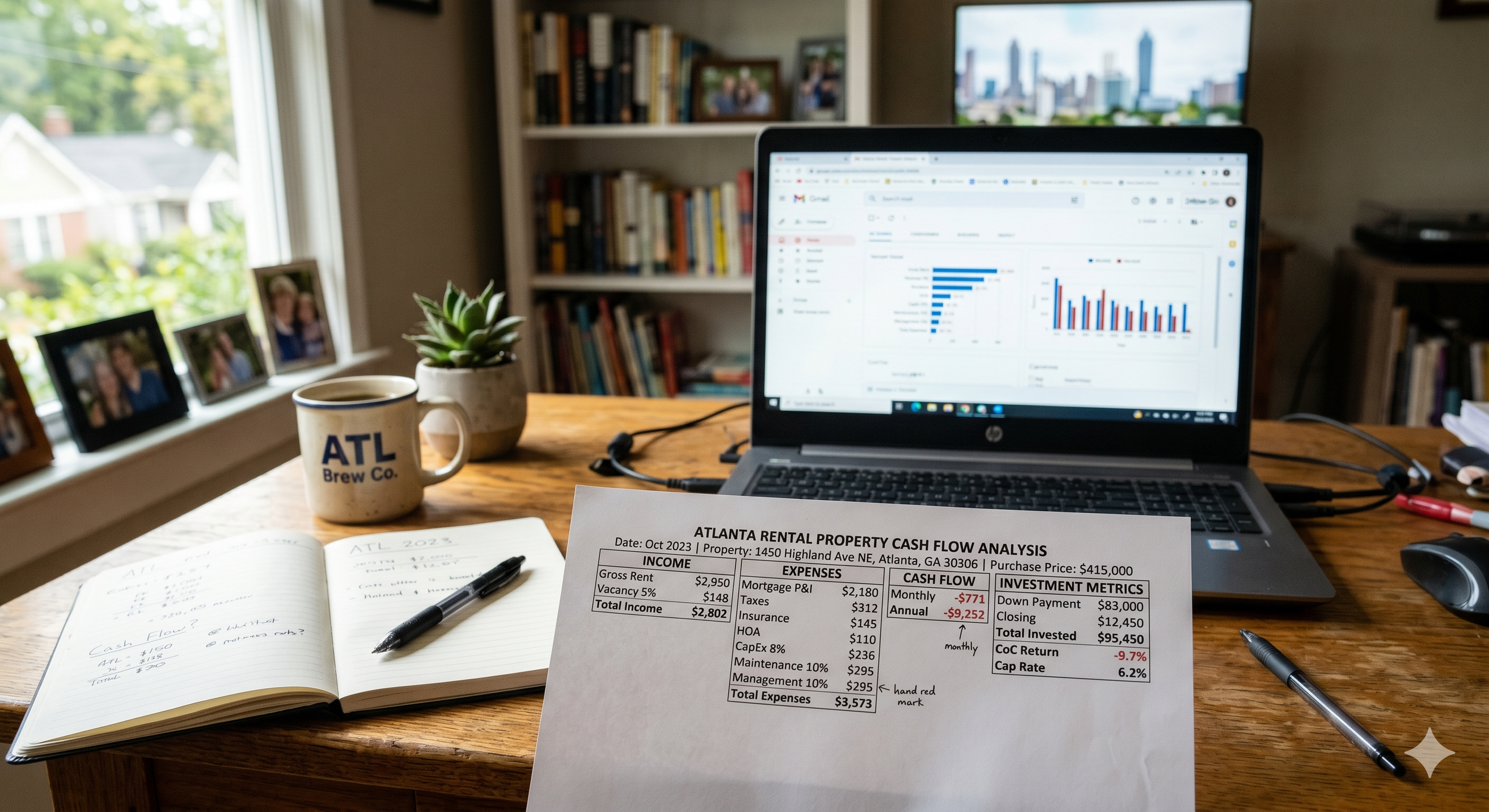
What do neighborhood comps measure that city-wide stats can't?
Comps measure the actual market for your actual home: same location, same type, same size and condition, same recent window, adjusted for the specific differences that move price. That is everything a metro stat throws away in the name of getting one tidy regional figure.
A genuine comp analysis controls for the variables that aggregate data deliberately ignores:
Location at the block level. Two homes a mile apart in Metro Atlanta can differ by hundreds of thousands of dollars based on school zone, BeltLine proximity, walkability, lot, and street. Comps stay inside your actual submarket. The metro median spans Buckhead estates and South Metro starter homes in the same calculation.
Property type and style. Comps match like to like. A craftsman bungalow is compared to other craftsman bungalows, not to a high-rise condo and a new-construction townhome averaged together.
Condition and updates. A renovated kitchen, a new roof, a finished basement, an unpermitted addition. Comps adjust for these. Aggregate stats cannot see them at all.
Recency. A strong comp closed in the last three to six months. A metro median for one month is a snapshot, and it gets revised as late sales report in, so even the headline figure you read today may change next month.
Closed price, not list price. Comps are built on what homes actually sold for, then reconciled against what is currently active and pending so you can read the direction of the market in real time. That is a far sharper instrument than a regional midpoint.
When I price a listing or evaluate a home for a buyer, I am building this kind of narrow, adjusted picture. It is slower and more work than quoting a headline, and it is the only method that produces a number you can actually transact on.
Why is "Metro Atlanta" too broad to describe my home's value?
"Metro Atlanta" is too broad because it bundles dozens of distinct submarkets, moving in different directions at the same time, into a single average that describes none of them. The phrase is a geographic convenience, not a market.
The official Metro Atlanta footprint covers eleven counties and well over six million people. Inside that boundary you have ultra-luxury enclaves where the median sits north of a million dollars, established intown neighborhoods in the high six figures, solid suburban family markets in the four-to-six-hundreds, and affordable South Metro communities where you can still buy a single-family home well under the regional median. These areas do not rise and fall together. In any given quarter, North Metro inventory may be climbing while an intown pocket stays tight, luxury may be holding firm while condos correct, and one county's schools keep demand competitive while another's market softens.
Average all of that into one number and you get a figure that is mathematically real and practically useless for your decision. It is like reporting the average temperature of the United States. Technically valid, completely unhelpful if you are deciding what to wear in Atlanta today.
This is also why out-of-town data and national portals so often get Atlanta wrong. A model that treats the metro as one uniform market misses the block-by-block reality that determines value here, and it routinely misjudges commute times, neighborhood character, and price dynamics that anyone working these submarkets daily would catch immediately. If you have ever felt like your area is moving differently than the citywide story suggests, you are not imagining it. I wrote more about that gap in Why Does My Area Feel Flat If Atlanta Is Still Expensive?, and the same divergence is why North Metro inventory has been rising while other submarkets stayed competitive.
Median vs. average: why do they sometimes move in opposite directions?
The median and the average move in opposite directions when the mix of sales shifts at the high or low end, because the two figures respond to that shift in completely different ways. You will sometimes see a market brief report that the median fell while the average rose in the same month, and that is not an error.
The median is the middle sale, so it is stable against outliers. One thirty-million-dollar estate closing does not move the midpoint much, because it is still just one sale sitting at the far end of the line. The average, by contrast, is sensitive to every dollar. A handful of high-end closings can lift the average noticeably even if the typical home did not change.
So in a month with several luxury sales but a generally softer mix of typical homes, the average can climb while the median slips. Each number is telling a true story about a different part of the market: the median says the typical sale was a bit lower, the average says the total dollars closed skewed higher because of activity at the top. Neither one tells you what your specific home is worth. Only your comps do that. If you want the longer view on how these regional figures have been behaving, I broke it down in Are Atlanta Prices Dropping or Just Normalizing?
How should I use each number if I'm buying in 2026?
Use city-wide stats to read leverage and direction, and use comps to decide what to actually offer. They serve different stages of your search, and confusing them costs buyers money.
Metro stats are how you take the temperature before you start. In early 2026, the regional picture showed inventory building toward roughly four months of supply, days on market lengthening, and bidding wars becoming the exception rather than the rule across much of the market. That is genuinely useful context. It tells you that you likely have more room to negotiate, more time to evaluate, and less pressure to waive protections than buyers faced in 2021 and 2022. That broad read shapes your strategy and your mindset.
But the moment you find a specific home, the metro number becomes irrelevant. What matters then is: what have similar homes in this exact submarket closed for in the last few months, how long has this one been sitting, how does its condition compare to those comps, and where is the supported value. A home in a tight intown pocket may still draw competition even in a softer regional market, while an overpriced listing in a slower segment may be ripe for a real negotiation. Comps, not the metro median, tell you which situation you are in. For the tactical side of writing offers in this market, I went deep in Negotiating in the 2026 Atlanta Market.

How should I use each number if I'm selling in 2026?
As a seller, treat city-wide stats as background and price strictly off your comps, because buyers and appraisers in your submarket will do exactly that. The metro median is the worst possible number to anchor your price to, and it is the one sellers reach for most.
Here is the failure I see. A seller reads that the metro average is over $500,000, decides their home is "above average," and prices accordingly, ignoring that their actual submarket comps support a very different figure. Or the reverse: a seller reads that "Atlanta prices fell" and slashes their price out of fear, leaving money on the table when their specific block never softened. Both are pricing off a regional number that was never about their house.
What actually determines your sale price is a narrow set of recent, comparable closings in your neighborhood, adjusted for your home's condition and features, read against current active and pending listings. In a market where buyers are more deliberate and inventory is fuller, correct pricing in the first one to two weeks is everything. Well-priced homes in good locations still move quickly. Overpriced homes sit, go stale, and eventually sell for less than they would have with accurate pricing from day one. The spread between fast sales and homes sitting one hundred-plus days is almost always a pricing-against-comps story, which I broke down in Why Are Some Atlanta Homes Selling in a Month While Others Sit 100+ Days?
Comps protect you in both directions. They keep you from overpricing into a stall and from underpricing out of panic.
How do I find the comps that actually apply to my home?
You find true comps by matching on submarket, property type, size, age, condition, and recency, then adjusting for the differences, and the honest answer is that doing it well requires access and judgment that a public portal cannot replicate. This is the part people most often try to shortcut, and it is where the biggest pricing mistakes happen.
A portal estimate is a model. It guesses your value from broad data and cannot see your renovated primary bath, your updated systems, the fact that your lot backs to a busy road, or the unpermitted square footage that will not count in an appraisal. It also tends to lean on a wider geographic radius than a real comp set should. That is why two homes on the same street can carry wildly different online estimates, and why those estimates routinely miss by tens of thousands of dollars in either direction.
A real comp analysis starts from closed MLS sales in your actual submarket, filters to genuinely similar homes, throws out the sales that are not truly comparable, and adjusts the rest for the specific ways your home differs. It then reconciles those closed sales against what is currently active and pending, because that is what tells you where the market is heading rather than where it was. That process is what produces a defensible value, the kind that survives an appraisal and an inspection and a deliberate 2026 buyer.
This is the work I do for every listing and every buyer I represent. If you want to know what your specific home is worth, or what you should actually offer on one, that answer does not live in a headline. It lives in the comps.
Frequently Asked Questions
Why is the Zillow estimate of my home different from what my agent says it's worth? Because they are produced two completely different ways. A portal estimate is a computer model that guesses value from broad regional data and cannot see your home's condition, updates, lot specifics, or permitted square footage. An agent's value comes from a hand-built comp analysis of recent similar sales in your exact submarket, adjusted for your home's real features. The model is fast and broad. The comp analysis is narrow and accurate for your specific property. When they disagree, trust the comps.
Which Atlanta median price is the "real" one? There is no single real one, because each source measures a different geographic area with a different method and a different set of sales. The FMLS and Atlanta REALTORS Association figures cover a defined eleven-county footprint and are widely used by local agents. Georgia MLS, Zillow, and the Census-based metro figures each define Atlanta differently and will report different numbers. The right question is not which is real, but which area, method, and time period the number reflects.
Can the median price fall while my home gains value? Yes, and it happens often. The metro median reflects the mix of homes that sold that month, not the value of any home that already exists. If more lower-priced homes or condos close in a given month, the median can fall even though single-family values in your neighborhood held steady or rose. Your comps, not the metro median, tell you what happened to your home.
Why does the news say Atlanta prices dropped when homes near me are still selling fast? Because "Atlanta" in a headline usually means a blended figure across the entire metro, which can be pulled down by softer segments like condos or by a shift in which homes sold, even while your specific submarket stays competitive. Metro Atlanta is dozens of submarkets moving at different speeds, and the headline averages them all into one number that may not describe your street at all.
How recent does a comp need to be to be useful? Generally within the last three to six months for an active market, and closer to three months when conditions are shifting quickly. Older sales can still inform the picture, but they need to be weighed carefully against current active and pending listings, because the market today may be moving in a different direction than it was six months ago.
Should I use city-wide stats at all when buying or selling? Yes, for the right job. City-wide stats are good for reading the broad direction of the market, your general leverage, inventory levels, and how long homes are taking to sell. They set your strategy and expectations. They are not built to price an individual home. For that, you need comps. Use each tool for what it does well.
Why do average and median prices sometimes move in opposite directions in the same month? Because they respond differently to high-end sales. The median is the middle sale and barely moves when a few luxury homes close. The average is sensitive to every dollar, so a handful of high-end sales can lift it even while the typical sale, and therefore the median, slips. Both can be true at once, and neither tells you your home's specific value.
What's the most common pricing mistake people make with these numbers? Anchoring to the metro figure instead of their submarket comps. Sellers overprice because the regional average sounds high, or panic-cut because a headline says prices fell. Buyers lowball every home because the median dropped, or overpay because they assume their target neighborhood matches the regional number. In both cases the fix is the same: price and offer off the comps that actually apply to the specific home.
Let's talk
I work with buyers and sellers throughout Metro Atlanta, and I read the numbers that actually apply to your home, not the headline that applies to six million people. If you are trying to price a listing, evaluate an offer, or just understand what your specific submarket is doing, that is exactly the conversation I am built for.
Visit kristenjohnsonrealestate.com or reach out directly. Come as you are, come on home.
Looking for more on how the 2026 Metro Atlanta market actually works? I've covered Why Does My Area Feel Flat If Atlanta Is Still Expensive?, Are Atlanta Prices Dropping or Just Normalizing?, and Why Are Some Atlanta Homes Selling in a Month While Others Sit 100+ Days?. Browse the full series at kristenjohnsonrealestate.com.