

Which Atlanta Neighborhoods Are Up-and-Coming in 2026? Following the Infrastructure and Development Money
The Atlanta neighborhoods drawing the most new investment in 2026 are the ones sitting next to something physical that is opening this year: a BeltLine segment, a transit line, a park, or a multibillion-dollar development. Downtown and South Downtown, Summerhill and Peoplestown, the Southside BeltLine corridor, Grove Park and the Westside, the southwest intown trail neighborhoods, Chamblee and Doraville, and the airport-corridor cities of East Point, College Park, and Hapeville are all seeing measurable activity tied to projects you can stand in front of and verify.
I work with buyers across Metro Atlanta, and "up-and-coming" is the phrase I hear more than almost any other. It usually means something vague: a feeling that an area is on the move. I read it differently. I read it through the public and private money already committed and the timelines attached to it, because that is the part you can actually check before you write an offer.
That distinction matters in 2026 more than it used to, because the metro market has cooled into something closer to balance. When prices are climbing everywhere, location detail gets papered over. When they flatten, the difference between a confirmed, funded project and a press-release rendering is the difference between a smart entry price and an expensive guess.
Here's what you need to know.
How I'm Defining "Up-and-Coming" in This Post
I am not ranking neighborhoods by vibe, buzz, or who is moving in. I describe what is being built and funded, not who lives anywhere. That is both the honest way to do this and the legally correct way under Fair Housing law, and it happens to produce better information anyway.
So every area on this list earns its place through at least one verifiable catalyst:
Public infrastructure that is open or opening in 2026: a BeltLine trail segment, a transit line, a park.
Major announced private development with money committed: a named project, a dollar figure, a construction status you can confirm.
Price and inventory data that shows where the market sits today relative to the metro.
If a project is only a rendering or a "planned" line item with no funding and no groundbreaking, I will tell you that directly. A lot of Atlanta neighborhood hype is built on the second category dressed up as the first.
One more note on the data. Median prices move month to month, and small neighborhoods with few sales can swing wildly on a handful of transactions. The figures below are sourced and dated where I cite them, but for a current, address-level read on any of these areas, you should pull live comps. I am happy to run those for you.
The 2026 Market Backdrop
Before the neighborhoods, the frame they sit inside.
As of the March 2026 Atlanta REALTORS / FMLS Market Brief covering the 11-county core, the metro median sales price was about $418,000, down roughly 1.6 percent year over year, with the average sale price around $525,500. Active listings stood near 17,723, up about 5 percent from a year earlier, putting the metro at roughly four months of supply. Single-family sales actually rose about 4 percent year over year that month, so demand is steady, not absent.
The City of Atlanta proper runs higher and a bit softer. Redfin put the citywide median around $425,000 for the three months ending April 2026, essentially flat year over year, with homes taking a median of about 64 days to sell. Mortgage rates have settled into the low-6 percent range for much of 2026.
| Metric (Metro Atlanta, 11-county core) | Reading | Source / date |
|---|---|---|
| Median sales price | ~$418,000 (about -1.6% YoY) | Atlanta REALTORS / FMLS, Mar 2026 |
| Average sales price | ~$525,500 | Atlanta REALTORS / FMLS, Mar 2026 |
| Active listings | ~17,723 (about +5% YoY) | Atlanta REALTORS / FMLS, Mar 2026 |
| Months of supply | ~4.0 months (near balanced) | Atlanta REALTORS / FMLS, Mar 2026 |
| City of Atlanta median | ~$425,000 (roughly flat YoY) | Redfin, 3 mo. ending Apr 2026 |
| City of Atlanta median days on market | ~64 days | Redfin, Apr 2026 |
| Typical 30-year mortgage rate | Low-6% range | 2026 market reporting |
Figures move month to month and vary by source and coverage area. Verify current numbers before acting.
The short version: more inventory, more time, more negotiating room than buyers have had in years, and price growth that has flattened across most of the metro. That backdrop is exactly why the where matters. Appreciation is no longer a rising tide. It is increasingly tied to specific, local catalysts. Here is where those catalysts are concentrated.
Downtown and South Downtown
The catalyst here is the largest concentration of construction in the city and a global event arriving in June.
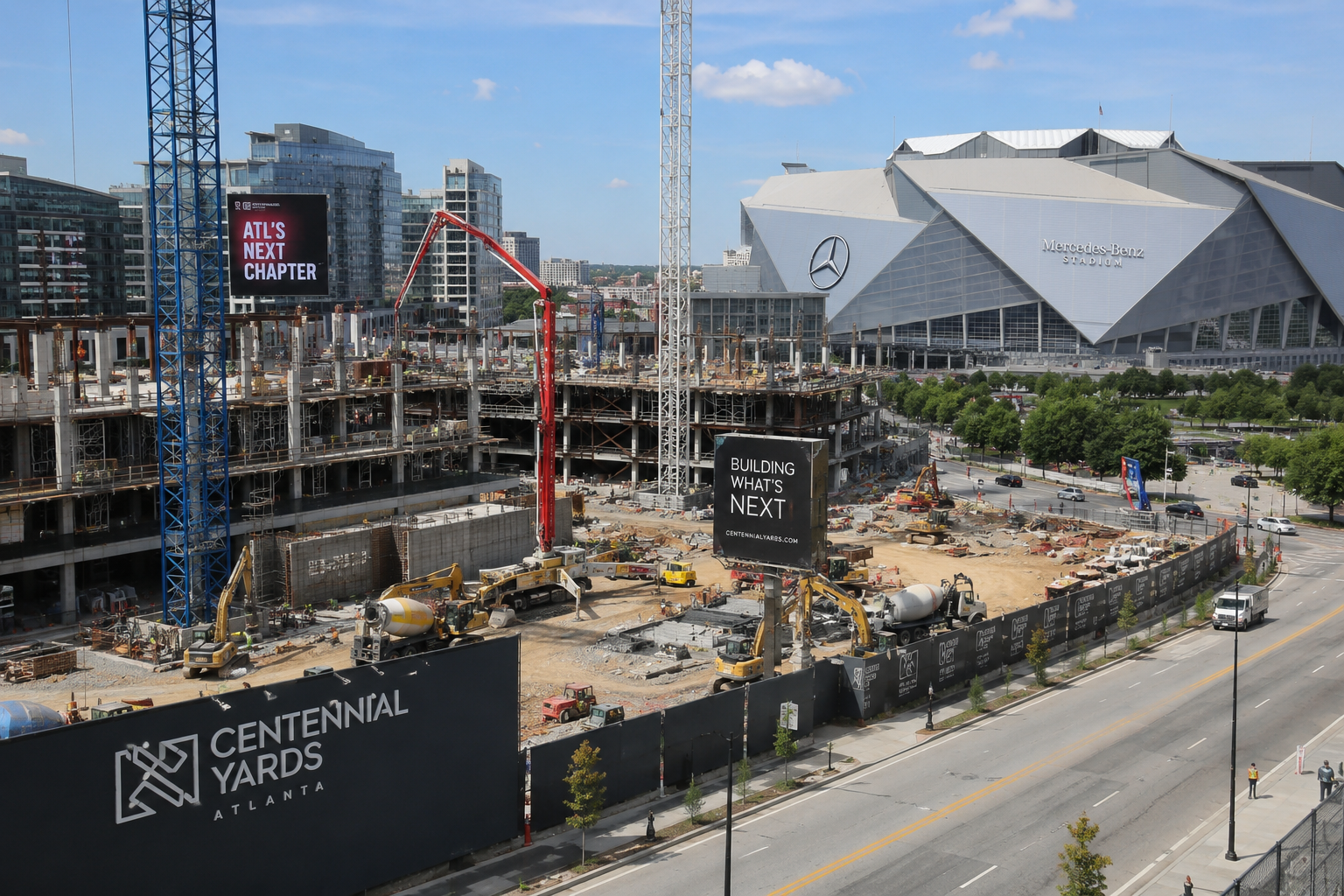
Centennial Yards, the roughly $5 billion redevelopment of the former Gulch across from Mercedes-Benz Stadium, is delivering its first wave in 2026. The Hotel Phoenix is open, the 304-unit Mitchell apartment tower opened in 2025 (studios started around $1,450 a month, with 20 percent of units set aside as affordable under a 99-year agreement with the city), and Cosm, a 70,000-square-foot immersive entertainment dome, is scheduled to open June 10, one day before Atlanta's first FIFA World Cup match on June 15. The full 50-acre buildout runs to roughly 2031, so this is a years-long story, not a finished one.
Next door, the South Downtown district (the historic blocks between Five Points and Garnett MARTA and the stadiums) is being renovated building by building, with a row of restaurants opening near a reworked Broad Street and an activated town square aimed at the World Cup crowds. MARTA's Five Points station, the system's busiest hub, is in the middle of a major modernization. The mayor has also moved to create a downtown enterprise zone to capture World Cup revenue and reinvest it locally.
For buyers, downtown is mostly a new-construction and condo market rather than a single-family one. The honest read: this is the highest-visibility bet on the list and the one with the most public momentum behind it, but also the one where the headline project is least finished. If you are buying a downtown condo in 2026, you are buying into a district that is genuinely changing and genuinely under construction at the same time.
Summerhill and Peoplestown
The catalyst here opened in April 2026: the MARTA Rapid A-Line, the city's first bus rapid transit line.
The Rapid A-Line (also called Rapid Summerhill) launched its first phase on April 18, 2026, alongside MARTA's NextGen Bus Network, the first ground-up redraw of the bus map since the 1970s. The five-mile, 14-stop BRT loop connects downtown to Capitol Gateway, Summerhill, Peoplestown, and the BeltLine's Southside Trail, with rail transfers at Five Points, Georgia State, and Garnett. Buses run with dedicated lanes in places and target 10-to-15-minute frequency. Phase two, completing the remaining stations, is slated for fall 2026.
That transit line sits on top of more than a decade of redevelopment around the old Atlanta-Fulton County Stadium site, where Georgia Avenue has added retail, a Publix, and a steady run of new townhomes and single-family infill.
The price reality: this area has already moved. NeighborhoodScout pegged the Peoplestown/Summerhill median around $635,000 in early 2026, and Summerhill townhome listings have hovered near $600,000. New-construction townhomes and detached homes drive a lot of that. If you are looking for an early-entry price here, you mostly missed it. What you get now is a close-in, increasingly transit-served Southside location at intown prices. I cover the area in more depth in my Summer Hill neighborhood guide, and the adjacent Grant Park guide is worth reading alongside it.
The Southside BeltLine Corridor: Pittsburgh, Chosewood Park, Capitol View, and Sylvan Hills
The catalyst here is the BeltLine's most significant 2026 milestone: the first continuous connection between the Eastside and Westside trails.
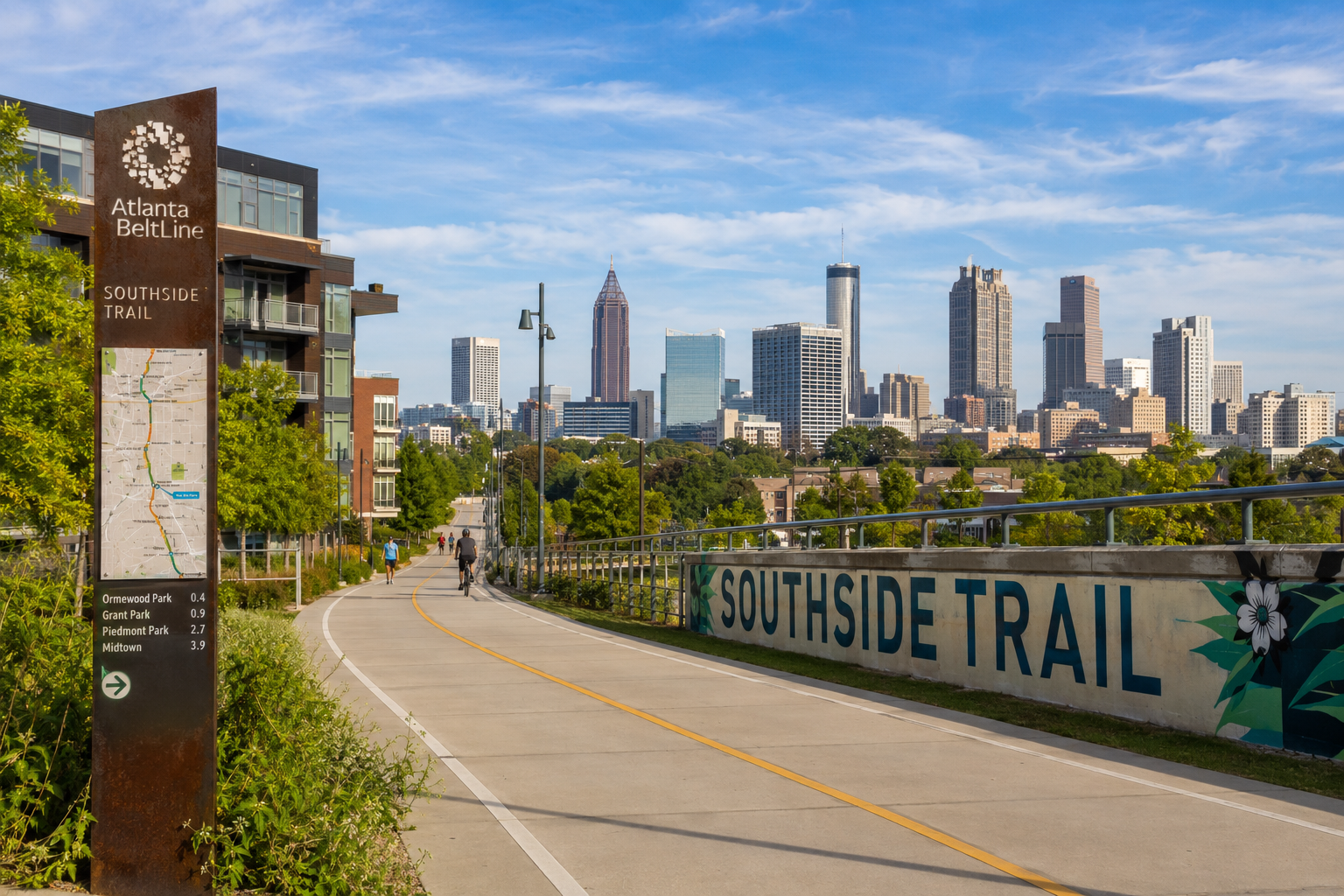
Southside Trail Segments 4 and 5 (Boulevard to Glenwood, connecting Grant Park, Ormewood Park, and Boulevard Heights) held a ribbon cutting on April 16, 2026. Segments 2 and 3, running 1.9 miles from Pittsburgh Yards to Boulevard, were fast-tracked to open before June, completing roughly 16.3 miles of continuous mainline trail and linking 36 neighborhoods for the first time. Pittsburgh Yards, a Annie E. Casey Foundation development on the old rail yards, anchors the western end of that connection.
This is the corridor where the trail itself is the change. Pittsburgh, founded in the 1880s and one of Atlanta's oldest historically Black neighborhoods, sits directly on the new segment, along with Chosewood Park, Capitol View, and Sylvan Hills. These areas hold a deep stock of early-1900s bungalows and cottages, and the corridor has seen steady renovation and new infill construction alongside the public trail investment.
On price, this stretch generally trades below the City of Atlanta median, with renovated and new-construction product pushing well above the older unrenovated stock on the same block. That block-by-block spread is real and it is wide, which is exactly why live comps matter more here than a neighborhood-wide median. If you want to be on the trail at a Southside price, this is the corridor to watch, with the understanding that "on the trail" and "two blocks off it" can be very different numbers.
Grove Park, Bankhead, and the Proctor Creek Greenway
The catalyst here is the largest park in the city and the greenway feeding into it.
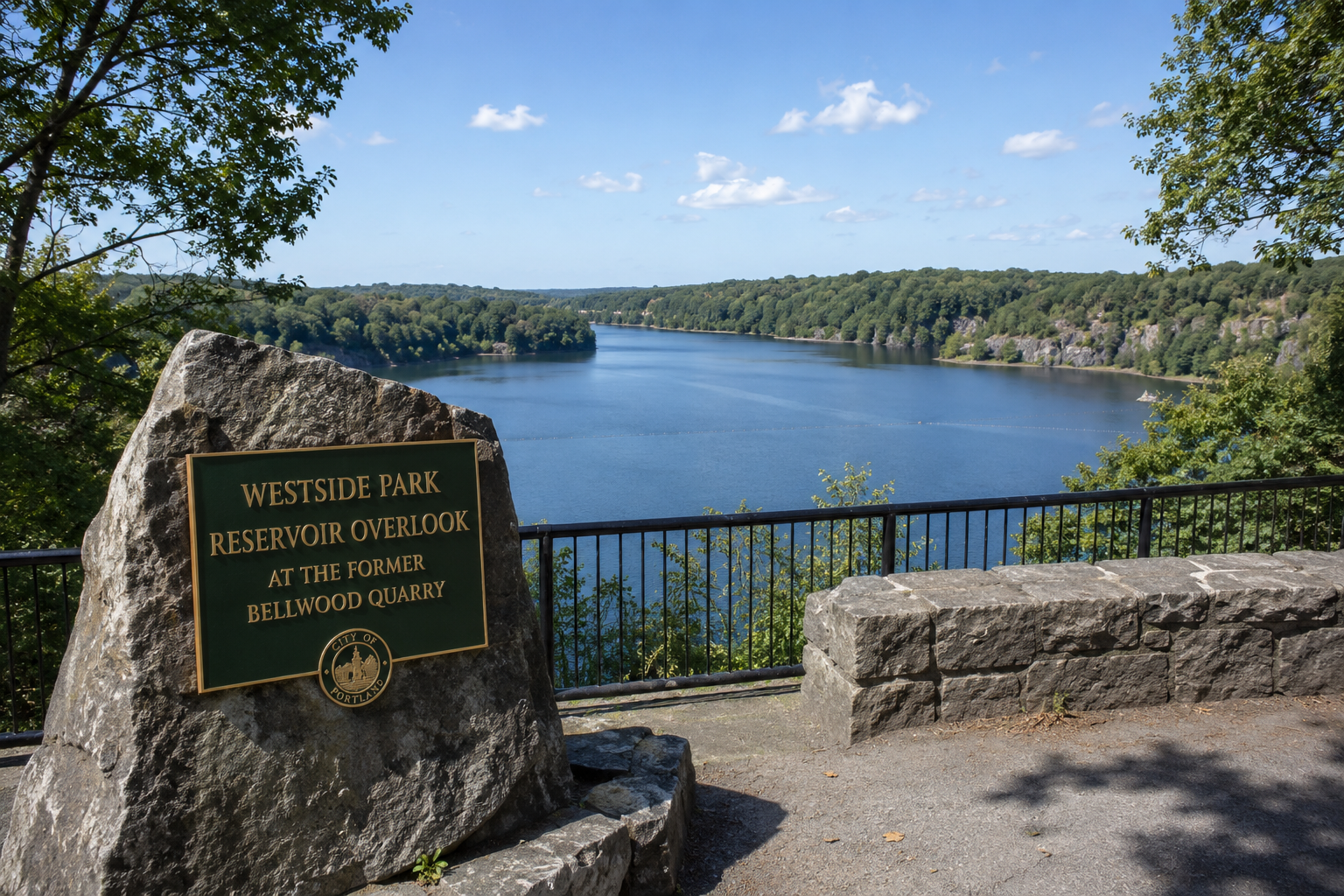
Westside Park, officially renamed Shirley Clarke Franklin Park, opened in 2021 on the former Bellwood Quarry between Grove Park, Bankhead, and Knight Park/Howell Station. At roughly 280 acres around a 2.4-billion-gallon reservoir, it is Atlanta's largest greenspace, with about five miles of paved trails and panoramic skyline overlooks. It connects to the Proctor Creek Greenway and will ultimately tie into the BeltLine's Northwest Trail. The Arthur M. Blank Family Foundation contributed a $17.5 million grant toward the surrounding BeltLine work.
Grove Park and Bankhead are historically Black Westside neighborhoods with a long civic history, and the public investment flowing through them (the park, the greenway, future trail connections) is concentrated and verifiable. The for-sale market here generally sits below the city median, and rents are among the most affordable in the city, with new infill construction near the park commanding higher numbers.
The honest tradeoff: parts of the Northwest BeltLine connection are still years out (design and construction on some Westside connector segments run into 2027 and 2028), so this is a buy-near-the-amenity-that-already-exists play, anchored by the park that is open today, with future trail upside that has timelines you should verify rather than assume.
The Southwest Intown Trail Neighborhoods: West End, Adair Park, and Oakland City
The catalyst here is the Westside Trail plus a cluster of adaptive-reuse development and a planned Campbellton Road transit line.
West End, Adair Park, and Oakland City sit along the BeltLine's Westside Trail, and the surrounding development is concrete: Lee + White, the warehouse district turned food-and-beverage hall on the Westside Trail, and the long-planned Murphy Crossing redevelopment on the old State Farmers Market site. Westside Trail Segment 6, connecting Lawton Street to Ralph David Abernathy Boulevard, is in active construction. The Oakland City MARTA station is the planned northern terminus of MARTA's proposed Campbellton Road bus rapid transit line, a roughly six-mile, nine-station corridor running toward Greenbriar in southwest Atlanta.
West End carries real legacy weight: it borders the Atlanta University Center, the largest consortium of historically Black colleges in the country, including Spelman, Morehouse, and Clark Atlanta. That institutional anchor is part of what makes the area's investment story durable rather than speculative.
These neighborhoods trade at intown-affordable prices that have risen with the trail, and I have written full guides on each with current numbers worth reading before you tour: West End, Adair Park, and Oakland City. The nearby Mozley Park guide covers another Westside option in the same orbit.
Chamblee and Doraville
The catalyst here is one of the largest film and mixed-use developments in the state, sitting on top of MARTA rail.
Assembly, the 135-acre redevelopment of the former General Motors plant in Doraville, is anchored by Gray Television's "Studio City," with 19 sound stages open in its first phase and plans for apartments, townhomes, a hotel, offices, and retail across the rest of the site. The project is projected to bring roughly 4,000 jobs, and Serta Simmons Bedding relocated its headquarters next door. The site sits directly on MARTA's Gold Line and I-285, and Assembly Atlanta has become an active production hub, including for network television.
Chamblee and Doraville also sit on the Buford Highway corridor, home to the Buford Highway Farmers Market and one of the deepest concentrations of international restaurants and groceries in the Southeast, which is an observable amenity that draws steady demand.
On price, Chamblee runs mid-range and variable depending on product type and month, with recent medians spanning roughly the mid-$400,000s into the $600,000s and a price per square foot near $283. Doraville generally trades lower. For North-side buyers who want transit access, a major employment anchor, and a genuine food scene without Buckhead pricing, this corridor is one of the more grounded growth stories on the list because the jobs and the rail are already there.
The Airport Corridor: East Point, College Park, and Hapeville
The catalyst here is the Aerotropolis strategy around the world's busiest airport, plus a 300-plus-acre development site and an existing studio anchor.
The Aerotropolis Atlanta Alliance coordinates development across ten cities surrounding Hartsfield-Jackson, anchored by the historic downtowns of East Point, College Park, and Hapeville. The headline opportunity site is Six West (formerly ATL Airport City), a roughly 320-acre, $1.5 billion master-planned site in College Park west of the airport, with a residential phase planned across about 56 acres and the city actively marketing parcels. East Point's economy got a long-term anchor when Tyler Perry Studios opened on the 330-acre former Fort McPherson Army base, bringing jobs and spending to the area.
These cities are the affordability frontier inside and just outside I-285. East Point's typical home value sits in the low-$200,000s by Zillow's index, with monthly medians swinging widely on low sale volume (Redfin showed about $230,000 in late 2025 while other trackers showed listings in the $400,000s, which tells you how much a few sales move the number). College Park and Hapeville run in a similar affordable band with their historic-downtown cores.
The honest caution: the airport is both the asset and the constraint. Aircraft noise and FAA land-use restrictions limit what can be built and how livable some pockets close to the flight paths are. This is an area where the specific street matters enormously, and where you want guidance on which blocks carry the noise and which do not.
The South Metro Suburbs
The catalyst here is simpler: land, new construction, and price.
South Metro communities including parts of South Fulton, plus Henry County around Stockbridge and McDonough, remain where new-construction inventory and the metro's most accessible price points are concentrated. There is no single trail or transit line driving this the way there is intown. The driver is supply and affordability, with highway access to the airport and job centers. For buyers priced out of intown growth corridors, this is where the new-build options and the lower entry prices live. My South Fulton guide digs into one of the most active pieces of this market.
| Corridor | Primary 2026 catalyst | Typical price band | Best suited for |
|---|---|---|---|
| Downtown & South Downtown | Centennial Yards ($5B), Cosm, World Cup, Five Points rebuild | New condos & rentals; varies widely | Buyers wanting downtown density and the most public momentum |
| Summerhill & Peoplestown | Rapid A-Line BRT (opened Apr 2026) + Southside Trail | ~$550K to $650K+ | Buyers wanting close-in, transit-served new construction |
| Southside BeltLine corridor (Pittsburgh, Chosewood Park, Capitol View, Sylvan Hills) | First continuous Eastside-to-Westside trail connection | Below city median; wide block-to-block spread | Buyers wanting the trail at a Southside price |
| Grove Park & Bankhead | Westside Park (largest in city) + Proctor Creek Greenway | Below city median; higher for new infill | Buyers prioritizing greenspace access today, trail upside later |
| SW intown trail (West End, Adair Park, Oakland City) | Westside Trail, Lee + White, Murphy Crossing, Campbellton BRT (planned) | Intown-affordable, risen with the trail | Buyers wanting trail-adjacent intown near the AUC |
| Chamblee & Doraville | Assembly / Gray "Studio City" + MARTA Gold Line | Chamblee ~mid-$400Ks to $600Ks; Doraville lower | North-side buyers wanting transit, jobs, and Buford Hwy food |
| Airport corridor (East Point, College Park, Hapeville) | Aerotropolis, Six West (~$1.5B), Tyler Perry Studios | Among the most affordable; East Point ~low-$200Ks (volatile) | Value buyers comfortable navigating airport-noise tradeoffs |
| South Metro (South Fulton, Henry / Stockbridge, McDonough) | New-construction supply + affordability (no single trail/transit driver) | Metro's most accessible entry prices | Buyers priced out of intown wanting new builds and space |
Price bands are directional and move with the market. Pull current, address-level comps before making decisions.
How to Actually Evaluate an "Up-and-Coming" Area
The most useful skill I can give a buyer chasing growth is the ability to separate what is funded and underway from what is merely announced. Here is how I do it.
Confirm the catalyst is real and dated. A trail segment with a ribbon-cutting date is real. A transit line carrying passengers is real. A park you can walk in is real. A development with topped-out buildings and an opening date is real. A "master plan," a rezoning, or a rendering with no groundbreaking is a maybe, and maybes can sit for a decade. Centennial Yards broke ground in 2022 and will not be fully complete until around 2031. The Campbellton BRT is still in development. Treat timelines as data, not decoration.
Price the catalyst that already exists, not the one that might. Pay for the park that is open, the trail you can ride today, the rail station already running. If future phases land, that is upside. If you pay today for upside that is years out and uncertain, you have overpaid.
Read the block, not the neighborhood. In trail corridors especially, the spread between a renovated home on the trail and an unrenovated one two streets over can be enormous. A neighborhood-wide median hides that. Comps on the specific street tell the truth.
Check the downside honestly. Airport noise. A trail connection still years from completion. New-construction inventory still being absorbed. Every area here has one. The areas worth buying are the ones where the catalyst outweighs the caveat for your specific situation.
If you want a wider read on whether the metro is genuinely softening or just normalizing, I broke that down in this market post.
What This Means If You're Buying or Selling in 2026
If you are buying, the cooled market is your friend here. You have more time and more leverage than buyers did two and three years ago, which means you can actually do the homework above instead of waving inspections to win a bidding war. Buy near the amenity that already exists, in the price band that makes sense whether or not the next phase lands, and lean on current comps rather than a neighborhood reputation. If you are weighing timing more broadly, this post on whether now is a good time to buy walks through the tradeoffs.
If you are selling in one of these corridors, the catalyst is a marketing asset only if you use it accurately. Proximity to a trail that opened, a station now running, or a park already built is a concrete, verifiable selling point. Proximity to something "planned" is not, and sophisticated buyers in a balanced market will discount it. Price to the comps on your block, not to the neighborhood's most optimistic headline.
Frequently Asked Questions
What does "up-and-coming" actually mean for Atlanta real estate in 2026?
In this post, it means a neighborhood with at least one verifiable 2026 catalyst: a BeltLine segment, transit line, park, or funded development that is open or opening, plus price and inventory data showing where the market sits today. It does not mean buzz or reputation. The useful version of the question is always "what is being built here, when does it open, and is it funded?"
Which Atlanta neighborhood has the most public investment behind it right now?
Downtown and South Downtown, by dollar volume, driven by the roughly $5 billion Centennial Yards project, the South Downtown renovation, the Five Points MARTA modernization, and a wave of World Cup infrastructure. The full Centennial Yards buildout runs to around 2031, so it is a long-term bet rather than a finished product.
How is the BeltLine changing which neighborhoods are growing in 2026?
2026 marks the first continuous connection between the BeltLine's Eastside and Westside trails through the Southside Trail, roughly 16.3 miles of continuous mainline trail linking 36 neighborhoods. That puts Southside neighborhoods like Pittsburgh, Chosewood Park, and Capitol View directly on the network, and it raises the value of being on the trail versus a few blocks off it.
Is MARTA expanding, and does it affect home values?
Yes. The Rapid A-Line, Atlanta's first bus rapid transit line, launched in April 2026 connecting downtown to Summerhill, Peoplestown, and the Southside Trail, alongside the NextGen bus network. A Campbellton Road BRT line in southwest Atlanta is in development. Transit access is a real, durable value driver, but a line carrying passengers matters more than one still in planning.
Are up-and-coming areas still affordable in 2026?
It depends on the corridor. Some, like Summerhill and Peoplestown, have already appreciated into the $600,000s and are no longer early-entry. Others, like the airport-corridor cities of East Point, College Park, and Hapeville, and the broader South Metro, remain among the most affordable in and around the city. The metro median was about $418,000 as of March 2026.
What is the most affordable growth area near Atlanta right now?
The airport corridor and the broader South Metro are where the lowest entry prices sit. East Point's typical home value runs in the low-$200,000s by Zillow's index, with wide month-to-month swings on low sale volume. South Fulton and Henry County offer new-construction options at accessible price points. Verify current comps before you anchor to any single number.
Is it risky to buy in an area that is still "developing"?
The main risk is paying today for future phases that are years out or uncertain. The way to manage it is to price the catalyst that already exists and treat anything unbuilt as upside, not as something you pay full freight for now. Confirm groundbreaking, funding, and timelines before you assume a "planned" project will arrive.
How do I tell a real catalyst from hype?
Look for a date and a status. A ribbon cutting, an operating transit line, a topped-out building, an open park: real. A master plan, a rezoning, or a rendering with no groundbreaking and no funding: a maybe. Atlanta has plenty of both, and the difference is the whole game.
Which growing Atlanta neighborhoods are best for investment potential?
The trail-adjacent Southside and Westside corridors and the transit-anchored Summerhill and Peoplestown area have the clearest infrastructure tailwinds, while the airport corridor and South Metro offer lower entry prices. The right answer depends on your budget, your timeline, and your tolerance for buying ahead of a catalyst. I am glad to talk through which fits your goals.
Where should I start if I want to buy in one of these areas?
Start with a current comp pull on the specific blocks you are considering, not a neighborhood-wide median, and confirm the status of whatever catalyst is drawing you there. I can run both for you and tell you honestly where the price already reflects the growth and where it does not.
Closing
I work with buyers across Metro Atlanta, and the areas in this post are the ones where I can point to something real (a trail, a line, a park, a project) rather than a feeling. That is the standard I hold any "up-and-coming" claim to, and it is the standard I would want held for me if I were the one writing the check. If you want a current, block-level read on any of these corridors, let's talk.
Visit kristenjohnsonrealestate.com or reach out directly. Come as you are, come on home.
Looking for more Metro Atlanta neighborhood and market guides? I've covered the Westside and Southside in depth, including West End, Adair Park, Oakland City, Summer Hill, and South Fulton. For the bigger picture, read whether Atlanta prices are dropping or just normalizing. Browse the full guide series at kristenjohnsonrealestate.com.