

Why Is North Metro Atlanta Inventory Rising, and How Should Sellers React in 2026?

North Metro Atlanta inventory is rising because the forces that froze the market for three years are finally loosening at the same time: homeowners who clung to pandemic mortgage rates are listing anyway, builders kept delivering new homes through the slowdown, and buyer demand pulled back from its 2021 frenzy. None of that means the market is crashing. It means the market is normalizing, and sellers who price and prepare for the market in front of them will still do well. Sellers who price for the market of two years ago will sit.
I work with buyers and sellers across Metro Atlanta, from intown Atlanta out through North Fulton, Cobb, Forsyth, Cherokee, and Gwinnett. Over the past two years the single most common question I get from sellers is some version of the same thing: my neighbor sold in a weekend in 2022, so why is my house still sitting?
Nearly a decade helping Atlanta sellers means I have watched this exact shift happen in slow motion. The market did not turn against sellers. It turned honest.
Here's what you need to know.
What "North Metro Atlanta" Actually Means in This Post
Before we get into the numbers, I want to be precise about geography, because "North Metro" gets used loosely and the differences matter for your sale.
When I say North Metro Atlanta in this post, I am talking about the northern arc of the metro: North Fulton (Alpharetta, Roswell, Milton, Johns Creek), Forsyth County (Cumming and the GA-400 corridor), Cherokee County (Woodstock, Canton), North Cobb (Kennesaw, Acworth), and the northern reach of Gwinnett (Buford, Sugar Hill). These are the suburbs people picture when they think of school-district demand, newer construction, and a commute down GA-400, I-575, or I-75 toward the job centers.
These submarkets do not move in lockstep. A townhome in central Alpharetta and a five-acre property in north Forsyth are answering to different buyers, different price ceilings, and different amounts of competition. So when you read a headline about "rising inventory," the honest answer to "does that apply to me" is: it depends on your county, your price band, and your condition. I will get specific about all three below.
The Numbers: How Much Has Inventory Actually Risen?
Let's start with the metro-wide picture, because it sets the frame, and then I will narrow in on North Metro.
Across the 11-county core metro tracked by First Multiple Listing Service, the March 2026 Market Brief reported 17,723 active listings, up 5.1% year over year and up 5.9% from February, with a 4.0-month supply of homes. A 4.0-month supply is the textbook definition of a market moving toward balance. For context, a balanced market is generally considered to be in the 4-to-6-month range. Below 4 months favors sellers. Above 6 favors buyers. The metro as a whole has crossed into neutral territory.
Now North Metro specifically, where the inventory build has been sharper than the metro average.
| Submarket | Inventory Trend (YoY) | Pace of Sale | Market Condition |
|---|---|---|---|
| 11-County Metro Atlanta | Active listings up ~5% YoY (March 2026) | ~4.0-month supply | Entering balanced |
| North Fulton (Alpharetta, Roswell, Milton, Johns Creek) | Active listings up ~40% YoY (March 2026) | Days on market rising YoY; fewer closings | Balanced, varies by price band |
| Alpharetta (city) | Supply rising; months of supply expanding | Roughly 40-to-70-day range to sell | Balanced |
| Forsyth County (Cumming, GA-400 corridor) | Active listings up sharply YoY | Averaging 60+ days to pending | ~3.4-month supply, transitioning to balanced |
Sources: First Multiple Listing Service (FMLS) March 2026 Market Brief; North Fulton and Forsyth County local market reports, early 2026. Figures shift monthly. Contact me for current numbers on your specific submarket.
A few things stand out in that table. North Fulton's inventory growth has been dramatic. One North Fulton market report covering Alpharetta, Johns Creek, Milton, and Roswell found active listings up roughly 40% year over year in March 2026, with closed sales down and days on market climbing. Alpharetta specifically has seen its month's supply and its days on market both move into balanced-market territory, with homes taking into the 40-to-70-day range to sell rather than the under-30-day pace of the boom.
Forsyth County tells a similar story. Local analysis puts Forsyth at roughly 3.4 months of supply, which the market there describes directly as a transition out of a strong seller's market and into a balanced one, with homes averaging over 60 days to go under contract.
The pattern is consistent across the northern arc: more homes for sale, fewer closings than a year ago, and longer time on market. That is not a collapse. Prices across the metro have stayed relatively stable, with the median sale price holding around $418,000 in March 2026, down only modestly year over year. What has changed is the pace and the leverage, not the price floor.
Why Is Inventory Rising? The Five Real Reasons
Rising inventory is not one thing. It is five things happening at once, and understanding which ones are driving your specific submarket helps you price correctly.
Reason One: The Mortgage Rate Lock-In Effect Is Loosening
This is the big one, so I want to spend real time on it.
For three years, the dominant force keeping homes off the market was the mortgage rate lock-in effect. The mechanics are simple. A homeowner who locked a 3% mortgage in 2020 or 2021, then watched rates climb to the 6% range, faced an unpleasant math problem: selling that home and buying another one means trading a 3% loan for a 6% loan, which can add hundreds of dollars a month to the payment on a similar house. So millions of homeowners simply stayed put. Research from the Federal Reserve Bank of Atlanta found that lock-in reduces the probability of a homeowner listing for sale by roughly 21% to 23%. Multiply that across a metro, and you get the frozen inventory we lived with from 2022 through most of 2024.
Here is why it is loosening now. First, time. The lock-in effect was never permanent, because life is not permanent. People get new jobs, have more children, get divorced, retire, lose a spouse, need to be closer to aging parents. Eventually the reason to move outweighs the cost of the higher rate. A national survey of agents this spring found that roughly one in three sellers listing are giving up a sub-5% mortgage rate to do it, because their circumstances require the move regardless of the rate.
Second, the math is slowly getting less painful. Every quarter, more homeowners hold mortgages closer to today's rates rather than to the pandemic bargains. The share of mortgaged homeowners with a rate below 6% has been declining steadily, which means the gap a mover has to swallow keeps shrinking. The lock-in effect has not disappeared. Most homeowners still hold a rate below where the market sits today. But the grip is loosening, and every month it loosens a little more.
There is also a metro-specific layer here worth naming. The lock-in effect has been described directly as the force that froze Atlanta's housing market, keeping turnover slow even while buyer demand stayed strong. It touched every part of the metro, from established intown areas through the fast-growing northern suburbs. When that force loosens, it loosens everywhere at once, which is part of why the inventory build has felt sudden rather than gradual. For three years, the resale supply North Metro should have produced through normal turnover simply was not happening. Now a portion of that backed-up supply is releasing.
What this means for you as a North Metro seller: if you have been waiting for the "perfect" moment when rates drop and you can sell into a frenzy, that moment is not coming back on the old terms. The homeowners around you are not all waiting anymore. They are listing. And here is the part sellers miss: every neighbor who lists is not just a data point, they are a direct competitor for the same buyer you are trying to reach. The longer you wait for a frenzy that is not returning, the more competition you list into. Which brings us to the next reason.
Reason Two: Builders Never Stopped
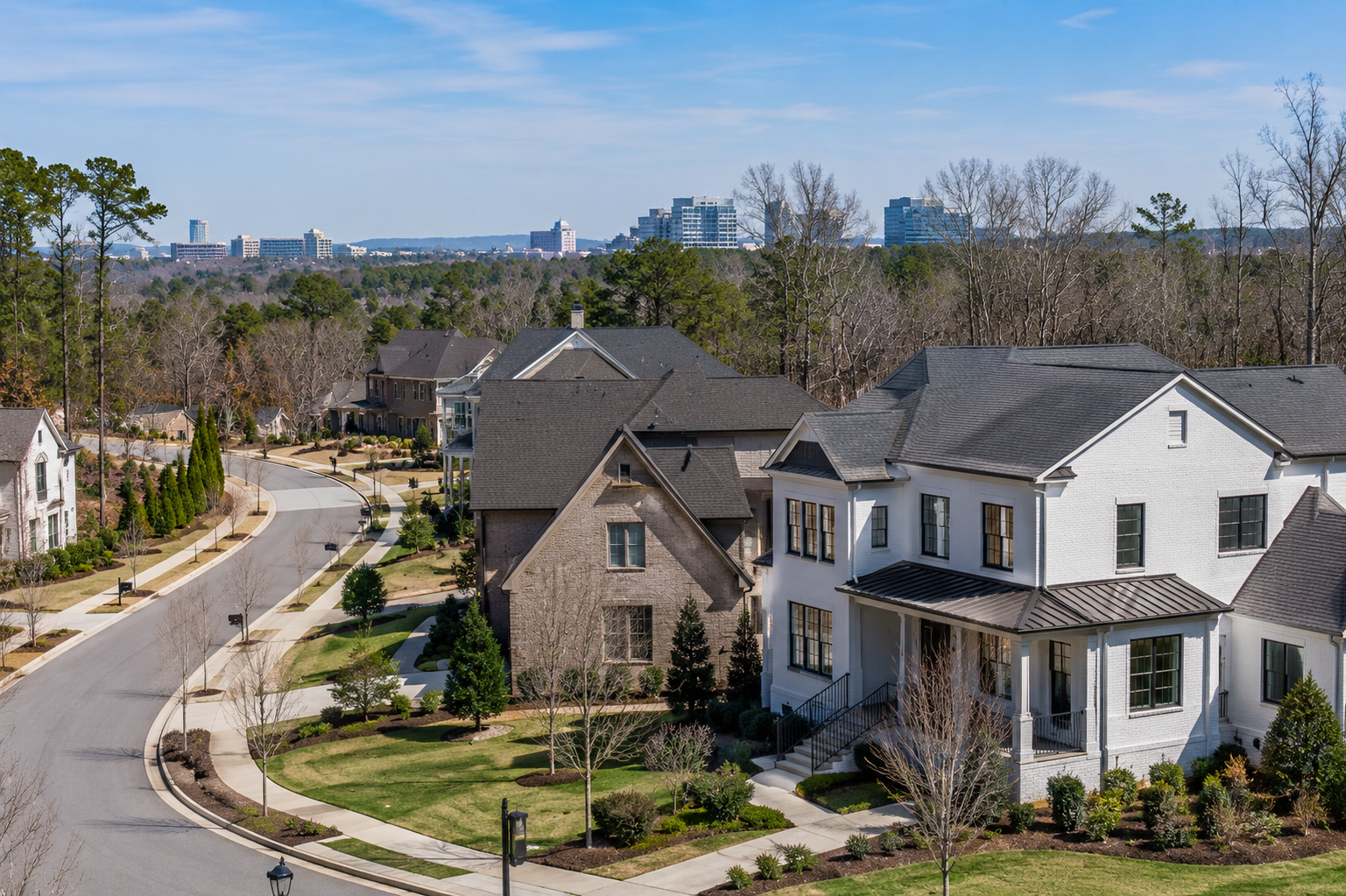
North Metro Atlanta has something intown neighborhoods largely do not: developable land. Forsyth, Cherokee, north Gwinnett, and the outer edges of North Fulton have all seen sustained new-home construction through the entire slowdown.
This matters for inventory in a specific way. A new-construction home is, by definition, not locked in. Nobody is sitting on a 3% mortgage inside a house that was just built. So while the resale market was frozen, builders kept adding unlocked supply to the market month after month. In Forsyth County, new construction has been concentrated along the Dawsonville Highway and in north Forsyth, with builders adding meaningful inventory in the $450,000 to $600,000 range.
For a resale seller, builder competition is real and you should plan around it. Builders can offer rate buydowns, closing cost credits, and brand-new everything, with no inspection surprises and a full warranty. Those are genuine advantages, and a buyer with a $550,000 budget in north Forsyth is weighing your 15-year-old house against a new one with all of those incentives attached. If you are selling a 15-year-old house three miles from a new subdivision, you are competing with that subdivision whether you like it or not.
But a resale home is not without its own advantages, and a good listing strategy leans into them. New-construction subdivisions are often on the outer edges of the county, on smaller graded lots, with young landscaping and no shade for a decade. An established resale home frequently sits closer to existing schools, retail, and highway access, on a larger or more mature lot, with grown trees and a neighborhood that already has its character. Those are real selling points, and they should be front and center in how the home is marketed. The mistake is pretending the builder down the road does not exist. The smart move is knowing exactly what you offer that the builder cannot, and pricing accordingly.
Reason Three: Buyer Demand Pulled Back From the Frenzy
Inventory is a function of two things: how many homes come on the market, and how fast they leave. Even if listings rose only modestly, inventory would still build if homes left the market more slowly. And they are.
Buyer demand did not vanish. Buyers are still active, and well-priced homes still sell. But buyers are no longer behaving the way they did in 2021. They are taking their time, comparing multiple homes, ordering inspections without waiving them, and walking away from homes that are priced or presented poorly. One North Fulton market report noted that showings per listing have dropped sharply compared to a few years ago. Fewer showings per listing plus more listings equals a market where homes accumulate.
The driver is affordability. Mortgage rates in the 6% range, combined with North Metro price points that run well above the metro median, have priced some buyers down a tier or out of certain submarkets entirely. The buyers who remain are real, qualified, and serious. They are just not desperate. That is the shift.

Reason Four: Seasonality Is Doing Its Normal Job
Some of the inventory rise is simply spring. Spring is when the largest share of listings hit the market every single year, as sellers who held through winter list to catch peak buying season. The 29.2% jump in metro sales from February to March 2026 is textbook seasonal momentum. When you read a March or April headline about inventory rising, part of that is the calendar, not a structural change. The structural change is the year-over-year comparison, and that one is real.
Reason Five: The Comparison Point Was Artificially Low
Finally, a point of perspective. Inventory looks like it is "rising" partly because it is rising from an extraordinarily low base. The 2021 through 2023 market was historically, abnormally tight. What we are seeing now in much of North Metro is not an inventory glut. It is a return toward the normal inventory levels that existed before the pandemic. Several North Metro submarkets are climbing back toward 2019 levels of supply, not past them.
I say this so you do not panic. "Rising inventory" sounds alarming. "Returning to normal" is the same fact, described honestly.
What Rising Inventory Does NOT Mean
It is just as important to be clear about what the inventory build is not, because fear drives more bad selling decisions than anything else.
Rising inventory does not mean a 2008-style crash. The 2008 collapse was driven by a wave of foreclosures, subprime lending, and homeowners who owed more than their homes were worth and could not afford their payments. None of those conditions describe North Metro Atlanta in 2026. Today's homeowners are sitting on years of accumulated equity, most hold fixed-rate mortgages they can afford, and distressed selling at scale is simply not in the data. More homes for sale because life events are finally outweighing low rates is the opposite of a foreclosure crisis. It is a healthy market unfreezing.
Rising inventory does not mean your home has lost value. Across the metro, prices have held relatively stable. What rising inventory changes is the speed of the sale and the amount of negotiating room a buyer has, not the underlying value of a well-maintained home in a desirable North Metro location.
Rising inventory does not mean you cannot sell. Homes are selling across North Metro every week. The well-priced, well-presented ones are selling at a normal, healthy pace. The narrative that the market has "shut down" for sellers is wrong. The market has simply stopped rewarding mistakes.
And rising inventory does not mean every submarket is the same. This is the error I most want North Metro sellers to avoid. A headline about metro-wide inventory tells you almost nothing about your specific street, your specific price band, and your specific home's condition. The next two sections get specific so you can locate yourself in the actual market rather than the headline version of it.

So How Should North Metro Sellers React? The Honest Strategy
This is the part that matters. Here is exactly how I coach North Metro sellers right now, in order of importance.
React One: Price to the Market in Front of You, Not Behind You
This is the single most important thing in this entire post, so I am putting it first and stating it plainly.
The most common, most expensive mistake North Metro sellers are making in 2026 is pricing their home based on what their neighbor got in 2022, or what the highest sale on the street ever hit, or what Zillow's automated estimate says. The market does not care about any of those numbers.
In a market with 4 months of supply and rising, the price you set in the first week determines almost everything that follows. Buyers today have options. They are comparing your home directly against several others in the same price band, often including new construction. If you price 8% over the market, you do not get 8% more. You get skipped. The home then sits, accumulates days on market, and eventually sells for less than it would have if it had been priced correctly from day one, because a stale listing signals to buyers that something is wrong.
I price using current comparable sales, current competing active listings, and the specific condition of your home. Not vibes, not the peak of the cycle, not a number that makes the conversation feel good. I would rather tell you a price you do not love than a price that costs you money. That is the job.
Let me be concrete about how overpricing actually costs you, because "price it right" sounds obvious until you watch it play out. When a home lists above the market, the buyers who could afford it look at it, compare it to the better-priced competition, and pass. The buyers who would love it at the correct price never see it, because it is above their search filter. So the home sits with the wrong audience. After two or three weeks with no offers, the price gets cut. But now the listing carries accumulated days on market, and every buyer who looks at it sees that number and assumes something is wrong. The eventual sale, after one or two more reductions, almost always lands below what a correct day-one price would have produced, and it takes far longer to get there. Chasing the market down is the most expensive way to sell a house. Pricing correctly from the first day is the cheapest.
There is also a Zillow problem worth naming directly. Automated valuation estimates are built from broad data and cannot see your home: its updates, its condition, its specific location on the street, the renovation your neighbor did that yours did not. I have seen those estimates run high and run low. Out-of-town buyers and even some out-of-area agents lean on them anyway. A correct price comes from someone who has stood in your home and in the competing homes, not from an algorithm that has stood in neither.
React Two: Understand Which Submarket and Price Band You Are In
"How should sellers react" has different answers depending on where your home sits. Here is the honest breakdown for North Metro in 2026.
| Price Band | What the Market Looks Like | Seller Strategy |
|---|---|---|
| Mid-range (broadly under ~$500K) | Largest pool of qualified buyers; most resilient demand; strongest price stability of any band. | Price competitively from day one and a well-prepared home can still move quickly. This is the most forgiving band, but it does not forgive overpricing. |
| Upper-mid (~$500K to ~$800K) | Solid demand but buyers compare carefully and negotiate. Heavy competition from new construction in Forsyth, Cherokee, and north Gwinnett. | Presentation and pricing precision both matter. Market explicitly against builder competition by leaning into lot, location, and maturity. |
| Luxury (~$800K to $1M+) | Highest months of supply; softest sale-to-list ratios. Buyer pool thins as price climbs. | Well-located luxury homes in excellent condition still sell. There is zero room for a pricing or presentation mistake. Expect a longer timeline. |
Price bands are general guides for North Metro Atlanta and shift by county and submarket. Your home's actual position depends on location, condition, and current comparable sales. Let's talk through where your home sits.
The pattern that holds across North Metro: the mid-range price bands, broadly the $499,000-and-under tier in North Fulton terms, have shown the most resilience and the strongest demand, because that is where the largest pool of qualified buyers is shopping. The luxury and upper-luxury bands carry the highest months of supply and the softest sale-to-list ratios, because the buyer pool thins as the price climbs. That does not mean luxury homes are not selling. Well-located luxury homes in excellent condition still move. It means luxury sellers in particular cannot afford a pricing or presentation mistake.
Know your band. Your strategy follows from it.
React Three: Presentation Is No Longer Optional
In 2021, a home could be dated, cluttered, and poorly photographed and still sell, because buyers had no alternatives. That market is over.
Today, North Metro markets are visibly splitting into two: homes that are well-maintained, properly prepared, and competitively priced are still selling, sometimes quickly. Homes with deferred maintenance, dated finishes, or last-year pricing are sitting and cutting price. Buyers with options exercise those options.
Practically, for a North Metro seller, this means: address the deferred maintenance you have been ignoring, because a buyer's inspector will find it and a buyer's agent will use it. The roof, the HVAC age, the water heater, the soft spot in the deck, the gutter that has been pulling away. Every item you leave is an item a buyer either negotiates against you or uses as a reason to choose a different home. Declutter and stage, physically when possible and virtually when not, because staging genuinely moves homes in this market by helping buyers picture their own lives in the space. A staged, photographed, well-prepared home does not just sell faster, it sells for more, because it removes the buyer's mental list of objections. Invest in professional photography, because the showing now happens online first, and a buyer who scrolls past your listing in a feed of competing homes never books a tour. The first showing is the photo. None of this is glamour. It is the baseline cost of competing in a market where the buyer has somewhere else to go.
I will also say this plainly: the homes that sit are very rarely sitting because of the market. They are sitting because of price, condition, or presentation, which are the three things a seller and their agent fully control. The market is not the problem. The market is just the conditions. The strategy is the variable.
React Four: Set Expectations on Timeline
If you sold a home in North Metro in 2021, recalibrate. Homes are taking longer to go under contract now, with North Fulton days on market up year over year and Forsyth averaging over 60 days to pending. A home sitting for six or seven weeks in 2026 does not mean something is wrong with it. It means the market has returned to a normal rhythm.
What that means for you: build the timeline into your plans. If you need to be in your next home by a certain date, work backward and list with enough runway. Do not assume a weekend sale. Some homes still get one. Plan for the market, not the exception.
React Five: Be Strategic, Not Emotional, About Negotiation
In a balanced market, buyers negotiate. They ask for repairs after inspection, they request closing cost help, they push on price if your home has been sitting. This is not buyers being difficult. This is what a normal market looks like, and most of us simply forgot, because 2021 was not normal.
The sellers who do best right now are the ones who treat negotiation as a process rather than an insult. A buyer asking for a $6,000 repair credit is not attacking you. They are at the table. The deal that closes is almost always better than the buyer who walks because the seller dug in on principle. I evaluate offers on the complete picture: not just price, but the strength of the buyer's financing, the closing timeline, and the contingencies. Sometimes the slightly lower offer with clean financing and a flexible close is the better deal. I will tell you which one is which.
React Six: Decide Honestly Whether This Is Your Window
Here is the part most agents will not say out loud. Not everyone needs to sell right now.
If you have a genuine reason to move, a job, a growing family, a downsizing decision, a relocation, then 2026 is a fine market to sell into. It is balanced, it is functional, prices are stable, and serious buyers are active. Price right, present well, and you will transact.
But if you are only considering selling because you think you should "catch the top," understand that the frenzy top is already behind us, and there is no signal pointing to a sudden return of 2021 conditions. Selling has real costs, and buying your next home means taking on a current-rate mortgage. If your current home genuinely works for your life and you have a low locked rate, staying put is a completely legitimate decision. I would rather tell you that than list a home you do not actually need to sell.
The right move depends on your life, not on a headline. That conversation is exactly the one I want to have with you before you do anything.
How North Metro Compares to the Rest of Atlanta
Quick context, because North Metro sellers often ask how their situation compares to intown or to the broader metro.
North Metro versus intown Atlanta: intown neighborhoods generally have less developable land, so the new-construction pressure on resale sellers is lower there than it is in Forsyth or Cherokee. North Metro sellers are competing with builders in a way many intown sellers are not.
North Metro versus the metro average: North Metro's inventory has risen faster than the 11-county metro average, with North Fulton's roughly 40% year-over-year jump well ahead of the metro's 5.1%. North Metro started from extreme tightness, carried heavy school-district demand, and is now seeing that demand met with more supply.
North Metro versus South Metro: South Metro and outer suburbs carry their own dynamics. Across the metro, the broad pattern is the same, more balance, more buyer leverage, but the specific months of supply and days on market vary submarket by submarket. There is no single Atlanta market. There are dozens.
The honest summary: every part of Metro Atlanta has moved toward balance. North Metro's version of that shift is more pronounced because it had the furthest to fall from peak tightness and because builders are actively adding supply.

Frequently Asked Questions
Is North Metro Atlanta a buyer's market or a seller's market in 2026?
It is best described as a balanced market that varies by submarket and price band. The 11-county metro sat at a 4.0-month supply in March 2026, the entry point of balanced territory, and several North Metro counties are at or near that range. Mid-range price bands still carry seller-leaning conditions in many areas, while luxury price bands have moved closer to buyer-leaning. The frenzy is over, but this is not a distressed market. Sellers who price and present correctly still do well.
Does rising inventory mean home prices in North Metro are falling?
Not significantly. Rising inventory has cooled the pace of sales and shifted negotiating leverage toward buyers, but prices across the metro have stayed relatively stable, with the March 2026 median sale price holding around $418,000, down only modestly year over year. The correction has been in speed and leverage, not in a price collapse. What has fallen is the ability to overprice and still sell fast.
Why is there suddenly more inventory in North Metro Atlanta?
Five forces at once: the mortgage rate lock-in effect is loosening as life circumstances force moves and as more homeowners hold rates closer to today's; builders kept adding new construction throughout the slowdown, especially in Forsyth and Cherokee; buyer demand pulled back from the 2021 frenzy due to affordability; spring seasonality always lifts listings; and the comparison point from 2021 through 2023 was an abnormally low base, so a return toward normal looks like a sharp rise.
Should I wait to sell my North Metro home until inventory drops again?
There is no current signal pointing to a return of 2021-style scarcity, so waiting for that specific condition is a bet against the data. If you have a genuine reason to move, 2026 is a functional market to sell into: balanced, stable on price, with active and qualified buyers. If you have no real need to move and hold a low locked mortgage rate, staying put is a legitimate choice. The decision should follow your life circumstances, not a headline.
How long does it take to sell a home in North Metro Atlanta now?
Longer than during the boom. North Fulton market reports show days on market up year over year, and Forsyth County homes are averaging over 60 days to go under contract. A well-priced, well-presented home in a strong price band can still sell quickly, but the baseline expectation should be measured in weeks, not days. A home that sits for six or seven weeks is behaving normally, not failing.
Why is my North Metro home not selling when my neighbor's sold fast in 2022?
Almost always one of three reasons: price, condition, or presentation. The 2022 market forgave all three because buyers had no alternatives. The 2026 market does not. Buyers compare your home directly against several competing listings, often including new construction. If your home is priced above the current market, carries visible deferred maintenance, or shows poorly online, buyers skip it. The fix is rarely dramatic. It is usually a correct price and proper preparation.
Are new-construction homes hurting resale sellers in North Metro?
They are real competition, particularly in Forsyth, Cherokee, and north Gwinnett where builders have land and are active. Builders can offer rate buydowns, closing cost incentives, and brand-new everything. A resale seller near an active subdivision is competing with it whether they intend to or not. The response is not to panic but to price and present with that competition factored in, and to lean into what a resale home can offer that new construction often cannot: established trees, larger lots, and a location closer to existing amenities.
What price range is selling best in North Metro Atlanta right now?
Broadly, the mid-range bands, which in North Fulton terms means roughly the $499,000-and-under tier, have shown the strongest demand and the best price resilience, because that is where the largest pool of qualified buyers shops. Upper-luxury bands carry the highest months of supply and the softest sale-to-list ratios. Luxury homes still sell, but the buyer pool thins as price rises, so pricing precision matters more at the top.
Is now a good time to sell a home in North Metro Atlanta?
For a seller with a real reason to move, yes. The market is balanced and functional, prices are stable, and serious buyers are active. The caution is that this is not a market that rewards overpricing or skipping preparation. Success depends on pricing to the current market, presenting the home well, and setting realistic timeline expectations. The frenzy that forgave mistakes is gone.
Should I be worried that the North Metro housing market is crashing?
The data does not support a crash narrative. Inventory rising toward pre-pandemic norms, prices holding relatively stable, and homes still selling at a measured pace describe a normalizing market, not a collapsing one. A crash involves falling prices and distressed selling at scale, and that is not what the current numbers show. The honest word for the 2026 North Metro market is balanced, not broken.
Selling in North Metro Atlanta in 2026
The North Metro market did not turn against sellers. It turned honest. The leverage that let a seller overprice, skip the prep work, and still sell in a weekend is gone, and it is not coming back on the old terms. What replaced it is a balanced, functional market where well-priced, well-presented homes still sell to real buyers. The sellers who struggle are the ones still pricing for 2022. The sellers who succeed are the ones pricing, preparing, and planning for the market that is actually here.
I work with sellers throughout Metro Atlanta and know how North Fulton, Forsyth, Cherokee, North Cobb, and north Gwinnett are each moving right now, submarket by submarket and price band by price band. If you are deciding whether to sell, what to list at, or whether this is even your window, that is exactly the conversation I want to have with you before you make a move.
Visit kristenjohnsonrealestate.com or reach out directly. Come as you are, come on home.
Looking for more Metro Atlanta market and neighborhood guides? I've covered North Fulton in depth, including Alpharetta, Milton, Roswell, and Johns Creek. For more on selling and negotiating in this market, read Negotiating in the 2026 Atlanta Market. Browse the full guide series at kristenjohnsonrealestate.com.