

Living in Vine City Atlanta GA: Historic Westside, Mercedes-Benz Stadium & Home Prices 2026
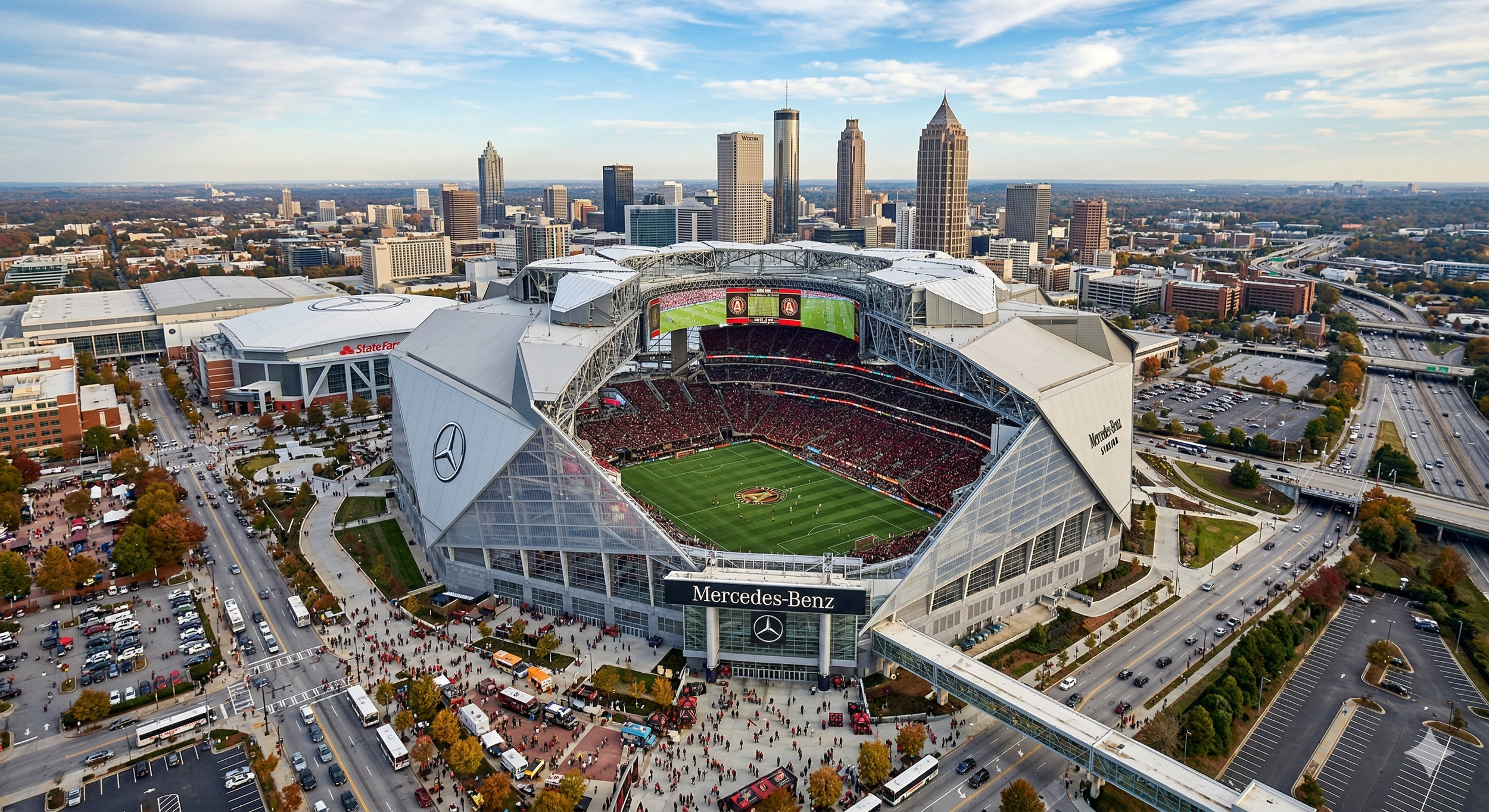
Vine City sits a half-mile west of downtown Atlanta, bounded by Northside Drive to the east where Mercedes-Benz Stadium rises above the roofline, Martin Luther King Jr. Drive to the south where Morris Brown College anchors the block, and Vine Street running through the center of the neighborhood that gives the area its name. It is one of the most historically significant neighborhoods in the entire city, a place where the Civil Rights Movement had a literal street address, and today it is also one of the most closely watched real estate markets on Atlanta's Westside. I work with buyers across Metro Atlanta, and Vine City comes up in a particular kind of conversation: buyers who want intown proximity without intown prices, buyers who understand that early-stage neighborhoods carry both opportunity and risk, and buyers who recognize that a neighborhood shaped by decades of disinvestment is now drawing serious capital from the city, from nonprofits, and from private developers who are betting on its location.
That location is the story. Vine City is one MARTA rail stop from Five Points and two stops from the Civic Center. It is walkable to State Farm Arena, to the Georgia World Congress Center, and to Mercedes-Benz Stadium on game day. It has direct BeltLine connector access to the Westside Trail. It sits at the doorstep of one of the largest concentrations of Historically Black Colleges and Universities in the country. And it carries median home prices that still reflect where the neighborhood has been, not yet where it is going.
Nearly a decade helping buyers across Metro Atlanta means I have watched Vine City evolve through multiple cycles of interest and, in some cases, disappointment. This iteration feels different. The investment is more structured, the nonprofit presence is more organized, and the public amenities, including Rodney Cook Sr. Park and the Westside Trail, are already built. That does not eliminate the complexity, and I will give you the honest version of all of it.
Here's what you need to know.
What Is Vine City and Where Is It?
Vine City is an intown Atlanta neighborhood in Fulton County, located in the city's Westside cluster, which also includes English Avenue, Ashview Heights, and Washington Park. The zip code is 30314. The neighborhood sits within the City of Atlanta limits and is served by Atlanta Public Schools.
Its borders are generally defined as:
East: Northside Drive (adjacent to Mercedes-Benz Stadium and the Georgia World Congress Center)
South: Martin Luther King Jr. Drive (the main commercial corridor, shared with the Atlanta University Center)
West: Joseph E. Lowery Boulevard (Ashby Street), where the Ashby MARTA station sits
North: Sunset Avenue and the English Avenue neighborhood
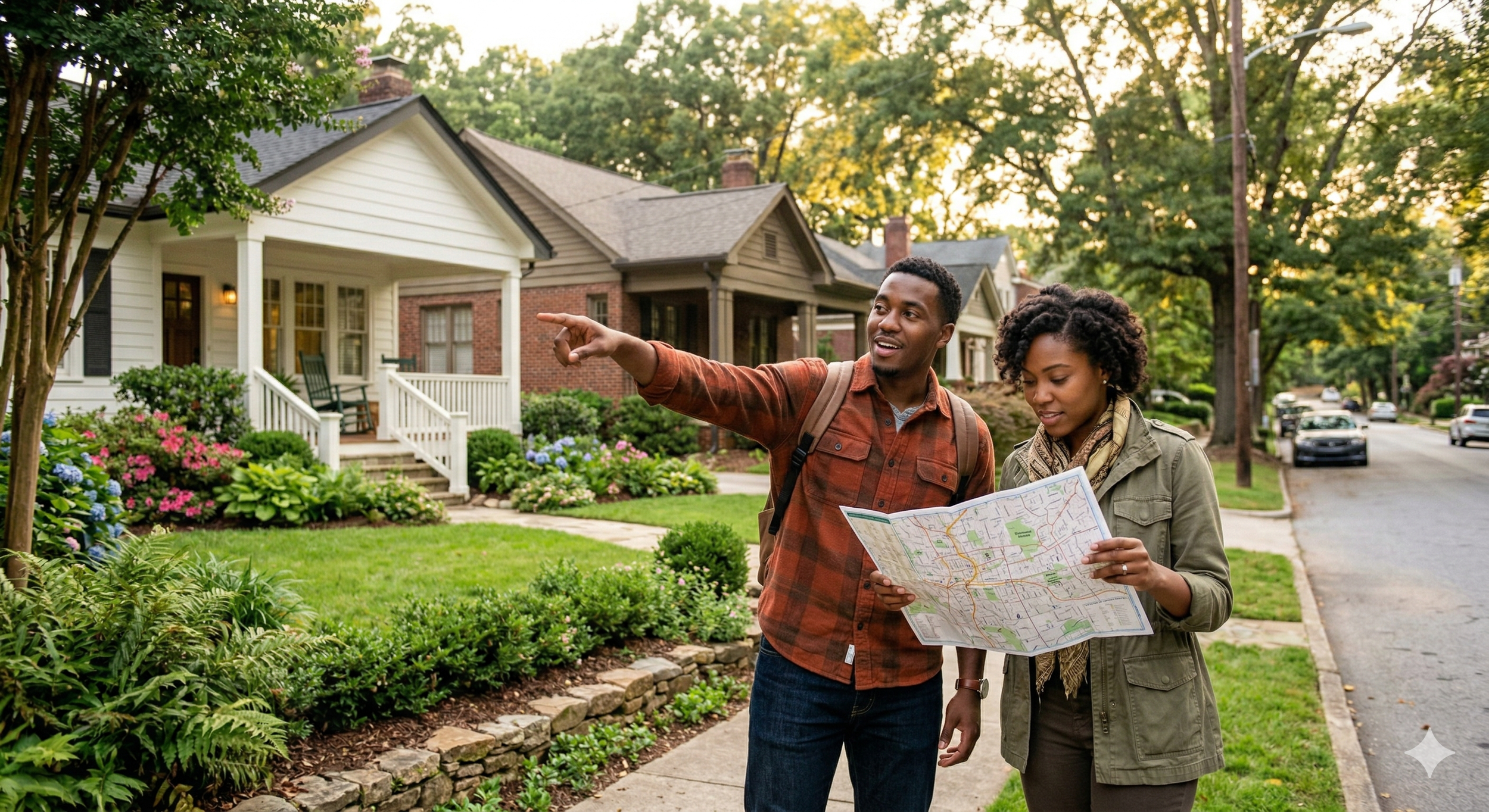
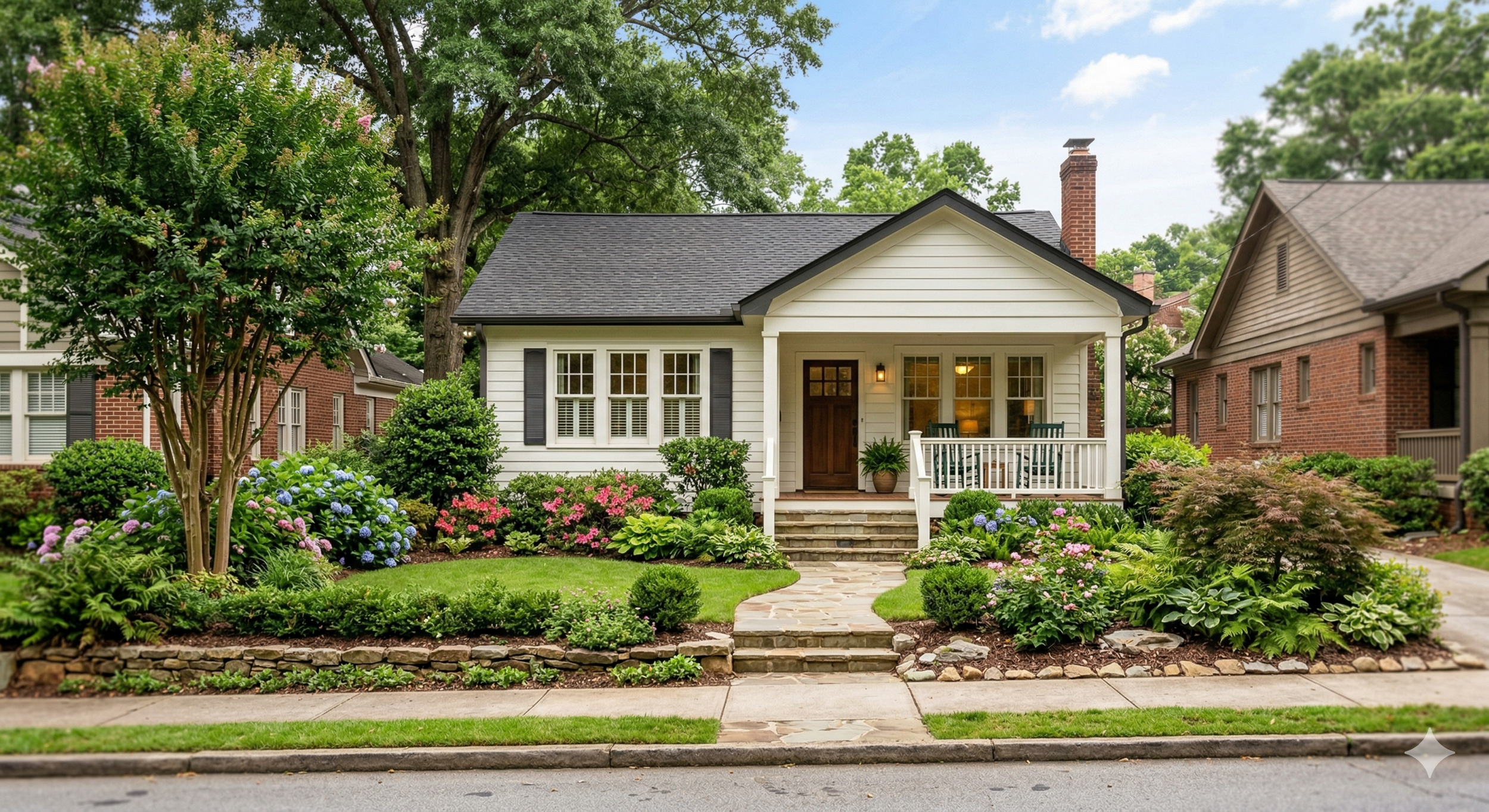
The neighborhood's grid is compact, with narrow streets and small lots that reflect its early 20th-century development pattern. Housing is predominantly single-family bungalows built between the 1920s and 1950s, with a growing number of new construction infill homes and a handful of condo and apartment buildings in the western section near Ashby Street.
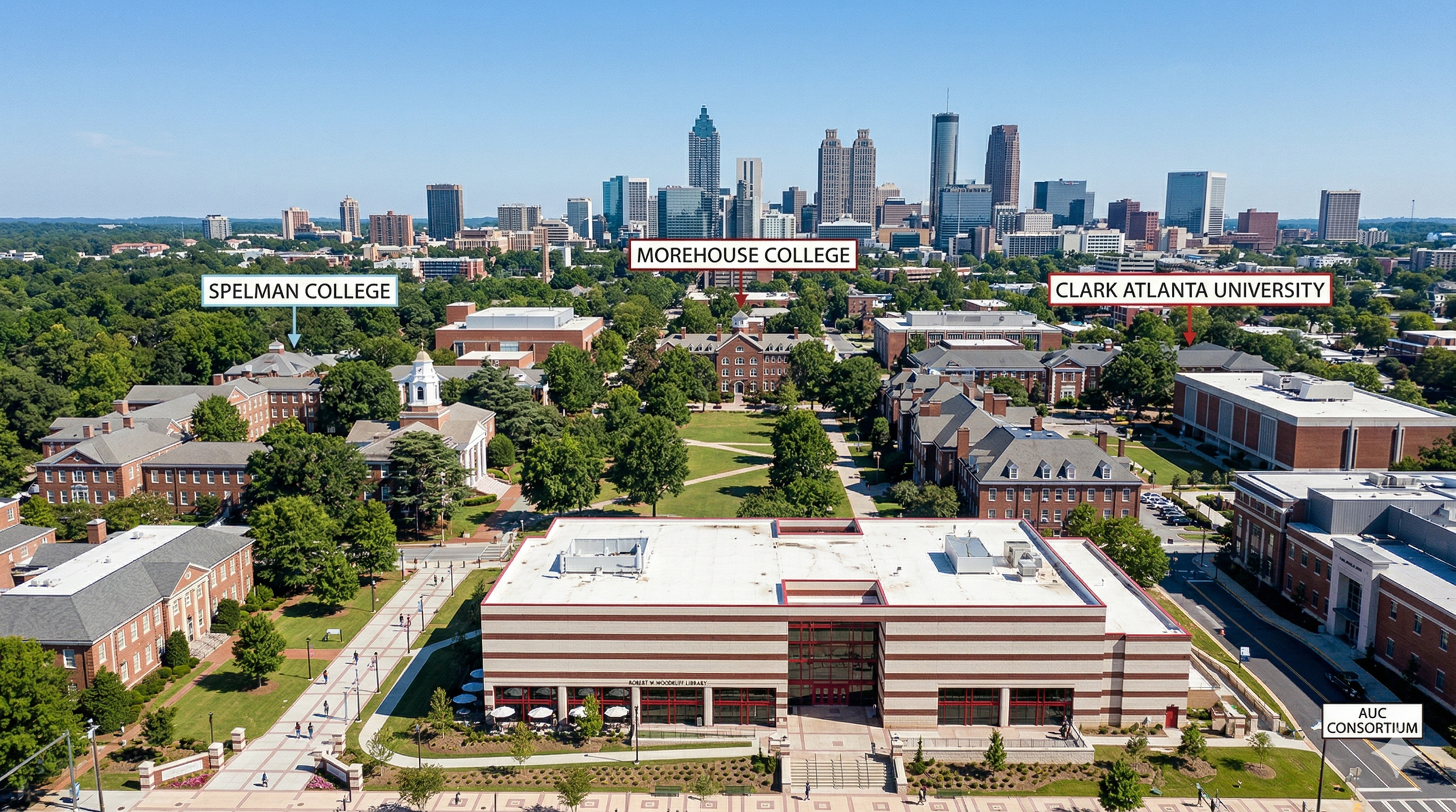
One thing buyers consistently underestimate about Vine City: the sheer concentration of institutional weight in this corridor. Within half a mile of the neighborhood's center, you have Morris Brown College, the Georgia World Congress Center (one of the largest convention facilities in the country), Mercedes-Benz Stadium, and the cluster of AUC schools that includes Clark Atlanta University, Morehouse College, Spelman College, and the Interdenominational Theological Center. These are not abstract amenities. They are the anchors that have drawn ongoing investment and that will continue to shape what gets built in and around Vine City for the next 20 years.
Vine City's History: What You Need to Reckon With
If you are buying in Vine City, you are buying in a neighborhood with one of the most concentrated Civil Rights histories in Atlanta. That history is not background color. It is the foundation that shapes everything about how Vine City is understood, how it has been treated, and where it is going.
In January 1966, Dr. Martin Luther King Jr. and Coretta Scott King, along with Rev. Ralph David Abernathy, led a protest march through Vine City specifically to call attention to the substandard housing conditions residents were living in. That same year, the Kings purchased the four-bedroom home at 234 Sunset Avenue, which became both their family residence and the operational base for the Southern Christian Leadership Conference until King's assassination in 1968. After his death, Coretta Scott King remained in the home and ran the King Center for Nonviolent Social Change from its basement. The National Park Service acquired the Sunset Avenue property in 2018, and as of 2025 the NPS has been working on a rehabilitation plan to open the home to the public.
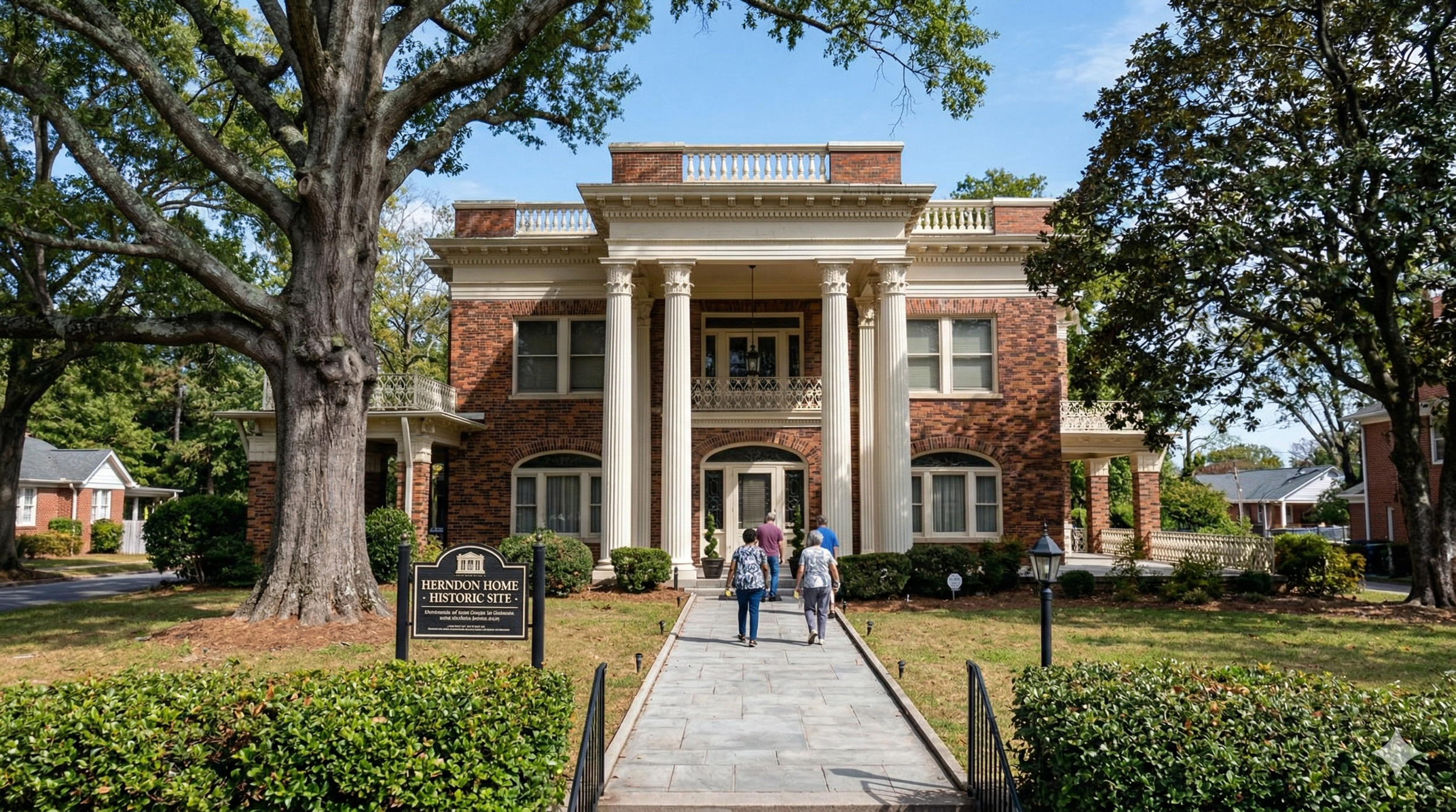
Julian Bond, co-founder of the Student Nonviolent Coordinating Committee and longtime Georgia legislator, lived in Vine City. Dorothy Bolden, a neighbor of King's who in 1968 organized the National Domestic Workers Union, connecting more than 13,000 women from 10 cities to demand fair wages and working conditions, lived in Vine City. Alonzo Herndon, born into slavery and later Atlanta's first Black millionaire, built his Classical Revival mansion at 587 University Place in Vine City in 1910; that home is now the Herndon Home Museum, a National Historic Landmark.
Pascal's Restaurant, tucked into this corridor, was the meeting ground where Maynard Jackson assembled his team in 1973 to plan the campaign that made him Atlanta's first Black mayor.
This is not a neighborhood where history is something that happened elsewhere and got commemorated here. The history happened on these streets. Buyers who understand that tend to approach Vine City differently than those who see only market metrics.
The neighborhood's arc since the 1960s has been well documented. As the Black middle class migrated to Atlanta's suburbs following desegregation, Vine City and English Avenue lost more than two-thirds of their population from a peak of roughly 50,000 in the 1960s. Decades of disinvestment followed. Real estate speculation ahead of the 2008 crash and the foreclosure wave that came after deepened the damage. The arrival of Mercedes-Benz Stadium in 2017 brought new attention, new capital, and new pressure on longtime residents, along with genuine infrastructure improvements. The ongoing work is complex, and any buyer honest with themselves will recognize that.
The Vine City Real Estate Market in 2026: Honest Numbers
Vine City's market data requires some context because the neighborhood has a small transaction volume and the data spread is wide. Here is what the most recent available figures show, and I will tell you how to read them.
According to data compiled by Homes.com through early 2026, the median sale price for Vine City homes over the last 12 months sits around $310,000, with the most current March 2026 median listed at approximately $325,000. The average days on market is roughly 46 to 53 days, which is competitive relative to the national average of 54 days. That figure from Redfin through November 2025 showed a year-over-year median price increase of approximately 32.5%, though that number reflects a small transaction pool and can shift significantly based on which properties closed in a given month.
The wide spread in what different sources report (you may see figures as low as $150,000 on listing aggregators) reflects the dramatic variance in property condition within Vine City. An unrenovated, aging bungalow on a street with significant deferred maintenance will price very differently from a fully renovated bungalow two blocks away, and both exist in the same zip code. New construction infill homes price differently still.
Here is what I tell buyers navigating this: the data reflects a market in transition, which means the number you see today represents a wide range of property conditions and expectations. Getting the actual number right for a specific property requires boots on the ground and comparable sales analysis from someone who knows this corridor. Contact me directly at kristenjohnsonrealestate.com for current, property-specific data.
What the broad price range looks like in practice:
The active market as of early 2026 shows listings generally falling into three tiers:
Under $200,000: Unrenovated or distressed single-family homes, vacant lots priced for development, properties needing significant work
$200,000 to $350,000: Partially renovated bungalows, condos at The Washington at West Side Village (a gated community on Mayson Turner Road), and fully renovated smaller homes
$350,000 to $500,000+: New construction single-family homes, fully renovated larger bungalows with modern finishes, and value-add investments with strong nearby comps
Multi-family properties and properties positioned for short-term rental use (given proximity to Mercedes-Benz Stadium) price based on income potential and have attracted investor interest, particularly ahead of the 2026 FIFA World Cup, which will bring matches to Mercedes-Benz Stadium.
Rental prices as of April 2025 average approximately $1,163 per month for one-bedroom apartments and $1,369 for two-bedrooms in the Vine City area.
Always verify current figures with me before making decisions. This market moves.
What You Get for the Money in Vine City
Under $200,000: At this price point in Vine City, you are primarily looking at unrenovated properties that require significant investment before occupancy, vacant lots suitable for new construction or vertical development, or properties with title or condition issues that require careful due diligence. This tier has attracted investor buyers, but it requires experienced guidance and thorough inspection.
$200,000 to $300,000: This is where entry-level renovated product and smaller condos live. The Washington at West Side Village is the primary condo product in this range, a gated community that offers one- and two-bedroom units with amenities including a pool and gym. The community is positioned near the Ashby MARTA station and has appeal for buyers who want urban proximity with security and HOA maintenance. Single-family homes at this price point typically show partial renovation or the original character of a 1920s-1950s bungalow with updated systems.
$300,000 to $450,000: This is where the renovated-and-move-in-ready single-family market concentrates. Craftsman bungalows with refinished hardwood floors, updated kitchens and baths, and covered porches are the typical product. New construction infill homes, some built with 4 bedrooms and modern layouts on standard city lots, are entering this range and above. The proximity to the BeltLine Westside Trail and to Rodney Cook Sr. Park adds value at this price tier that was not present five years ago.
$450,000 and above: Custom and high-finish new construction, larger renovated homes, and properties positioned as short-term rental investments given stadium proximity. The upper end of the Vine City market is still being defined as development activity continues.
The Investment Context: What Is Actually Happening in Vine City Right Now
Vine City is one of the most actively redeveloping neighborhoods on Atlanta's Westside, and buyers deserve a clear picture of what that means on the ground in 2026.
Rodney Cook Sr. Park opened in 2021 and represents the most visible public investment in recent years. The $45 million park sits on 16 acres on Vine Street and was designed specifically to address the neighborhood's chronic flooding problem by routing stormwater into a 10-million-gallon pond. The park includes a playground, splash pad, amphitheater, and open lawn space. It has become a genuine anchor amenity and a meaningful quality-of-life improvement for existing residents.
The Westside BeltLine Trail has extended connectivity through this corridor and provides a three-mile greenway connection that the Arthur M. Blank Family Foundation has credited with beginning to have a measurable economic development impact, similar to what the Eastside Trail produced over the past decade.
Morris Brown College redevelopment. In December 2025, the Invest Atlanta Board approved a major redevelopment plan for approximately 8 acres at 50 Sunset Avenue and 41 Griffin Street, adjacent to the Morris Brown campus. The plan, developed by Resurgence Commercial Partners, calls for a 100-room boutique hotel, 200 mixed-income rental units, 15 for-sale homes, a 30,000-square-foot innovation and learning facility in partnership with Morris Brown, neighborhood-serving retail (including the potential for a small grocery store), and workforce development space. This project is designed to bring life back to what has been one of the most prominently vacant sites in the neighborhood. The approval was given in late 2025; construction timelines are still being refined.
Georgia Power substation. Worth knowing because it is an active community issue: a new Georgia Power electrical substation broke ground in 2025 along Northside Drive, on a block between Magnolia and Foundry Streets. Vine City residents have raised concerns about its placement given an existing substation nearby. Georgia Power has said the project will strengthen the grid serving the area, including the power demands of nearby Centennial Yards. Construction is scheduled to pause during 2026 FIFA World Cup events and is expected to be completed in 2028. The aesthetics and footprint are still being worked out with community input. This is something to walk and evaluate if you are considering properties near that corridor.
The Blank Foundation and Westside Future Fund have committed significant capital to this neighborhood over multiple years. The Arthur M. Blank Family Foundation has invested $30 million in Westside revitalization; Invest Atlanta has committed $15 million. These are structured, long-term commitments rather than one-time grants.
FIFA World Cup 2026. Atlanta is a host city, and Mercedes-Benz Stadium is one of the primary venues. This has accelerated short-term rental investment in the immediate area and is cited by multiple listing agents as a catalyst for demand in properties within walking distance of the stadium.
Getting Around: Commute Times and Transit Access
Vine City's transit profile is one of its genuine, measurable advantages. Here is the honest picture.
MARTA Rail. Vine City has two MARTA rail stations within its boundaries or at its edge:
Vine City Station (502 Rhodes St NW) on the Blue and Green Lines, opened in 1979. The station connects directly to the stadium via a pedestrian bridge over Northside Drive. The Atlanta University Center Shuttle provides free service to students and faculty from this station. One stop east puts you at the Dome/GWCC/Philips Arena/CNN Center station, and two stops east reaches Five Points.
Ashby Station on Joseph E. Lowery Boulevard (the western boundary), also on the Blue and Green Lines, provides a second access point particularly for residents in the western portion of the neighborhood.
Having two rail stations in a single neighborhood is unusual in Atlanta and is a significant commuter advantage.
Downtown Atlanta: 5 to 10 minutes by car off-peak. By MARTA, one or two stops, under 10 minutes. During Falcons or Atlanta United game days, driving near Northside Drive becomes significantly slower, and MARTA is the better option by a wide margin.
Midtown: 10 to 15 minutes by car off-peak. By MARTA, transfer at Five Points to the Red or Gold Line northbound.
Georgia Tech: 10 to 15 minutes by car. The campus is directly north, accessible via Northside Drive or through the West Midtown corridor.
Airport (Hartsfield-Jackson): Morris Brown College's website notes the airport is approximately 15 minutes away, which is accurate off-peak via I-75/85. During morning rush (7 to 9 AM), count on 25 to 35 minutes or more. MARTA's direct rail connection to the airport from Five Points is a strong option for airport travel without parking costs.
I-75/I-85: The Downtown Connector runs along the eastern edge of the Vine City corridor, accessible via several on-ramps from the neighborhood. This gives reasonable highway access to points north and south, though rush-hour congestion on the Connector is significant and you should always use live traffic data for planning.
Walkability: Vine City has a moderate walk score that reflects its transit strength more than its pedestrian retail environment. Day-to-day errands still require a car for most residents, though the growing development activity on MLK Jr. Drive and the proximity to the AUC campus area creates some walkable options. Block-by-block conditions vary, and a drive-through at different times of day is the best way to assess specific streets.
Things to Do in and Near Vine City
Mercedes-Benz Stadium. The stadium sits literally at Vine City's eastern border, which means game days for the Atlanta Falcons (NFL) and Atlanta United (MLS) are a neighborhood event. The stadium also hosts major concerts, college football championships, and will host multiple 2026 FIFA World Cup matches. For residents who are sports fans or entertainment seekers, this is a major amenity. For those who are not, game day traffic on Northside Drive is a real consideration in your daily routine.
State Farm Arena. Home of the Atlanta Hawks, connected to the stadium district and accessible via MARTA or a short walk from downtown. Vine City residents can walk or take rail.
The Herndon Home Museum. At 587 University Place, across from Morris Brown College, the 1910 Classical Revival mansion built by Alonzo Herndon is open to the public and operates as a National Historic Landmark. The museum tells the story of a man born into slavery in 1858 who built a barbershop empire and founded the Atlanta Life Insurance Company, becoming Atlanta's first Black millionaire. It is one of the most substantive museums in intown Atlanta and is directly in the neighborhood.
Rodney Cook Sr. Park. The 16-acre park on Vine Street with its splash pad, playground, amphitheater, and open lawn is now a genuine gathering space for the neighborhood. The stormwater management infrastructure is designed to reduce the flooding that has historically affected streets in the area.
Washington Park. The historic park immediately west of Vine City along Ollie Street features tennis courts and a heated indoor pool, one of the few public facilities of its kind in intown Atlanta. Washington Park is also historically significant as Atlanta's first planned park designed for Black residents, developed in 1919.
The AUC Campus Area. The cluster of Clark Atlanta University, Morehouse College, Spelman College, Morris Brown College, and the Interdenominational Theological Center sits directly south of Vine City along MLK Jr. Drive. The campus area includes dining options, events open to the public, and is home to some of Atlanta's most significant cultural institutions.
Pascals. The Pascals name has deep roots in this corridor, known as the gathering ground for civil rights and political leaders. The current iteration on MLK Jr. Drive carries that history forward.
Westside Trail Access. The BeltLine Westside Trail connector provides greenway access that links the neighborhood into Atlanta's broader trail network.
Schools in Vine City
Vine City is served by Atlanta Public Schools. The schools that serve properties in this attendance zone include:
Michael R. Hollis Innovation Academy serves students in Pre-K through 8th grade and is the primary school serving the Vine City attendance area for elementary and middle grades. APS designates it as an Innovation Academy with a focus on STEM integration.
Booker T. Washington High School serves 9th through 12th grade and is one of Atlanta's most historically significant schools, established in 1924 as Georgia's first public high school for Black students. The school is located on Vine Street in the neighborhood.
School attendance zones in Atlanta Public Schools can be complex and are subject to change. Always verify the specific school assignment for any property address you are considering by contacting APS directly or using the APS school finder tool at the APS website before making a purchase decision. Research and visit schools to determine fit for your family. Never rely on a listing or online guide for zoning confirmation.
Vine City Compared to Nearby Neighborhoods
Part of understanding Vine City is understanding what you are choosing over, or in addition to, when you are evaluating the Westside and adjacent intown neighborhoods. Here is how the comparisons actually break down.
Vine City vs. West End Atlanta. West End sits south and slightly west, with its own deep history and a more established commercial corridor along Ralph David Abernathy Boulevard. West End has further along its redevelopment arc, with the AUC corridor, Lee + White development (breweries, food hall), and BeltLine Westside Trail access that draws consistent foot traffic. Median prices in West End trend higher than current Vine City figures. You get more developed retail and dining infrastructure in West End; you get stronger proximity to downtown and the stadium in Vine City. Both are on the BeltLine connector. Living in West End Atlanta GA
Vine City vs. Adair Park. Adair Park sits directly south of West End and shares the BeltLine Westside Trail as its primary amenity driver. It has seen significant new construction townhome development and a wave of Craftsman bungalow renovations. Adair Park's price points are somewhat similar to Vine City's upper range. The feel is quieter and more residential than Vine City, without the stadium adjacency. If you want BeltLine proximity with a calmer daily environment and less near-term development activity around you, Adair Park may be the better fit. Living in Adair Park Atlanta GA
Vine City vs. Summerhill. Summerhill is on the Southside of downtown, immediately adjacent to Georgia Avenue and the site of the old Atlanta-Fulton County Stadium. The Grant Park neighborhood anchor and the Summerhill commercial corridor along Georgia Avenue have made Summerhill one of the more developed of Atlanta's near-intown transitional neighborhoods in recent years, with specific dining destinations and a more established retail presence than Vine City currently has. Prices in Summerhill have moved faster. If you want a neighborhood that is further along its transition curve, Summerhill reflects that. Living in Summerhill Atlanta GA
Vine City vs. Castleberry Hill. Castleberry Hill is directly east of Vine City, across Northside Drive, and has a completely different character as Atlanta's original arts district. It features loft-style residences, art galleries, and is in active redevelopment with significant demolition and reconstruction happening in the blocks around the stadium. Castleberry Hill's pipeline is more focused on larger mixed-use and residential density than Vine City's mix of single-family and infill. If you want a loft aesthetic over a bungalow, Castleberry Hill is the comparison.
Vine City vs. English Avenue. English Avenue borders Vine City directly to the north and is at an earlier stage of its redevelopment arc, with a higher proportion of vacant or distressed properties and slower institutional investment to date. Vine City's Rodney Cook Sr. Park, dual MARTA access, and stadium adjacency have given it stronger near-term momentum. English Avenue buyers are typically operating with a longer time horizon.
Streets and Subdivisions: Block-by-Block Reality
Vine City is not a uniform neighborhood. The character of individual streets varies meaningfully, and any buyer should walk specific blocks at different times of day before committing.
Vine Street NW. The spine of the neighborhood, running east-west through the center. Rodney Cook Sr. Park anchors the western end of Vine Street and has brought consistent foot traffic and maintenance visibility to that block. The eastern end of Vine Street approaches Northside Drive and the stadium.
Sunset Avenue NW. A street with direct historical weight, where the King Family Home sits at 234 Sunset Avenue (NPS-owned and under rehabilitation) and where the planned Morris Brown College redevelopment site sits at the western end at Sunset and Griffin. Properties on and near Sunset carry both the historical significance and the development activity that brings.
Ashby Circle NW and Ashby Street NW. The western edge of the neighborhood along Ashby Street (Joseph E. Lowery Boulevard) is where much of the newer construction is concentrated. Ashby Circle in particular has seen renovated and newly built homes that buyers have cited for BeltLine access and proximity to the Ashby MARTA station.
Mayson Turner Road NW. Home to The Washington at West Side Village, the gated condo community that represents the primary for-sale condo product in Vine City. The community offers modern finishes, amenities, and HOA-managed maintenance for buyers who want the neighborhood's location without single-family maintenance responsibility.
Lena Street NW. A street that has attracted renovated Craftsman bungalows, some to full modern standard. Properties on Lena have drawn buyer interest from the first-time buyer and urban professional segment.
Harwell Street NW and Ollie Street NW. Farther into the residential fabric, these streets include a mix of long-term owner-occupied homes and properties in various stages of renovation or vacancy. These corridors reflect both the depth of the neighborhood's character and the ongoing variation in property condition that buyers must assess carefully.
What Vine City Is Right for, Honestly
Vine City tends to be the right neighborhood when:
You are buying with a longer horizon than 12 to 24 months and understand that the investment thesis is based on trajectory, not current condition. The public amenities are in place; the private development is in motion; the price points still reflect where this neighborhood has been more than where it is going. Buyers who bought in Grant Park, Old Fourth Ward, or Reynoldstown before those neighborhoods fully turned understand this pattern.
You are a buyer who places real weight on transit access and can see yourself commuting by MARTA rather than depending on a car for every trip. Two rail stations in a single neighborhood is a genuine, concrete advantage that most of Metro Atlanta does not have.
You are purchasing in proximity to the AUC campuses for family or personal reasons, for student housing investment, or because the institutional employment base of the HBCU corridor matters to your lifestyle or professional network.
You want downtown accessibility without downtown prices and are willing to navigate a neighborhood in transition rather than pay the premium for one that has already arrived.
You are an investor or house hacker who has done the analysis on short-term rental potential given stadium proximity and FIFA World Cup demand, and you have modeled the numbers honestly rather than optimistically.
Think carefully about Vine City if:
You are expecting a fully developed neighborhood environment with walkable daily retail, diverse dining options, and the kind of street-level activation you find in Ponce City Market's shadow or along the Eastside BeltLine. That is not Vine City in 2026. The amenity infrastructure is improving, but it is not there yet.
You are not prepared to do thorough due diligence on individual properties. The spread between well-renovated and distressed product is significant. A property inspection is not optional here; it is essential.
You are uncomfortable with near-term construction activity in and around the neighborhood. Between the Morris Brown redevelopment, the Georgia Power substation, and the ongoing infill development, Vine City will have active construction in its immediate environment for the next several years.
You need every investment dollar to perform in year one. This is a neighborhood that rewards patience.
Frequently Asked Questions About Living in Vine City Atlanta
What are home prices in Vine City in 2026?
The most current data shows a median sale price in the range of $310,000 to $325,000 for Vine City homes, with a year-over-year appreciation trend of approximately 32% based on November 2025 Redfin data. That figure reflects a small transaction pool and the wide range of property conditions in the neighborhood. Entry-level product (unrenovated or distressed) can price well under $200,000; fully renovated Craftsman bungalows and new construction single-family homes price from $350,000 upward. Condos at The Washington at West Side Village generally range in the $150,000 to $300,000 tier depending on unit size and condition. Always verify current pricing for specific properties with a local agent.
Is Vine City a good investment in 2026?
Vine City presents a real investment opportunity for buyers with a medium to long time horizon who can tolerate near-term complexity. The public infrastructure (Rodney Cook Sr. Park, Westside BeltLine Trail) is built. The institutional investment (Invest Atlanta, Arthur M. Blank Family Foundation, Westside Future Fund) is committed and multi-year. The planned private development at the Morris Brown site represents significant capital entering the immediate area. The FIFA World Cup in 2026 is accelerating short-term rental demand near the stadium. None of that eliminates the risk that comes with any transitioning neighborhood, and property condition analysis at the individual level is essential. I would not frame this as a safe, low-complexity investment. I would frame it as an opportunity that requires eyes-open commitment.
How close is Vine City to downtown Atlanta?
Vine City is approximately half a mile to three-quarters of a mile from the edge of downtown Atlanta and about a mile to 1.5 miles from the heart of it. By MARTA, it is one to two stops to Five Points. By car, off-peak, it is 5 to 10 minutes. On game days or during peak rush hour, add significant time to the car-based estimate.
Does Vine City have good MARTA access?
Yes, and it is one of Vine City's most concrete advantages. The neighborhood has two MARTA rail stations: Vine City Station on the Blue and Green Lines (502 Rhodes St NW), with a pedestrian bridge connection to Mercedes-Benz Stadium, and Ashby Station at the neighborhood's western edge on Joseph E. Lowery Boulevard. Both stations put downtown within a few minutes by rail and provide connections to all four MARTA lines via Five Points.
What schools serve Vine City?
Vine City is served by Atlanta Public Schools. The primary schools serving the neighborhood are Michael R. Hollis Innovation Academy (Pre-K through 8th grade) and Booker T. Washington High School (9th through 12th grade), one of Georgia's most historically significant public schools, established in 1924 as the state's first public high school for Black students. School attendance zones can change; verify the specific zoning for any property you are considering by contacting APS directly. Research and visit schools to determine fit for your family.
Is Vine City safe to live in?
Vine City has historically had elevated crime statistics, and that is documented. What is also documented is the ongoing and active investment from the city, nonprofits, and private developers in changing those conditions. Street-by-street and block-by-block variation is significant: some corridors, particularly those near Rodney Cook Sr. Park, near Ashby Street, and near the newer development activity, have a different daily reality than more vacant or isolated stretches. I always tell buyers to walk the specific blocks of any property you are seriously considering, at different times of day, before making a decision. That is honest guidance for any transitioning neighborhood, and Vine City is no exception.
How does Vine City compare to West End Atlanta?
West End is further along its development arc, with a more established commercial corridor (Lee + White development, breweries, dining on Ralph David Abernathy Boulevard), and median prices that have moved higher than current Vine City figures. Vine City has stronger direct downtown and stadium proximity and dual MARTA access. West End feels more settled in terms of daily neighborhood experience; Vine City is operating at an earlier stage with more open upside and more open-ended near-term experience. Both neighborhoods are on the BeltLine Westside Trail.
What is the MLK Jr. Family Home in Vine City?
The home at 234 Sunset Avenue NW, purchased by Dr. Martin Luther King Jr. and Coretta Scott King in 1966, is where the family lived until King's assassination in 1968. Coretta Scott King remained at the home and founded the King Center for Nonviolent Social Change in its basement. The National Park Service acquired the property in 2018 and has been working on a rehabilitation and public access plan. As of 2025, the NPS was finalizing site plan options; the home was not yet open to the public but is a nationally significant historic site that will eventually be a permanent part of the neighborhood's heritage landscape.
Is Vine City near the BeltLine?
Yes. Vine City has access to the BeltLine Westside Trail via the Westside Trail connector. The full Westside Trail, a three-mile greenway, runs through the broader Westside neighborhood cluster and has been a driver of both economic development attention and quality-of-life improvement in the area.
What is being developed in Vine City right now?
The most significant active development is the planned mixed-use project at 50 Sunset Avenue and 41 Griffin Street adjacent to Morris Brown College, approved by Invest Atlanta in December 2025. That project includes a 100-room boutique hotel, 200 mixed-income rental apartments, 15 for-sale homes, a 30,000-square-foot Morris Brown-affiliated innovation and learning center, and neighborhood-serving retail. A Georgia Power electrical substation is also under construction along Northside Drive between Magnolia and Foundry Streets, with completion expected in 2028. Multiple infill residential projects are in various stages of permitting and construction throughout the neighborhood.
What is the long-term outlook for Vine City real estate?
The structural case for Vine City is strong: two MARTA stations, downtown adjacency, BeltLine access, a cluster of HBCU institutions, Mercedes-Benz Stadium, and committed long-term investment from major philanthropic and public sector sources. The price points still reflect the neighborhood's past more than its trajectory. The honest caveat is that "long-term" in this context means a 5 to 10 year horizon, not a 12-month flip. Buyers who approach Vine City with realistic expectations about the pace of change, do thorough property-level due diligence, and hold with patience are positioned for the kind of appreciation that intown Atlanta's transitional neighborhoods have historically produced.
Can I use Vine City property for short-term rentals?
Short-term rental viability in Vine City is real, particularly given stadium proximity and the 2026 FIFA World Cup bringing significant international visitor volume to Mercedes-Benz Stadium. Atlanta has short-term rental regulations that require registration and compliance with city ordinances. Before purchasing any property with short-term rental intent, verify current City of Atlanta STR regulations, confirm the specific property is eligible, and model your income projections conservatively. The demand during major events will be real; the consistency of off-event demand is the variable to stress-test in your analysis.
The Bottom Line on Vine City
Vine City is a neighborhood that requires more honesty than most real estate conversations allow. It is not a finished product, and I am not going to sell it to you as one. What it is: one of the most historically significant neighborhoods in Atlanta, with infrastructure already in place (park, BeltLine access, transit), committed long-term capital from credible institutional sources, downtown proximity that very few intown neighborhoods can match at anything close to these price points, and a story that is still being written.
I work with buyers throughout Metro Atlanta and know this Westside corridor in detail. If you are evaluating Vine City seriously, whether as a primary residence, an investment, or as part of a broader intown Atlanta comparison, let's talk through the numbers and the specifics. The decision to buy here should be made with clear information, not just with optimism about trajectory.
Visit kristenjohnsonrealestate.com or reach out directly.
Come as you are, come on home.
Exploring more of Atlanta's Westside and intown neighborhoods? I've covered the surrounding cluster, including Living in West End Atlanta GA, Living in Adair Park Atlanta GA, and Living in Summerhill Atlanta GA. Browse the full Metro Atlanta neighborhood guide series at kristenjohnsonrealestate.com.