

Georgia's Due Diligence Period Explained: What Atlanta Buyers Need to Know in 2026

In Georgia, the due diligence period is a negotiated window — typically 7 to 14 days after both parties sign the contract — where you can inspect the property and walk away for any reason with your earnest money returned. What catches most buyers off guard is that Georgia uses a two-payment system: a separate, non-refundable due diligence fee paid directly to the seller, plus earnest money held in escrow that you get back if you exit during the period. Understanding the difference between those two checks, and knowing exactly what happens when the deadline passes, is some of the most important information I share with buyers before they go under contract.
What Is Georgia’s Due Diligence Period?
When you go under contract on a home in Atlanta, you don’t immediately own it and you’re not immediately committed. What you have is a protected investigation window — the due diligence period — during which you can inspect the property, review documents, verify what you’re buying, and terminate the contract for any reason at all.
Georgia law doesn’t mandate a specific length for the due diligence period. It’s negotiated between buyer and seller and written directly into the purchase contract. In practice, most Atlanta transactions today land somewhere between 7 and 10 days for standard purchases. In hotter markets or competitive situations, sellers sometimes push for shorter windows — as few as 3 to 5 days — to keep momentum and reduce their time off market. On more complex properties, or in less competitive areas, buyers can often negotiate 10 to 14 days.
The period starts the day both parties have signed the contract. Not the next business day. The day you sign. I tell every buyer the same thing: don’t wait until Monday morning. Schedule your home inspector on the day your contract is executed — not the following week.
This is different from how many other states handle it. States like North Carolina have a similar due diligence fee structure, but the majority of states use what’s called an “inspection contingency” — a more familiar model where buyers can exit based on inspection results without a separate non-refundable fee to the seller. Georgia’s model is unique, and it trips up buyers who’ve purchased in other states and assume the process works the same way here.
For a broader look at what happens after your offer is accepted — including what the closing attorney does, the appraisal process, and what to expect on closing day — I wrote a full guide on what happens after your offer is accepted in Atlanta.
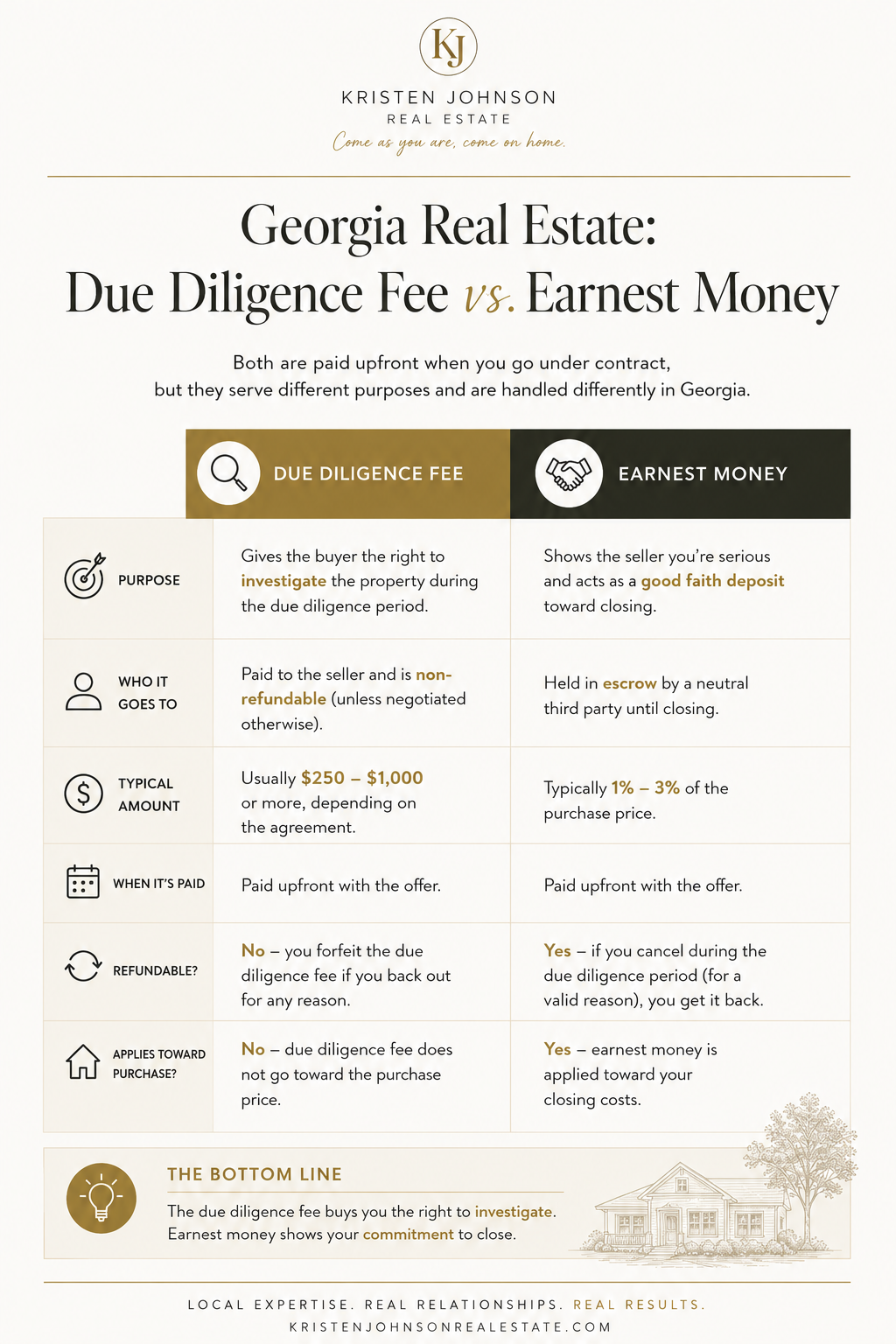
The DD Fee vs. Earnest Money — Georgia’s Two-Check System
Here’s where the confusion happens for most buyers, and I see it constantly.
When you go under contract in Georgia, you typically write two separate checks:
1. The Due Diligence Fee
This goes directly to the seller. It’s not held in escrow. It’s not refundable to the buyer, except in very limited circumstances (such as the seller defaulting on the contract). The moment you sign the contract, that money belongs to the seller.
The due diligence fee compensates the seller for taking their home off the active market while you inspect it. The amount is negotiated — there’s no set requirement. In practice, fees range from a few hundred dollars up to 1% to 2% of the purchase price in more competitive situations. On a $500,000 home, that could mean anywhere from $500 to $5,000 or more. What you offer as a due diligence fee is part of the strategy in how you structure your offer. A higher fee can signal serious buyer intent to a seller; a lower fee keeps more cash protected.
2. Earnest Money
Earnest money is held by the listing broker or a designated escrow account — not by the seller. This is your refundable good-faith deposit. If you terminate the contract at any point before the due diligence deadline, your earnest money comes back to you in full. The seller keeps the due diligence fee, but you recover your earnest money. See my full guide on how earnest money works alongside the DD fee in Georgia, including how much to offer and what happens if the deal falls through.
Earnest money is typically 1% to 3% of the purchase price, sometimes more in highly competitive markets. On a $500,000 home, that’s $5,000 to $15,000 sitting in escrow until closing or termination.
The bottom line: If you terminate during due diligence, you forfeit the DD fee and recover the earnest money. If you make it through due diligence and the deal closes, both amounts apply toward your closing costs and down payment. If you terminate after the due diligence deadline without a valid contractual reason, you typically forfeit the earnest money too — and the DD fee is long gone.
If you’re planning your total cash-to-close, make sure you factor in how much you’ll need beyond your down payment. I break down all the buyer closing costs in Georgia in a separate guide that includes the cash you need to have ready at the contract stage, not just at closing.
What to Do During Due Diligence — And Why Day One Matters
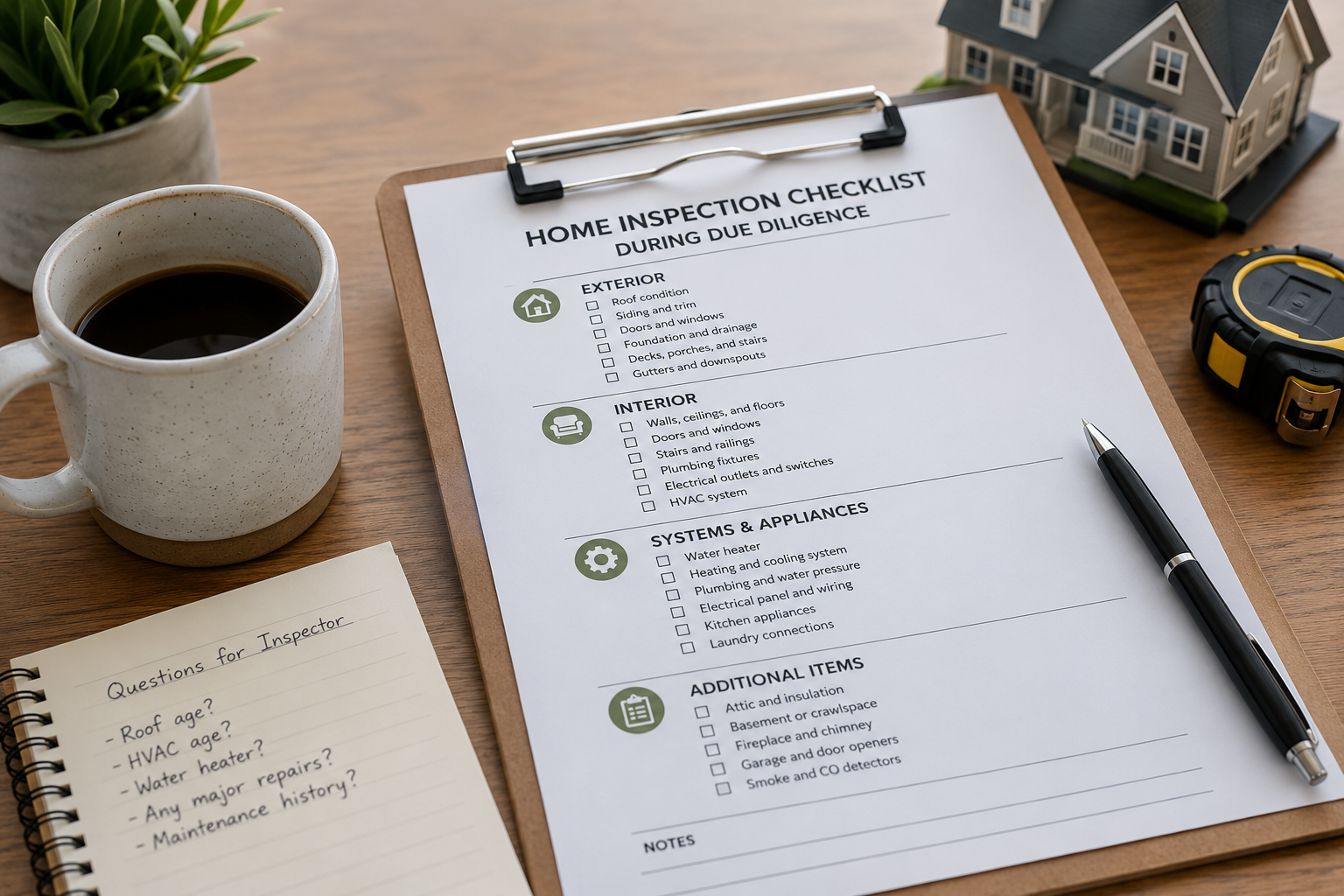
The due diligence period is your protected window to verify everything about the home. Here’s what I recommend for every buyer.
Schedule your home inspector immediately. In Atlanta, especially in intown neighborhoods during spring and early summer, good inspectors book up fast. A standard home inspection costs between $350 and $650 for most single-family homes. It takes 2 to 4 hours and covers the roof, attic, foundation, electrical, plumbing, HVAC, and interior spaces. Your inspector should be licensed in Georgia and carry errors and omissions insurance.
Get a termite inspection. Georgia is one of the highest-risk states in the country for termite activity. Most mortgage lenders require a clear termite letter (also called a Wood Infestation Report or WIR). Plan on this being a standard part of your due diligence, not optional. Cost is typically $75 to $150 separately or included with your home inspection.
Consider a sewer scope if you’re buying intown. Homes in Kirkwood, Grant Park, Edgewood, Inman Park, and other older Atlanta neighborhoods often have original cast-iron or clay sewer lines that can be 60 to 100 years old. Tree root intrusion and deterioration are common. A sewer scope — a camera inspection of the main sewer line — costs around $150 to $300 and can reveal problems that don’t show up on a standard home inspection.
Radon testing. More relevant in the northern suburbs near the Blue Ridge foothills (Alpharetta, Milton, Canton) than in the city core, but worth requesting depending on where you’re buying. Radon is a colorless, odorless gas that accumulates in basements and below-grade spaces.
Pay attention to drainage. Atlanta’s red clay soil does not absorb water well. Grading, drainage, and water intrusion at foundation walls are some of the most common issues found in metro Atlanta inspections. Your inspector should flag any evidence of prior water intrusion, and you should verify the grading directs water away from the foundation.
Get homeowners insurance quotes. Georgia home insurance rates have increased significantly — premiums in Atlanta average around $3,420 per year, well above the state average, due to hail exposure, rebuild costs, and other factors. Get quotes during due diligence, not after closing. Some homes — particularly those in certain flood zones or with older roofing systems — are much more expensive to insure than you might expect, and that affects your carrying costs.
Review HOA documents if applicable. If the property is in a homeowners association, Georgia law gives you the right to review the association’s financials, governing documents, and meeting minutes. Do this during due diligence. I’ve seen buyers walk away after discovering an HOA with inadequate reserves facing a major special assessment.
If this is your first purchase and you’re navigating the process for the first time, I covered the most common first-time buyer mistakes in Atlanta in a separate post — including several that relate specifically to the due diligence period.
What Happens When the Due Diligence Deadline Passes?
The due diligence deadline is a hard stop. There’s no grace period, no automatic extension unless the seller agrees to one, and no exceptions built into the standard GAR contract simply because you couldn’t get an inspector out in time.
Once that deadline passes without a written termination notice:
Your earnest money is no longer automatically protected.
If you back out without a valid contractual reason (a remaining financing contingency, for example), the seller can claim your earnest money.
You lose the right to terminate for any reason — you now need a specific contractual basis to exit.
Buyers sometimes miss the deadline because they underestimate how quickly the time goes, or because they’re waiting on inspection reports and assume they have more flexibility than they do. If an inspection comes back with issues after the due diligence period expires, you’re in a negotiation, not a protected exit. You can ask the seller for repairs or credits, but you can’t simply terminate and recover your earnest money the way you could have the day before.
If you need more time — because a specialist inspection takes longer to schedule, or because a report reveals something that requires a structural engineer — talk to your agent before the deadline. A seller may agree to a short extension of the due diligence period, but you need to get that in writing before the current deadline passes.
One other situation worth knowing: the due diligence fee goes to the seller even if the seller defaults on the contract and the deal falls apart on their end. In that case, you’d typically recover the DD fee as well as your earnest money — but that’s the exception, not the standard outcome.
Planning to Buy a Home in Georgia?
Understanding due diligence before you submit an offer can help you make better decisions once you are under contract. If you are not currently represented and want clear guidance through the Metro Atlanta buying process, schedule a buyer consultation with Kristen.
Already under contract or currently represented? Contact your real estate agent and a Georgia real estate attorney about your specific situation.

Frequently Asked Questions
How long is the due diligence period in Georgia?
There’s no legally mandated length. It’s negotiated and written into the contract. Most Atlanta transactions use 7 to 10 days. In competitive markets, sellers sometimes push for shorter periods. In less competitive situations or on complex properties, buyers often negotiate 10 to 14 days or longer. The timeline starts the day both parties sign the contract.
Is the due diligence fee refundable?
Generally no. The due diligence fee is paid directly to the seller and is non-refundable to the buyer in almost all circumstances. The main exception is if the seller defaults on the contract — in that case, the buyer may be entitled to recover both the DD fee and the earnest money. Otherwise, plan to forfeit the DD fee if you exit the contract for any reason, including a bad inspection.
What’s the difference between the DD fee and earnest money?
The DD fee goes directly to the seller at contract signing and is non-refundable. Earnest money is held in escrow by the listing broker or a designated account and is refundable if you terminate within the due diligence period. If you close on the home, both amounts are typically credited toward your down payment or closing costs.
Can I back out of a purchase during the due diligence period?
Yes. During the due diligence period, you can terminate the contract for any reason — or no reason at all — simply by delivering written notice before the deadline. Your earnest money is returned in full. The seller keeps the due diligence fee. After the deadline expires, terminating without a valid contractual basis typically means forfeiting your earnest money.
What should I do if my home inspection finds major problems?
You have three options during the due diligence period: terminate the contract and get your earnest money back, ask the seller to make repairs or provide a credit at closing, or proceed as-is with the information you now have. If the problems are severe enough that you can’t get comfortable with the property at the agreed price, the protected exit during due diligence is exactly what it’s there for. You don’t have to justify it to the seller — you just need to deliver written notice before the deadline.
How much should I offer as a due diligence fee?
It depends on the market and how competitive the situation is. In a multiple-offer situation on a high-demand property, a higher DD fee signals serious intent to the seller. In a less competitive environment, a lower fee keeps more of your cash protected. I typically guide my clients on what amount makes strategic sense given the specific property and market conditions — there’s no universal answer.
What if I need more time during due diligence?
Ask before the deadline passes. You’ll need the seller’s written agreement to extend the period. Most sellers will accommodate a reasonable extension if you’ve been communicative and there’s a legitimate reason — a delayed specialty inspection, for example. What won’t work is realizing the deadline has passed and asking for more time retroactively. Once it expires, it’s gone.
Do I need a home inspection in Georgia if the seller doesn’t require it?
No one can require you to get a home inspection, but skipping it in Georgia is genuinely risky. Georgia is a caveat emptor (buyer beware) state with limited mandatory seller disclosure requirements. Once you close on a home, your legal ability to hold a seller accountable for defects you could have found through inspection is severely limited. The cost of a home inspection — $350 to $650 for a standard single-family — is one of the most cost-effective purchases you’ll make in the entire transaction.
Planning to Buy a Home in Georgia?
Understanding due diligence before you submit an offer can help you make better decisions once you are under contract. If you are not currently represented and want clear guidance through the Metro Atlanta buying process, schedule a buyer consultation with Kristen.
If you are planning to buy in Metro Atlanta, learn more about Kristen’s buyer representation services.
Already under contract or currently represented? Contact your real estate agent and a Georgia real estate attorney about your specific situation.
Kristen Johnson is a real estate agent and team lead with Kristen Johnson Real Estate at Compass Metro Atlanta. A native Atlantan who grew up in East Point and lives in Edgewood, she has guided clients through more than $50M in sales across the city and suburbs, drawing on a background as a labor doula that shapes her calm, clear, client-first approach. Connect with Kristen at kristenjohnsonrealestate.com.