

Living in Fayetteville GA: Fayette County Schools, Trilith & What Homes Cost in 2026
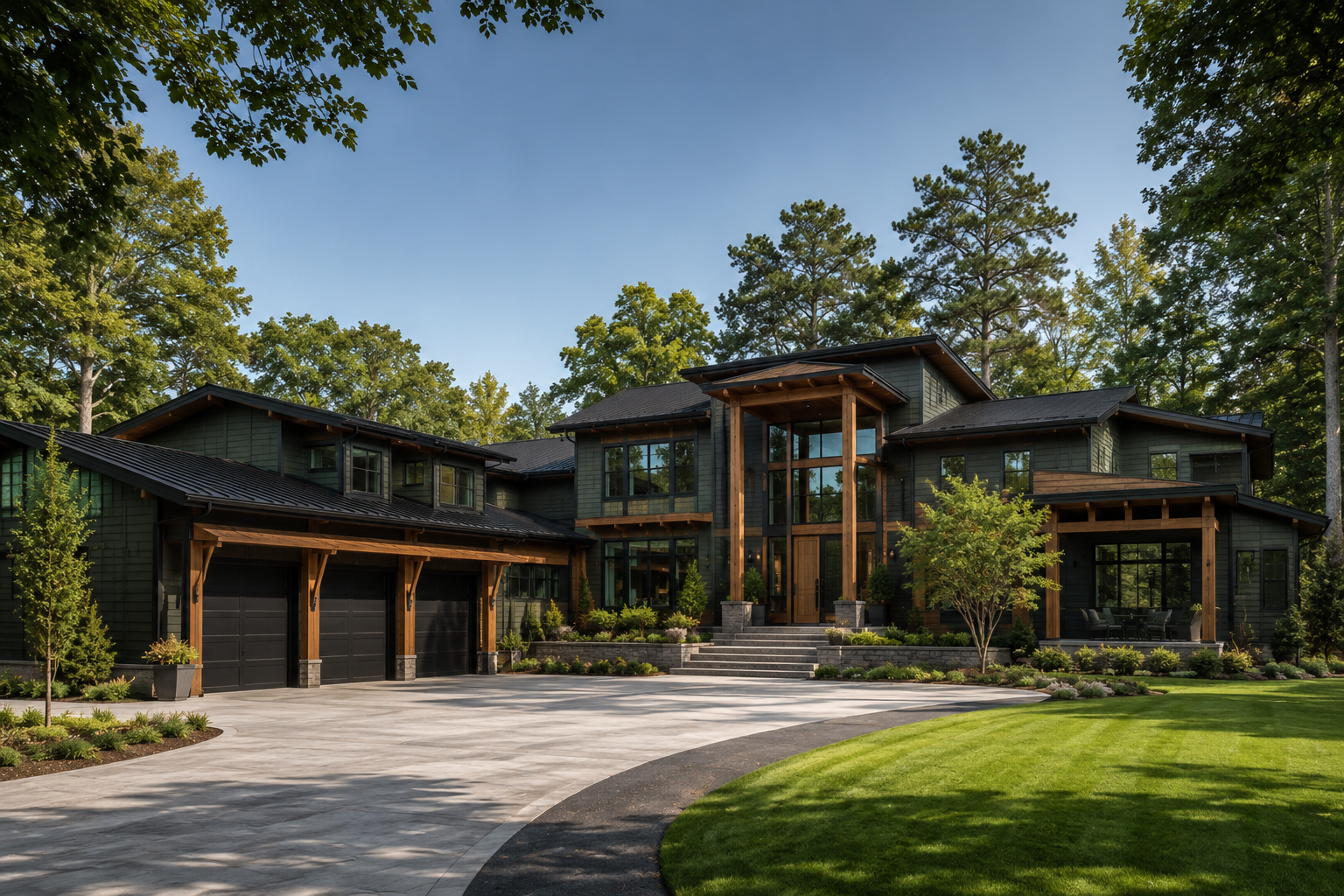
If you're researching Metro Atlanta suburbs from outside the state, Fayetteville probably surfaced for one of three reasons: Fayette County's public schools, the Trilith development that grew up around the former Pinewood Atlanta Studios, or the fact that you can sit at the historic courthouse square downtown and be at Hartsfield-Jackson in roughly 25 minutes. Those three things are real, and they're each their own conversation. None of them tell you the whole story.
Fayetteville is the county seat of Fayette County, 22 miles south of downtown Atlanta with a city population of just under 19,000 and a much larger commuter and unincorporated population pulling in from the surrounding county. It is a small town that happens to sit inside the south metro Atlanta orbit, with a downtown built around the oldest surviving courthouse in Georgia (1825) and a film-industry-fueled new urbanist development a few miles south that has rewritten what people think Fayetteville is.
I work with buyers across Metro Atlanta, including families relocating from out of state who are weighing south metro against the more obvious North Fulton and East Cobb options. Fayetteville comes up in those conversations more now than it did five years ago, and the reasons for that are specific.
Nearly a decade of helping Atlanta buyers means I know what the headline numbers miss: the difference between a Trilith address and a Fayette County address ten minutes away, what zoning means for which of five high schools your kids attend, what the airport commute actually looks like at 6 AM on a Tuesday, and how the south metro market has moved differently than intown Atlanta over the last two years.
Here's what you need to know.
What Is Fayetteville, and Where Does It Sit in Metro Atlanta?
Fayetteville is in Fayette County, due south of Atlanta along Highway 85 and Highway 54. It was incorporated in 1823 and named, along with the county, for the Marquis de Lafayette, the French general who fought alongside George Washington in the Revolutionary War. The land was taken from the Creek people through a treaty during the early period of Indian removal. The area was developed for cotton plantations with labor extracted from enslaved African Americans, who for more than a century made up the majority of the county's population.
The city's population went from 2,715 in 1980 to 18,957 at the 2020 census. That's nearly a 7x increase in 40 years, driven first by Atlanta's southward suburban spread and accelerated more recently by the film industry settling into Fayette County in 2014.
Geographically, Fayetteville sits between two well-known south metro names. Peachtree City, with its golf cart paths and master-planned villages, is immediately west. Senoia, the small Coweta County town where The Walking Dead filmed and which has become a tourist destination in its own right, is about 15 miles southwest. To the north is Tyrone, then Fairburn and the south Fulton stretch leading into Hartsfield-Jackson. To the east is Lovejoy and Henry County, with Stockbridge and McDonough beyond.
The city itself covers about 13 square miles. ZIP codes 30214 and 30215 both belong to Fayetteville. 30214 covers the northern and western parts of the city, including the area around Piedmont Fayette Hospital. 30215 covers the southern stretch toward Brooks and includes most of the Trilith footprint and the more rural Fayette County land south of the city limits.
The northern part of the city, around Highway 54 and Highway 85, is more built out: shopping at Fayette Pavilion, the hospital corridor, established subdivisions with smaller lots and older homes from the 1980s through early 2000s. The southern part has larger lots, newer construction, and a more rural feel as you move toward the county line. Trilith sits in this southern band, adjacent to Trilith Studios.
The Trilith Effect: What's Happening South of Town
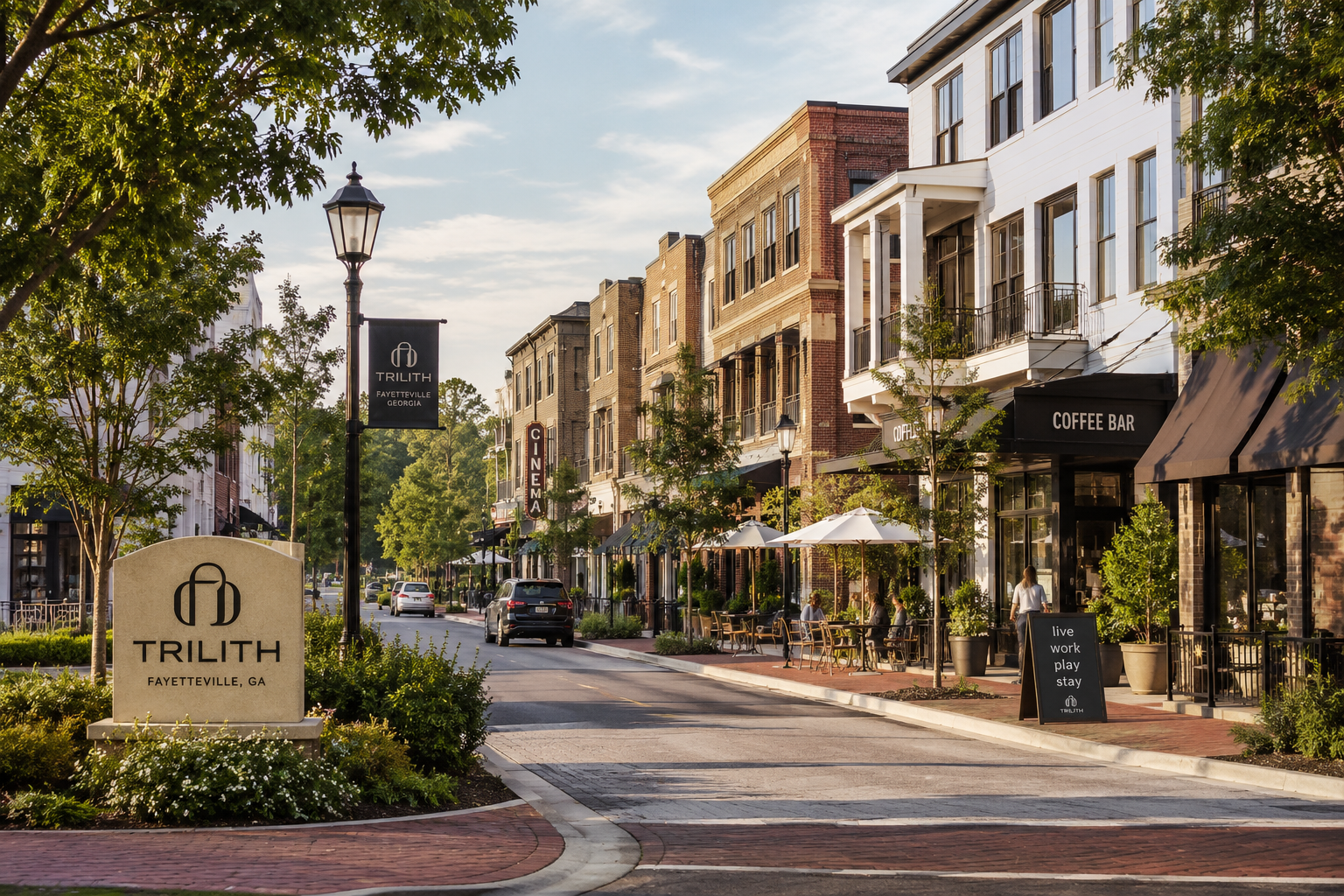
You cannot write about Fayetteville in 2026 without writing about Trilith. The development has changed the math on this market.
The story starts with film tax credits. Georgia offers a 20% tax credit on productions that spend $500,000 or more in the state, plus another 10% if they include the Georgia peach logo in the credits. That 30% effective discount made Georgia one of the largest film production locations in the country. In 2013, Pinewood Group, the British studio behind decades of James Bond films, announced it was opening its first US production facility in partnership with the Cathy family trust, which owns Chick-fil-A. The result was Pinewood Atlanta Studios, on 690 acres of former farmland in Fayette County. The first film to shoot there was Ant-Man in 2014.
What followed was the Marvel Cinematic Universe. Captain America: Civil War, Spider-Man: Homecoming, Black Panther, Avengers: Infinity War, Avengers: Endgame, Spider-Man: No Way Home, WandaVision, Ms. Marvel, and a long list of others were filmed at the studio in Fayetteville. In 2020, Pinewood sold its share to the Cathy trust and the operation was renamed Trilith Studios. The facility now spans roughly 700 acres with 32 soundstages and a 400-acre backlot, making it the largest production facility in Georgia and the largest purpose-built film studio outside Hollywood.
In 2016, the same ownership group started building a town across the street. Originally called Pinewood Forest, it was renamed the Town at Trilith when the studio rebranded. The vision was a European-inspired walkable community designed for the price sensitivities of creative professionals at various career stages, ranging from micro-homes and townhomes to custom-designed estate homes. The plan is for 1,400 residential units total: roughly 750 single-family homes, 600 multifamily lofts, 192 hotel rooms, and 270,000 square feet of retail, office, and restaurant space.
What sets Trilith apart from a normal master-planned subdivision:
The residential neighborhoods are the largest geothermal community in the United States
51% of the development is dedicated to green space
15 miles of nature trails on site
54 acres of forest preserved within the development
19 landscaped parks
Single-family lot sizes start at 1,800 square feet, much smaller than typical Georgia suburban lots, which is intentional and lets the architecture front a walkable "green street"
Architecture spans modern Nordic, Georgian London facades, Provencal cottage styles, all built to a curated design code
There is also Trilith Live, a 530,000-square-foot live entertainment complex that began opening in phases starting in early 2025. It includes a 2,200-seat theater, two 25,000-square-foot soundstages, a luxury cinema (Trilith Cinemas, with a Samsung Onyx LED screen, the first in the US), production suites, and 120,000+ square feet of creative office space. The first hotel on the property, the Trilith Guesthouse, opened in January 2024 as part of Marriott's Tribute Portfolio.
Here is the honest part of the Trilith story that buyers should know. In August 2025, The Wall Street Journal reported that Trilith Studios was "largely empty" because production costs in Georgia have risen and many production companies, including Marvel, have shifted projects to the United Kingdom where filming is cheaper. Trilith's CEO has called the slowdown cyclical and said a new normal should settle in by 2027. There has also been ongoing litigation around the Town at Trilith: in 2022, five Black residents of the community filed a racial discrimination lawsuit against Trilith Development, Trilith Studios, and the Trilith Owners Association alleging multiple incidents of discrimination and retaliation during their time as residents. The lawsuit was filed in Fulton County Superior Court. Trilith publicly denied the allegations.
What that means for buyers: Trilith is not just a development, it's an ecosystem tied to an industry that is currently in a soft patch. The homes are real, the architecture and amenities are real, and the long-term thesis is intact. But anyone buying into Trilith should understand they're buying into a specific cultural and economic story, not a standard suburban subdivision.
What Does Fayetteville Cost? Home Prices in 2026
Pricing in Fayetteville has to be parsed by location, because the city and the surrounding county trade at very different price points.
The city of Fayetteville (ZIP 30214 and 30215)
Zillow's most recent data shows the average Fayetteville home value around $448,000, down approximately 1.1% year over year, with homes going to pending in around 45 days. Redfin tracks the city median sale price closer to $381,000, with around 85 days on market in early 2025 and roughly 2 offers per home on average. Movoto shows the city median list price at $499,000 with about 59 days on market in March 2026.
The spread between those three sources tells you what's happening: the city itself has a wide price distribution. There's a lot of older inventory in the $300K–$450K range and a steady stream of new construction and Trilith inventory pulling the high end up.
Fayette County overall
Fayette County's median sale price is meaningfully higher than the city's. Redfin shows the county median at $533,000 with roughly 70 days on market. That's about 25% above the national median and reflects the fact that the county contains Peachtree City (one of the highest-income suburbs in south metro), the rural southern Fayette County land with larger acreage homes, and Trilith.
Trilith specifically
Trilith homes are priced well above the surrounding Fayetteville market. New construction townhomes from Patrick Malloy Communities start around $727,000 and run into the $845,000 range. Single-family homes from the Trilith Builders Guild start around $715,000 and go significantly higher. Resale homes in Trilith have averaged around $1.4M on the single-family side and around $781,000 on the townhome side in recent listings, with custom estate homes well above $1M. Lot sizes are small, but the price is reflecting the brand, the architecture, and the geothermal infrastructure rather than land area.
What you get for the money
A snapshot by price tier:
$300K–$400K: older homes in established Fayetteville subdivisions, generally 3 bed / 2 bath ranchers and traditionals built in the 1980s and 1990s. Sizes typically 1,500–2,000 square feet. North side of the city closer to Highway 54.
$400K–$550K: the volume range for the city. Newer construction in subdivisions off Highway 85 and Highway 54, four-bedroom homes generally 2,200–3,200 square feet, often on quarter to half-acre lots.
$550K–$750K: newer builds, larger square footage (3,200–4,500), often in subdivisions that back to woods or with finished basements. Also entry to Trilith townhomes.
$750K–$1.2M: the upper Fayette County market, including custom builds in the southern part of the county on multi-acre lots, Trilith single-family homes, and homes in select estate-style subdivisions in 30215.
$1.2M+: custom estate homes and Trilith's higher-tier inventory. Some southern Fayette County land with horse properties or significant acreage falls here.
These ranges are current as of recent MLS data, but the market shifts. For property-specific numbers in any subdivision or zone, contact me directly.
Market trends to watch in 2026
A few patterns I'm tracking in the Fayetteville market:
Days on market are longer than they were in 2021–2022. Redfin shows the city median at 85 days on market in recent reporting, compared to roughly 30 days at the peak of the post-pandemic market. This is consistent with the broader Metro Atlanta shift toward a more balanced market. Sellers who price aggressively still see fast offers; sellers who anchor to 2022 peak comps sit longer.
Inventory has grown. As of recent counts, the Fayetteville area has well over 500 active listings. That's significantly higher than 2021 levels and gives buyers real choice.
The Trilith premium is a separate market within the broader market. Trilith homes trade on their own logic: architectural style, brand association, geothermal infrastructure, and walkability. A $1.4M Trilith single-family home is not directly comparable to a $700K Fayetteville custom build with twice the lot, because the buyers are looking for different things.
Migration data shows Fayetteville continues to attract out-of-state buyers, particularly from New York, Los Angeles, and Washington metros. Redfin's migration analysis lists New York as the top out-of-metro origin for Fayetteville home searches, which is a relevant signal for the relocation buyer profile.
Fayette County Public Schools
Fayette County Public Schools is the local district. It has consistently been one of the higher-performing districts in Georgia. The district average ranking on Niche is 10/10, placing it in the top 5% of Georgia districts on that measure. Math proficiency district-wide averages 60% versus the Georgia state average of 39%, and reading proficiency averages 60% versus 40% statewide.
There are five high schools in the district, and zoning matters because they each serve different geographic slices of the county. Buyers need to verify zoning by the specific property address before making any decisions.
The five Fayette County high schools
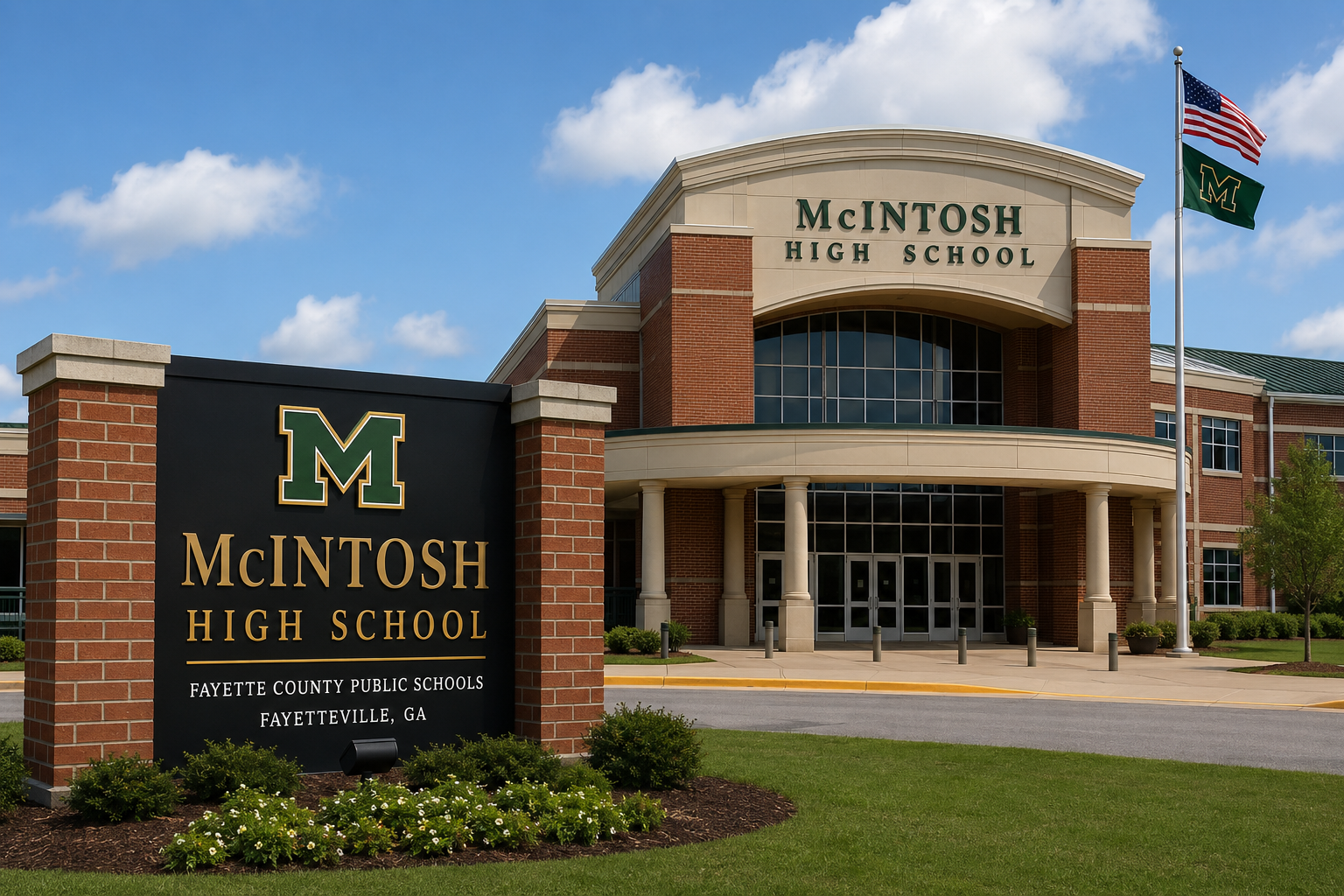
McIntosh High School (Peachtree City). Ranked #23 in Georgia by U.S. News & World Report. Serves much of Peachtree City and parts of western Fayette County.
Starr's Mill High School (193 Panther Path, Fayetteville, 30215). Ranked #25 in Georgia by U.S. News. Niche grade A, with a 10/10 GreatSchools rating. Serves much of southern Fayetteville and the south Fayette County area, including most of Trilith. SAT average around 1240, ACT average 28.
Whitewater High School (100 Wildcat Way, Fayetteville, 30215). Ranked #43 in Georgia by U.S. News. Serves the eastern portion of the county.
Sandy Creek High School (360 Jenkins Rd, Tyrone, 30290). Ranked #83 in Georgia by U.S. News. Serves Tyrone and parts of northern Fayette County.
Fayette County High School (Fayetteville). Ranked #92 in Georgia by U.S. News. Serves much of the city of Fayetteville proper. Designated a National Blue Ribbon School in 1999.
Middle schools serving Fayetteville
The five middle schools serving Fayette County are J.C. Booth Middle School, Flat Rock Middle School, Rising Starr Middle School, Bennett's Mill Middle School, and Whitewater Middle School. Rising Starr Middle is consistently among the top-ranked middle schools in the district and feeds Starr's Mill High. J.C. Booth Middle feeds McIntosh High. Whitewater Middle feeds Whitewater High. Flat Rock Middle feeds Fayette County High and Sandy Creek High depending on the elementary feeder pattern. Bennett's Mill Middle serves much of the central county and feeds multiple high schools depending on address.
Elementary schools
The district operates roughly 14 elementary schools, including Braelinn Elementary, Peeples Elementary, Peachtree City Elementary, Kedron Elementary, Inman Elementary, Fayetteville Elementary, Sara Harp Minter Elementary, Spring Hill Elementary, Huddleston Elementary, Oak Grove Elementary, North Fayette Elementary, Robert J. Burch Elementary, and Cleveland Elementary. Braelinn Elementary and Peeples Elementary are the highest-ranked in the district by Public School Review. Math proficiency at the top Fayette County elementary schools runs around 74% to 82%, with reading proficiency in the 78% range, well above state averages.
Charter and magnet options
Fayette County does not have an extensive charter or magnet system the way some neighboring counties do. The district has historically prioritized traditional public school structure over school choice mechanisms. Within the traditional structure, advanced learning programs run through individual schools, and AP coursework is available at all five high schools. AP participation rates vary by school, with Starr's Mill and McIntosh typically reporting the highest participation.
Private school options in Fayetteville include Our Lady of Victory Catholic School, Grace Christian Academy, The Forest School (an Acton Academy located on the Trilith Studios property), Foundry Academy, and Counterpane School. Tuitions range from roughly $7,000 to $17,000+ annually depending on the school.
A few practical notes:
Zoning is by specific address, not subdivision. Two houses on the same street can sometimes attend different elementary schools. Always verify with Fayette County Public Schools directly.
The district has school choice in some grade configurations, but it's not unlimited and changes year to year.
Boundary maps are publicly available on the Fayette County Board of Education website (fcboe.org), and the most current version is from June 2023.
Research and visit schools to determine fit for your family. Always verify zoning by specific property address.
Commuting from Fayetteville: Honest Numbers
This is where Fayetteville surprises out-of-state buyers. The geography is more favorable than people expect.
To Hartsfield-Jackson International Airport (ATL)
The road distance from Fayetteville to ATL is about 15 to 16 miles, primarily up Highway 85. Off-peak driving time is 25 to 30 minutes. During morning rush (7–9 AM), expect 35 to 45 minutes if you're heading toward the south or north entrance of the airport. This is one of the closest airport commutes of any Metro Atlanta suburb, and it's a real draw for buyers who travel frequently for work or who work in airport-adjacent industries.
To Downtown Atlanta
22 miles, generally up I-85 from the airport interchange or through Highway 85 to I-285. Off-peak, you can make it in 30 to 35 minutes. During morning rush, plan 50 to 65 minutes depending on traffic at the I-85/I-285 interchange and downtown connector backups. Reverse commute from downtown back to Fayetteville in the afternoon can also be slow, often 50 to 70 minutes.
To Midtown Atlanta
About 25 miles. Off-peak 35 to 40 minutes. Morning rush 55 to 75 minutes.
To Buckhead
About 30 miles. Off-peak 40 to 45 minutes. Morning rush 65 to 90 minutes. This is the commute that wears Fayetteville buyers out. If your job is in Buckhead five days a week, Fayetteville is a hard sell.
To the Perimeter
About 30 to 32 miles to Perimeter Mall area. Off-peak 40 to 50 minutes. Morning rush 70 to 100 minutes. Same problem as Buckhead.
To Trilith Studios and the south Fayette County film cluster
If you live in central Fayetteville or northern Fayette County, you're 10 to 15 minutes from the Trilith Studios gate. That proximity is the real reason production crews and film industry professionals have moved to the area.
MARTA
MARTA does not run rail to Fayetteville. The closest rail station is the airport (the southern terminus of the Red and Gold lines). MARTA bus Route 191 connects parts of Fayetteville and Clayton County to the airport, but it's a long, multi-transfer trip (1 hour 23 minutes from Fayetteville to ATL per published schedules). For practical purposes, Fayetteville is a car-dependent suburb.
The honest summary: Fayetteville works for buyers commuting to the airport, the south metro employment corridor (Jonesboro, College Park, Hapeville), and to the film industry in Fayette County. It works less well for OTP corporate commutes north of the perimeter, and it's a stretch for daily intown Atlanta office commutes if you're going further than downtown.
Things to Do in and Around Fayetteville
The downtown historic square is the center of civic life. The 1825 courthouse, the oldest surviving in Georgia, anchors the square and now functions as a welcome center and the offices of Main Street Fayetteville and the Fayette County Development Authority. The clock tower was added in 1888 when the railroad came through.
A few things worth knowing about the square:
Holliday-Dorsey-Fife House (1855). Built by John Stiles Holliday, uncle of John Henry "Doc" Holliday, the western gambler and dentist. Now Fayette County's first historical museum.
Margaret Mitchell Library (1948). Named for the author of Gone with the Wind. Houses Civil War and genealogical records for the Fayette County Historical Society. Mitchell's fictional Fayetteville Female Academy was modeled on a real school once housed in the Holliday-Dorsey-Fife home.
Old Train Depot (1902). Restored and now serving as the welcome center.
Villages Amphitheatre. Outdoor concert venue completed in 2002, hosts events through the spring and summer.
Annual events on the square include the Bluegrass Blast, the Old Courthouse Art Show, Main Street Festival, Trick or Treat on Main Street, the Dickens Christmas Tree Lighting, and the Christmas in Fayetteville festival. Fayetteville received its Main Street City designation in 1996.
A note on Civil War history. Fayetteville's connection to the Civil War is real but should be framed honestly. The county was developed for cotton plantations using enslaved African American labor. In July 1864, Union cavalry under General George Stoneman raided through Fayetteville as part of the broader Atlanta Campaign aimed at ending the Confederacy and the system of slavery it was fighting to preserve. After the war, Reconstruction brought continued violence, including from the Ku Klux Klan, against Black residents. The Confederate monument that still stands at the courthouse today was erected in 1934, decades after the war, during a period when many such monuments went up across the South. Visitors should understand the courthouse square as a place to reckon with that history, not as a scenic amenity uncoupled from it.
Shopping and dining
Fayette Pavilion is the major retail node, located off Highway 54 near the I-85 / Highway 85 corridor. Anchors include Target, Walmart, Home Depot, Best Buy, Dick's Sporting Goods, Marshalls, TJ Maxx, and Cinemark Tinseltown. It's one of the largest open-air shopping centers in south metro Atlanta.
Trilith has its own restaurant and retail district, including:
Roam at Trilith (coffee shop and bookstore)
The Spring Restaurant
Honeysuckle Gelato
Piedmont Provisions Market (the autonomous grocery store)
Trilith Cinemas (luxury movie theater with the Samsung Onyx LED screen)
The Trilith Guesthouse hotel
Downtown Fayetteville dining has built up around the square, with restaurants and breweries including Line Creek Brewing Company, Fountain Oak Wine Co., 240 The Restaurant, and a growing roster of small operators.
Parks and recreation
Lake Horton (1,200-acre reservoir in southern Fayette County, fishing and boating)
Lake McIntosh (650 acres, fishing, kayaking, no swimming)
McCurry Park (large city park, athletic fields, walking trails)
Starr's Mill (historic 1825 grist mill, picturesque waterfall, popular for photos and weddings, located off Highway 74)
Heritage Park (downtown park near the square)
15 miles of nature trails inside Trilith
Medical
Piedmont Fayette Hospital is a 282-bed acute care hospital at 1255 Highway 54 West, with 24-hour emergency services, cardiovascular care, OB/GYN, a comprehensive cancer center, robotic surgery, and rehabilitation services. Piedmont Fayette has received the Healthgrades America's 50 Best Hospitals award for multiple consecutive years.
Streets, Subdivisions, and Where to Look in Fayetteville
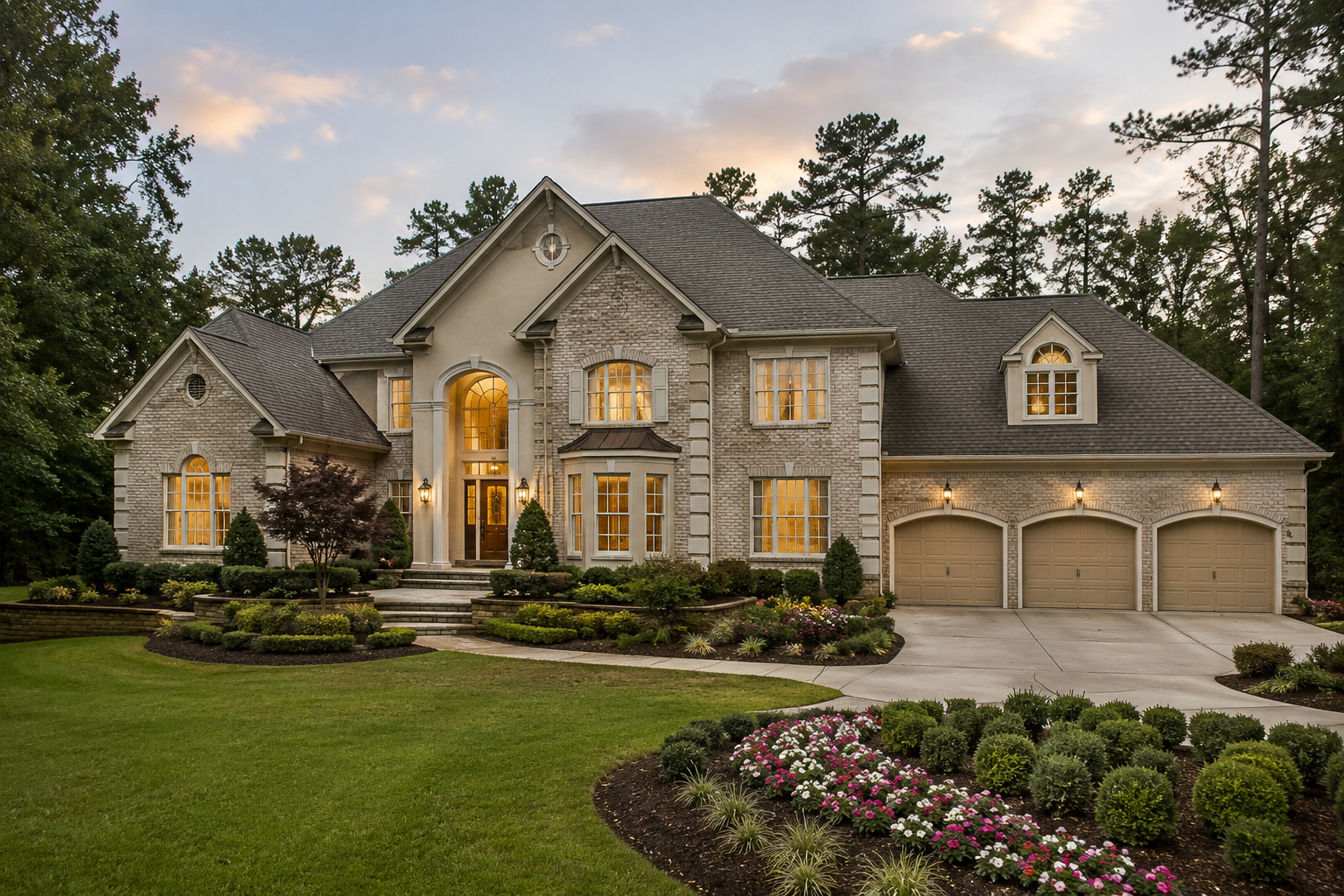
The Fayetteville housing stock is genuinely varied. Here's how it breaks down geographically.
Trilith (south Fayetteville, off Highway 74)
Sub-neighborhoods within Trilith include the cottage districts, the canopy district, the lakeside district, and a townhome cluster. Streets within Trilith carry European-village inspired names. The custom estate homes sit further into the development, often on the perimeter where lots can stretch larger. Townhome streets sit closer to the commercial core and the Trilith Guesthouse.
The cottage districts feature smaller-footprint single-family homes (often 2,000 to 2,800 square feet) designed in Provencal, Nordic, and English cottage styles. The canopy district has slightly larger single-family homes with more contemporary architecture. The lakeside district fronts the central pond and includes some of the development's higher-priced custom builds. Townhomes from Patrick Malloy Communities cluster along streets including Heatherden Avenue and run from roughly 1,800 to 2,500 square feet.
What buyers should look at carefully in Trilith: HOA fees are higher than typical Fayetteville subdivisions and cover the geothermal HVAC infrastructure, amenity access, and a meaningful portion of the landscaped common areas. Lot sizes are intentionally small (1,800 to 3,200 square feet in many cases), which is part of the new urbanist design philosophy but is a different living experience than typical suburban Georgia lots. The architectural review process within Trilith is strict, which protects the visual coherence but limits exterior modifications after closing.
Northern Fayetteville (30214, north of downtown)
This is the more established, denser side of the city. Subdivisions like Bonnie Glen, Whitney Park, Whitewater Creek, and Lafayette Park. Homes generally from the 1980s through 2010s. Lot sizes from a quarter acre to half acre. Closer to Highway 54 shopping and Piedmont Fayette Hospital. Pricing primarily in the $350K to $550K range, with some larger homes pushing into the $600s.
This is also where most of the older, more affordable Fayetteville inventory sits. Homes here were built when the city was still growing into its current footprint, and they tend to be solid three-bedroom, two-bath traditionals on quarter-acre lots. Many have been updated over the past decade. The trade-offs: less curated streetscape, smaller bedrooms in some 1980s builds, and HVAC and roof timing that buyers should pay close attention to during inspection.
Western Fayetteville (toward Tyrone and Peachtree City)
Includes neighborhoods like Stonebriar, Cardiff Park, Tara Plantation, and the area along Sandy Creek Road. Some of these zone to Sandy Creek High School rather than Fayette County High. Mid-to-upper $400s through $700s.
This part of the city benefits from proximity to Peachtree City's amenities (15 minutes to Peachtree City's downtown) while keeping a Fayetteville address. Some of the larger custom subdivisions in this zone have golf cart path access that connects into the Peachtree City network. Lot sizes generally larger than the northern part of the city.
Southern Fayetteville and rural south Fayette (30215)
Larger lots, newer construction, some horse properties. Subdivisions like Camden, Bridlewood, Bramblewood, and custom-built homes on Highway 92, Hilo Road, and McElroy Road. This zone mostly feeds into Starr's Mill High School. Pricing from $500K to well over $1.5M depending on land and house size.
This is also where you find the rural Fayette County estate market: five-acre and ten-acre tracts with custom homes, often with horse facilities or significant outbuildings. The buyer profile here is different from the rest of the city, and inventory is thin. Properties in this band can sit on market longer because the audience is narrower, but pricing per acre tends to hold up well.
Eastern Fayetteville
Toward Whitewater High School. Subdivisions like Whitewater Creek, Stonewall Manor, and parts of the eastern Highway 54 corridor. This part of the county is more spread out, with a mix of newer construction and 1990s-era subdivisions. Commute distance to the airport is slightly longer than the central or western parts of the city. Pricing generally $400K to $700K.
When I work with buyers in Fayetteville, the subdivision question is almost always second to the school zone question and the commute question. Decide those first, then narrow the subdivisions.
How Fayetteville Compares to Nearby Areas
Fayetteville vs. Peachtree City
Peachtree City is the bigger name. It's master-planned around 100+ miles of golf cart paths that connect homes to schools, shopping, and parks. The population is roughly 39,000, more than double Fayetteville's. Pricing in Peachtree City typically runs higher (median around $565K county-wide includes both), and the inventory skews more toward planned communities like Kedron, Glenloch, and Aberdeen. Peachtree City zones primarily to McIntosh High and Starr's Mill High.
Who Fayetteville wins for: buyers who want closer access to downtown Fayetteville's historic square, more varied housing stock at slightly lower price points, and access to Trilith.
Who Peachtree City wins for: families specifically prioritizing the golf cart lifestyle, the highest-end Fayette County schools (McIntosh), and a more uniformly suburban planned environment.
Fayetteville vs. McDonough / Henry County
McDonough is east, in Henry County, about 30 minutes from Fayetteville. Henry County pricing is lower (county median around $370K), and the school system is different (Henry County Schools is generally rated below Fayette County). The trade-off is Fayetteville's premium pricing for a stronger school district vs. McDonough's affordability.
Fayetteville vs. Newnan / Coweta County
Newnan is southwest, in Coweta County, about 25 to 30 minutes. Newnan's historic downtown is one of the most attractive in Georgia and the city has a strong identity. Pricing is comparable to Fayetteville. Coweta County schools are highly rated. The decision usually comes down to which downtown and which set of schools you prefer, and which commute geography works for your job.
Fayetteville vs. Stockbridge
Stockbridge is east, in Henry County, closer to I-75 and Eagle's Landing. Pricing in Stockbridge is generally lower than Fayetteville. School ratings are lower on average. Stockbridge is a stronger fit for buyers heavily focused on I-75 corridor commutes.
Fayetteville vs. South Fulton (East Point, College Park, Hapeville)
South Fulton sits between Fayetteville and the city of Atlanta. Pricing has risen significantly in East Point and Hapeville over the past five years, but the school ratings are different (Fulton County Schools serves these areas). The advantage of south Fulton is closer proximity to intown Atlanta and MARTA rail access. The advantage of Fayetteville is the stronger school district and more space for the money.
Who Is Fayetteville Right For?
Fayetteville tends to be the right fit when:
You're relocating from out of state and one of your top priorities is a strong public school district at a price point under the North Fulton premium
You travel frequently and want to be 25 minutes from Hartsfield-Jackson
You work in the film industry or work-adjacent to the Trilith production ecosystem
You want a historic, walkable downtown without paying intown Atlanta prices
Your commute is to the airport corridor, south metro, or the film cluster, not OTP north
You want a meaningful house with some yard at a price between $400K and $700K
You like the idea of a small town that still has a real downtown but want to be close enough to Atlanta to use the city
You're considering Trilith specifically for the architectural style, walkability, and amenity package and you understand the broader market context
Think carefully about Fayetteville if:
Your daily job is in Buckhead, the Perimeter, or any OTP-north office park
You need MARTA rail access to your workplace
You're price-sensitive under $350K and need a lot of options at that point (Fayetteville inventory is thin below $350K)
You want a fully walkable, urban-density living experience day to day (Trilith approximates this, but the broader city is car-dependent)
You're buying in Trilith and assuming the film industry's local presence will remain at peak 2018–2022 levels (the market is currently in a softer phase)
Frequently Asked Questions
What is the median home price in Fayetteville, GA in 2026?
The city of Fayetteville median home value is approximately $448,000 according to Zillow's 2026 data, with a wide range depending on neighborhood. Fayette County overall sits closer to $533,000 because it includes Peachtree City and the higher-end southern Fayette County market. Trilith homes start around $715,000 for single-family and run well above $1M for custom builds.
How far is Fayetteville from downtown Atlanta?
22 miles, generally 30 to 35 minutes off-peak and 50 to 65 minutes during morning rush hour. Most Fayetteville residents reach downtown via Highway 85 to I-85 northbound.
How far is Fayetteville from Hartsfield-Jackson airport?
About 15 to 16 miles, 25 to 30 minutes off-peak. This is one of the closest airport commutes of any Metro Atlanta suburb, which is a major draw for frequent travelers and airport-adjacent industries.
Is Fayetteville in Fayette County?
Yes. Fayetteville is the county seat of Fayette County. The county also includes Peachtree City, Tyrone, Brooks, and Woolsey, plus large unincorporated areas. Different parts of the county are zoned to different school districts within Fayette County Public Schools.
What are the best schools in Fayette County?
Fayette County Public Schools is consistently ranked in the top 5% of Georgia districts. By U.S. News rankings within Georgia, McIntosh High (Peachtree City) ranks 23rd, Starr's Mill High (south Fayetteville) ranks 25th, Whitewater High (eastern Fayetteville) ranks 43rd, Sandy Creek High (Tyrone) ranks 83rd, and Fayette County High (Fayetteville) ranks 92nd. The "best" school depends entirely on which one your address is zoned to. Always verify zoning by specific property address.
What is Trilith and is it part of Fayetteville?
Trilith is a 235-acre master-planned residential and mixed-use development in the southern part of Fayetteville, adjacent to Trilith Studios (the former Pinewood Atlanta Studios). It includes plans for 1,400 homes, retail, hotels, and the Trilith Live entertainment complex. Yes, it's a Fayetteville address. The development is the largest geothermal community in the United States, and 51% of its footprint is green space. Home prices in Trilith start around $715,000 and run into the $1.5M+ range.
Was Pinewood Studios in Fayetteville renamed?
Yes. Pinewood Atlanta Studios was rebranded as Trilith Studios in October 2020 after the Pinewood Group sold its stake to River's Rock LLC, the Cathy family trust. The studio's name comes from "trilithon," a Stonehenge-style architectural structure.
What movies were filmed in Fayetteville, GA?
Trilith Studios (formerly Pinewood Atlanta) has been the primary US production location for the Marvel Cinematic Universe. Films shot there include Ant-Man, Captain America: Civil War, Spider-Man: Homecoming, Black Panther, Avengers: Infinity War, Avengers: Endgame, Spider-Man: No Way Home, and Black Panther: Wakanda Forever, plus Disney+ series including WandaVision, Loki, and Ms. Marvel. Many non-Marvel productions have also filmed there.
Is Fayetteville a good place to live?
Fayetteville consistently ranks in best-places-to-live lists for Georgia. The strongest cases for living here are the school district, the airport proximity, the historic downtown, the housing value relative to the school quality, and the Trilith amenity layer in the south part of the city. The weakest cases are the OTP-north commute and the lack of MARTA rail access.
What is the population of Fayetteville, GA?
The 2020 census put the city of Fayetteville at 18,957. The county population is closer to 120,000+ as of recent estimates. The city has grown roughly 7x since 1980.
Is Fayette County conservative or liberal?
Politically, the county has historically leaned Republican but has shifted toward more competitive elections over the past decade as the suburban population has grown and diversified. This is a question I'd suggest researching directly rather than relying on broad assumptions.
What are the property taxes in Fayetteville?
Fayette County millage rates have historically been moderate compared to other Metro Atlanta counties. Combined city + county + school millage typically puts effective property tax around 1.0% to 1.2% of assessed value, though this changes annually. For specific property tax estimates, contact the Fayette County Tax Commissioner or your real estate agent for the most current numbers on a specific property.
Should I buy in Trilith or in a regular Fayetteville subdivision?
This is a real fork in the road for buyers considering Fayetteville. Trilith is a different product than the rest of Fayetteville: smaller lots, curated architecture, a walkable village environment, geothermal infrastructure, and a price premium that reflects all of it. A regular Fayetteville subdivision gives you more square footage and yard for the money, often in a school zone every bit as strong as Trilith's (Starr's Mill High serves much of both). The question is whether you're buying a house and yard or buying into a specific community and lifestyle. Both are valid. They're just different decisions.
What's the weather like in Fayetteville?
Humid subtropical, four seasons. Hot summers (highs in the 90s for much of June through August, with humidity), mild winters (highs typically in the 50s, occasional ice events), pleasant springs and falls. The county sits in a region First Street Foundation flags for elevated heat exposure over the next 30 years, with a projected increase in days over 105°F.
Is Fayetteville good for first-time buyers?
Fayetteville can work for first-time buyers, but you need to set expectations correctly. The bottom of the city's inventory is generally in the $300K to $400K range for older 1,500 to 2,000 square foot homes. Below that, options are thin. For first-time buyers focused on this market, I usually recommend looking at older homes in the 30214 ZIP code that haven't been heavily updated as a renovation opportunity, townhomes in the city, or houses just over the county line in Clayton or Coweta County if pricing requires it. First-time buyer programs available statewide (Georgia Dream, lender-specific down payment assistance) apply in Fayetteville the same as anywhere else in Georgia.
How does Fayetteville's market compare to North Fulton suburbs?
This is the comparison I get most often from relocation buyers. The short version: North Fulton (Alpharetta, Milton, Johns Creek, Roswell) is generally $150,000 to $300,000 more expensive at comparable square footage, has a longer commute to the airport (45 to 60 minutes vs. 25 to 30), and has comparably strong but differently-ranked schools. Buyers who pick North Fulton over Fayetteville usually do so because their jobs are in Buckhead, the Perimeter, or Alpharetta itself. Buyers who pick Fayetteville over North Fulton are usually optimizing for value per square foot, airport proximity, or a particular interest in the Trilith ecosystem.
Is Fayetteville growing or shrinking?
Growing. The city's population went from 2,715 in 1980 to 18,957 in 2020. Fayette County is one of the higher-growth counties in south metro Atlanta. Trilith alone has added meaningful inventory and population over the past five years, and continued buildout is planned through 2032. New retail and commercial development is active around the Highway 54/Veterans Parkway corridor, the courthouse square (the Meridian on the Square mixed-use project is currently under construction at the northwest corner of the square), and the Trilith expansion footprint.
Working with Me in Fayetteville
I work with buyers across Metro Atlanta, including families relocating to Fayetteville from out of state, buyers weighing the south metro market against North Fulton, and clients specifically interested in Trilith or the rural southern Fayette County market. I know the school zones, the commute realities, and the price tiers in detail.
Visit kristenjohnsonrealestate.com or reach out directly. Come as you are, come on home.
Looking for more Metro Atlanta neighborhood guides? I've covered north metro suburbs in depth, including Alpharetta, Milton, Roswell, and Johns Creek, plus the Cobb County cluster including East Cobb and Marietta. Browse the full guide series at kristenjohnsonrealestate.com.