

Living in Peachtree City GA: Golf Cart Paths, Top Schools & What Homes Cost in 2026
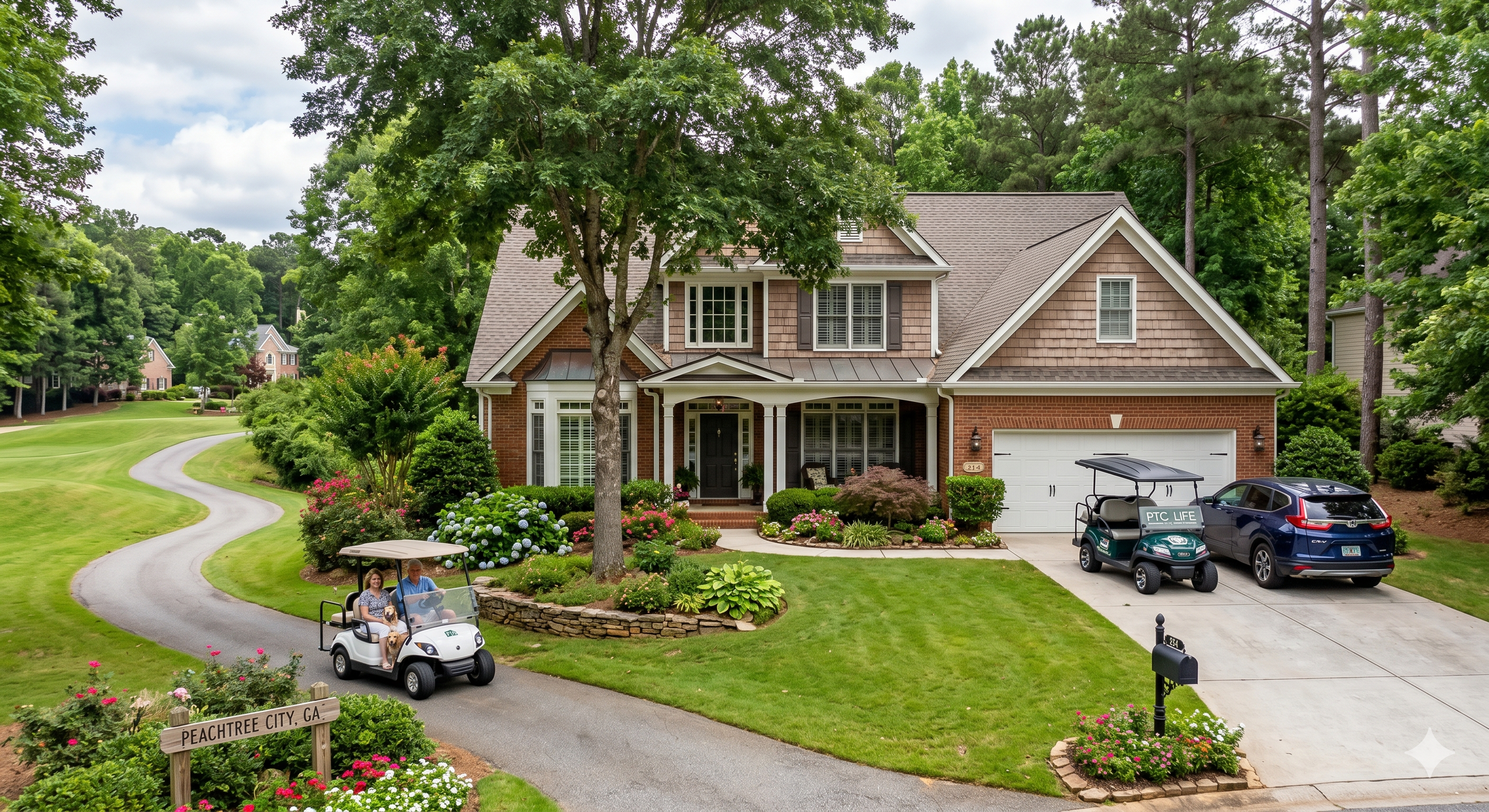
If you're researching Peachtree City, you've already heard about the golf cart paths. It's the first thing anyone tells you about this place, and for once the reputation is built on something concrete: more than 100 miles of paved multi-use paths that connect every neighborhood to every school, shopping center, park, restaurant, and church inside the city limits. Over 10,000 households own a golf cart. Kids drive them to McIntosh High School. Parents run errands to Walmart on them. The paths cross under Highway 54 and Highway 74 through dedicated tunnels and bridges, which means you can move through most of the city without ever sharing a road with a car.
That's the part of Peachtree City that goes viral. The part that actually matters when you're buying a home here is everything underneath it: the village structure, the school zone math, the price gap between an Aberdeen mid-century rancher and a custom build in Wilksmoor, the realities of a 40-minute Hartsfield commute, the fact that the entire city was master-planned in 1959 and is still operating off that original blueprint.
I work with buyers across Metro Atlanta who are evaluating Peachtree City against North Fulton, East Cobb, Newnan, and the South Fulton/Henry County corridor, and the buyers most likely to land here are the ones doing the math on commute, schools, and lifestyle in that exact order. PTC is roughly 30 miles south of downtown Atlanta and about 25 minutes from Hartsfield-Jackson without traffic, which makes it a strong fit for airport-dependent professionals (Delta employees, pilots, flight crews, frequent business travelers) and for anyone working at Trilith Studios, which sits about 10 miles east in Fayetteville and remains the largest film production facility in Georgia.
Nearly a decade of helping Atlanta buyers across the metro means I know what the data doesn't show: how the five villages actually differ in feel and price, why the McIntosh zone trades at a premium compared to Starr's Mill or Whitewater zoning, what Lake Peachtree boating rights mean for resale (very few homes have them), how the school cart parking lots and the path system change daily life in ways you can't appreciate until you spend a Saturday here.
Here's what you need to know.
What Is Peachtree City, and Where Is It?
Peachtree City sits in Fayette County, about 30 miles south of downtown Atlanta and 25 miles southwest of Hartsfield-Jackson Atlanta International Airport. It was chartered on March 9, 1959, on roughly 12,000 acres of land acquired by a group of developers who wanted to build one of the South's first planned communities, part of the same mid-century "new town" movement that produced places like Reston, Virginia and Columbia, Maryland.
The original master plan called for the city to be divided into self-contained villages, each with its own elementary school, shopping center, parks, and recreational facilities, all connected by a network of paths designed for foot, bike, and golf cart traffic. That plan is still the operating system. Peachtree City today is organized into five villages: Aberdeen, Braelinn, Glenloch, Kedron, and Wilksmoor. Each village has its own elementary school, its own retail anchor, and its own character.
A few things to understand before you go further:
Peachtree City is not Peachtree Corners. Peachtree Corners is a separate city in Gwinnett County, north of Atlanta, with no relationship to PTC beyond the name. Buyers confuse them constantly. If you're searching for "Peachtree City" online and getting results 50 miles north of where you mean to be, that's why.
The full build-out is capped. The original 1959 plan projected 80,000 to 110,000 residents. In 1985, that was revised down to about 45,000 at full build-out. According to the 2020 Census, Peachtree City has roughly 38,000 residents. The city is approaching its planned ceiling, which is why new construction is concentrated in Wilksmoor (the West Village) rather than spreading citywide.
Fayette County is its own thing. Peachtree City is the largest city in Fayette County, but it shares the county with Fayetteville, Tyrone, Brooks, and Woolsey. The Fayette County Public Schools district serves all of them. Buyers comparing PTC to other suburbs need to understand that the county lines and school zoning matter as much as the city limits.
Peachtree City Home Prices in 2026: The Numbers
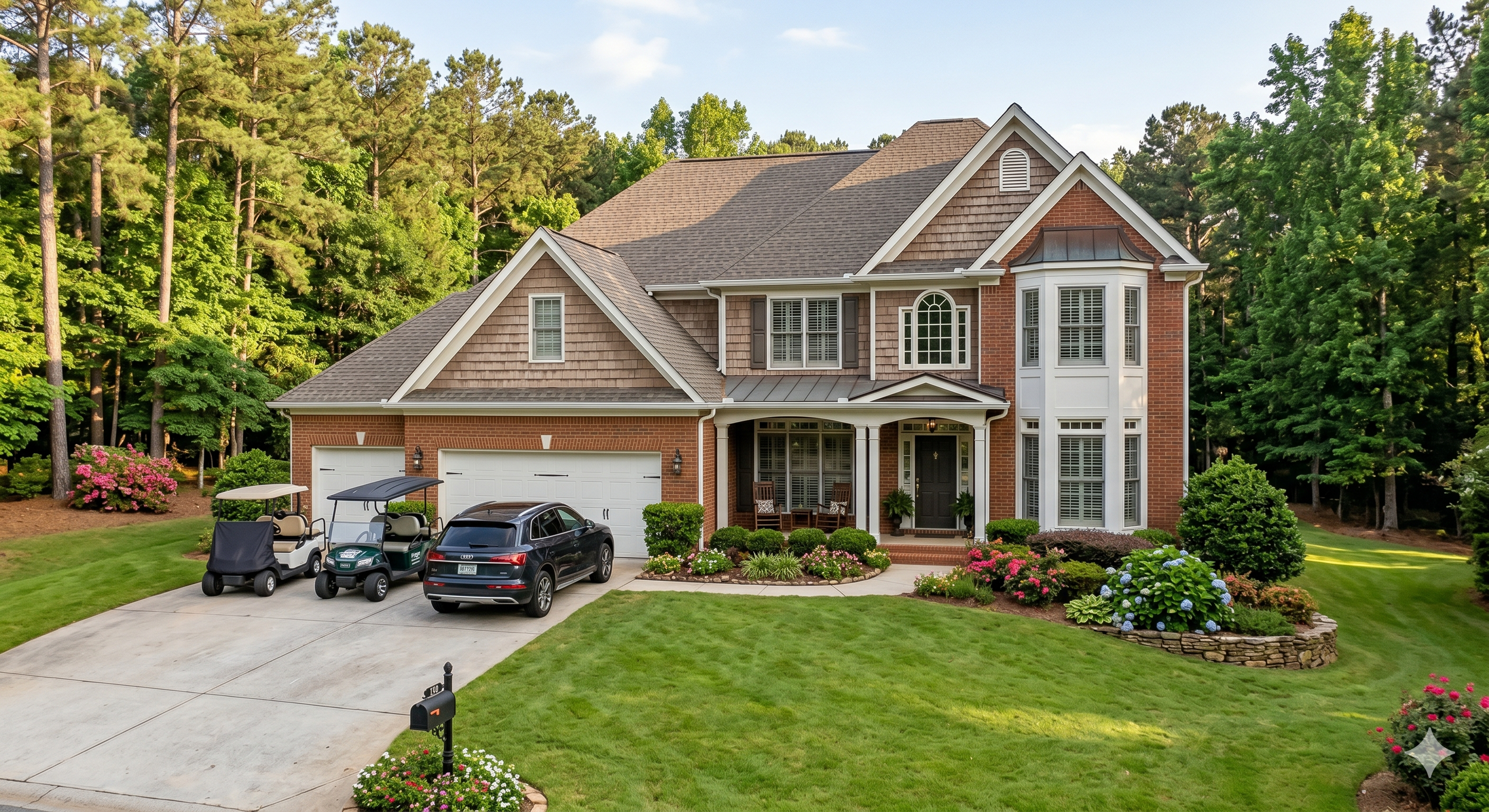
I'll give you the data sources and let you triangulate, because the median sale price for Peachtree City varies more across sources than most Metro Atlanta cities. Part of that is because the city includes everything from $300K townhomes to multi-million-dollar custom estates on Lake Peachtree.
As of early 2026:
Redfin reported a February 2026 median sale price of $590,000 in Peachtree City, down 4.6% year-over-year, with homes selling in a median of 65 days on market. Median price per square foot was $229.
Movoto reported a March 2026 median sale price of $624,999 with homes spending 52 days on market, up from 27 days the year prior. The median list price in May 2026 sat at $645,000.
Houzeo showed a median sale price of $724,700, up 0.21% year-over-year, with 1.12 months of supply and a sale-to-list ratio of 97.62%.
Homes.com put the 12-month median sale price at $559,000, a 5% increase from the prior year, with typical price ranges from $300,000 for a 2-bedroom up to $800,000 for larger 5-bedroom homes.
Zillow's Home Value Index pegged the average home value at $515,510, up 3.9% over the past year.
The spread tells you something real about the market. Peachtree City has a wide price distribution across its villages and home types, and which dataset you pull tells you which slice of the market you're looking at. Median listing data skews higher because it includes everything currently listed. Median closed sales data captures what actually traded. Zillow's index includes the rental and condo inventory that drags the average down.
The honest summary: most single-family buyers shopping Peachtree City are in the $500K–$800K range. Entry pricing on townhomes and condos starts in the mid-$200Ks to low $300Ks. Custom homes, lakefront properties, and the higher-end new construction in Wilksmoor and Kedron can reach $1M–$2M+. Days on market has roughly doubled compared to 2024–2025, which means buyers have more negotiating room than they did during the pandemic-era frenzy but inventory still moves faster than the national average.
For current data on a specific village or street, I run pulls directly from the FMLS: what's listed, what's pending, what closed in the last 60 days, and what's been sitting. Public-facing data tools are useful for big-picture context but lag 30 to 90 days behind the live market.
A note on the 2024-to-2026 market shift: Peachtree City was one of the suburbs that saw the most aggressive price appreciation during the pandemic-era frenzy of 2020 through 2022. Buyers from intown Atlanta and from out-of-state remote workers drove demand to levels the city had not seen before. From 2024 into 2026, the market has rebalanced. Days on market have roughly doubled. Sale-to-list ratios have moved from above 100% to roughly 97 to 98%. Year-over-year price changes have been modest in either direction, depending on the data source and the slice of the market. For buyers, this means more room to negotiate, more time to make a decision, and less of the panic-bidding dynamic that defined 2021. For sellers, it means pricing has to be right from day one. The homes that linger past 60 days typically have a pricing or condition issue, not a market issue.
Property taxes and HOA fees: Fayette County property tax rates are among the more competitive in Metro Atlanta, which has historically been part of PTC's appeal compared to Fulton, DeKalb, and Cobb. Individual property tax bills depend on the assessed value, the homestead exemption status, and any village-level or subdivision-level overlays. Many PTC subdivisions have HOA fees, though they vary widely: some are nominal (under $500 annually), some are more substantial for communities with shared pools, tennis, or maintained common areas ($1,000 to $3,000+ annually). Country club dues for Flat Creek, Braelinn Golf Club, and Planterra Ridge are separate and significant for members. Always pull the HOA documents and the county tax record before committing to a specific property.
The Five Villages: What's Different About Each One
This is the part most online guides handle badly. The five villages of Peachtree City are not interchangeable. They differ in build era, lot size, price point, school zoning, and feel. Buyers who don't understand the village structure end up either paying too much or settling in the wrong part of town.
Aberdeen Village
Aberdeen is one of the two original villages, developed primarily in the 1970s and 1980s. It sits on the southern side of the city, anchored by the Aberdeen Village Shopping Center and Flat Creek Country Club. Homes here are predominantly ranch-style and split-level builds on mature wooded lots, with the largest concentration of original 1970s construction in the city.
What you get in Aberdeen: established trees, larger lots than newer construction, lower price points relative to Kedron and Wilksmoor, and direct path access to Lake Peachtree, the city's largest lake. Aberdeen has long been popular with downsizing buyers and retirees, but families buy here too, particularly those zoned for McIntosh High School.
Price range: roughly $400K–$700K for most single-family homes, with some larger lakefront and golf-course-adjacent properties trading higher.
The honest read on Aberdeen: this is where you'll find the most renovation opportunities in Peachtree City. Many of the 1970s and 1980s ranch homes here have original kitchens and bathrooms, and a buyer willing to take on a renovation can build equity in a way that's harder to find in the newer villages. The trade-off is that you're inheriting older systems, including HVAC, plumbing, and electrical panels that may need updates, and the floor plans reflect 1970s design preferences (sunken living rooms, formal dining, compartmentalized layouts) that not every buyer wants. Aberdeen rewards buyers who are doing math on renovation costs and long-term hold value.
Braelinn Village
Braelinn was developed in the 1990s and 2000s on the western side of the city. It's anchored by the Braelinn Village Shopping Center and Braelinn Golf Club. Homes here are generally newer than Aberdeen, with more traditional and Colonial Revival builds, and lot sizes vary from compact to substantial.
Braelinn Elementary sits within the village, and the village is known for direct path access to Drake Field on Lake Peachtree. The Greens at Braelinn provides apartment inventory for renters who want PTC access without buying.
Price range: roughly $450K–$800K for single-family, with townhomes and condos available in the $250K–$400K range.
Glenloch Village
Glenloch is the other original village (alongside Aberdeen), built out mostly in the 1970s and 1980s. It runs along Highway 54 in the central part of the city, giving residents the fastest access to the main commercial corridor. Glenloch tends to have larger estate-style homes than Aberdeen, sitting on bigger lots, and it includes some of the city's most established golf-course-adjacent neighborhoods.
Highway 54 access is the practical advantage here. If your commute pattern involves frequent trips north toward Hartsfield or east toward I-85, Glenloch's location cuts time off your day.
Price range: roughly $500K–$900K for most single-family, with higher-end custom properties reaching $1M+.
Kedron Village
Kedron sits in the northern part of Peachtree City and was developed mainly in the 1990s and 2000s. It's anchored by Kedron Village Shopping Center (Publix, Kohl's, restaurants), the Kedron Fieldhouse and Aquatic Center, and Lake Kedron. Kedron Estates is one of the higher-end subdivisions in the city, with custom homes on large lots, some on multi-acre sites along Flat Creek.
Kedron is the village most commonly associated with the McIntosh High School attendance zone (verify zoning by specific property address), which keeps prices elevated. The Retreat at Kedron Village apartments provides rental inventory in this part of town.
Price range: roughly $550K–$1M+ for single-family, with custom estate homes on larger lots reaching $1.2M–$2M.
Wilksmoor Village (West Village)
Wilksmoor is the newest of the five villages, sitting on the western edge of the city and still seeing active new construction. Homes here are predominantly built from the 2000s forward, with the most recent custom builds and production homes in the city. Lot sizes vary widely depending on builder and section.
Wilksmoor is where you'll find most of the new-build inventory in Peachtree City, including some of the higher-end custom properties. It's also where path access can vary the most. Some sections are fully integrated with the city's cart network, others have less developed connections, which matters if the path system was part of your reason for buying here.
Price range: roughly $500K–$1.2M+ for single-family, with new custom construction reaching higher.
The honest read on Wilksmoor: this is where buyers go who want a newer build without leaving Peachtree City. The trade-off is that some sections of Wilksmoor feel less like classic PTC and more like a typical Atlanta suburban subdivision, because they were developed under newer construction patterns that don't match the wooded, integrated feel of Aberdeen or Kedron. Verify the specific subdivision's path connection and tree coverage before buying here. The best Wilksmoor properties get the new construction benefit and the PTC lifestyle benefit at the same time. The weaker ones give up some of the PTC character in exchange for newness.
The Golf Cart Path System: How It Actually Works
The path system is what makes Peachtree City function differently from any other Atlanta suburb. It's worth understanding the mechanics before you buy here, because the paths are a major reason home values hold the way they do.
The basics: More than 100 miles of paved multi-use paths run through the city, connecting all five villages to schools, shopping, recreation, places of worship, and the three lakes (Peachtree, Kedron, McIntosh). The paths cross major roads through dedicated tunnels and bridges, so you can move through most of the city without sharing a road with cars.
Cart registration: All golf carts must be registered with the city within 10 days of purchase. The current resident fee is $45 for a 3-year cycle (2026–2028). Non-residents pay $250 annually ($15 registration plus $235 path user fee).
Who can drive: Age 16 and older can operate a cart without a license. Age 15 can operate with a learner's permit. Ages 12–14 can operate only with a parent, grandparent, legal guardian, or licensed adult 18+ in the front seat. Under 12 cannot operate.
Where carts can and cannot go: Carts are prohibited from traveling on or crossing Highway 54, Highway 74, Peachtree Parkway, and Crosstown Road except at designated tunnels and bridges. Where a path runs parallel to a street, path use is mandatory. Carts must come to a complete stop before crossing any road from a path.
What this means in practice: McIntosh High School has a golf cart parking lot. So does Walmart. Many restaurants have designated cart parking. Kids ride to school, parents ride to Publix, families ride to the amphitheater for summer concerts. Peachtree City Police patrol the paths on carts. The system is so embedded in daily life that homes with direct path access (paths backing the property, paths within a block) consistently trade at a premium over homes that don't.
The trade-offs you should know: The paths get heavy use after school lets out (3:00–5:00 PM), and inexperienced young drivers are part of the mix. Bicycle commuters and walkers learn to be aware. The path system also doesn't replace a car for trips outside the city. There is no MARTA in Fayette County, and the nearest train station is at the airport.
If the path system is core to your reason for moving here, look specifically for homes with direct path access. Listings often note "golf cart path access" or "backs to greenbelt." Those are the homes that capture the lifestyle benefit fully.
The premium for path access at resale: I have watched two functionally similar homes a quarter-mile apart in PTC trade with meaningful price differences attributable mostly to path access. The home with the path running directly behind it (allowing cart access from the back yard without crossing a street) consistently commands more than the home where the nearest path is two blocks away. The exact premium varies by section and by price point, but for buyers thinking long-term about resale, prioritizing direct path access is one of the most concrete value plays in Peachtree City.
What the path system does NOT do: It does not connect Peachtree City to neighboring municipalities. You cannot ride a golf cart to Senoia, Fayetteville, Newnan, or Tyrone (though there has been periodic discussion of extending paths into Tyrone). It does not replace cars for commuting to Atlanta. And it does not function as a bicycle-only or pedestrian-only system. Sharing the path with carts, including young drivers, is part of the deal.
Getting Around: Honest Commute Numbers
Peachtree City is roughly 30 miles south of downtown Atlanta. The drive sounds short on paper. It rarely is in practice. Here's what you should plan for.
Hartsfield-Jackson Atlanta International Airport: 25 minutes off-peak via Highway 74 to I-85 North. During morning rush (6:30–9:00 AM), expect 35–50 minutes. PTC has long been popular with Delta pilots and flight crews specifically because the airport access is reliable compared to almost anywhere else south of the city. The reverse commute also helps for evening returns.
Downtown Atlanta: 45–55 minutes off-peak via Highway 74 to I-85 North. During morning rush, expect 60–80 minutes. This is the commute that breaks for a lot of buyers. If your office is downtown and you're commuting daily, the time adds up fast.
Midtown Atlanta: 50–60 minutes off-peak. Morning rush: 65–85 minutes. Same dynamic as downtown. Daily commuting from PTC to Midtown is a major lifestyle commitment.
Buckhead: 55–70 minutes off-peak. Morning rush: 75–95 minutes. This is the longest of the major employment-corridor commutes and the one I'd flag most aggressively if you're considering it. Buyers commuting to Buckhead daily from PTC tend to either negotiate hybrid schedules or eventually move closer in.
Trilith Studios (Fayetteville): 15–20 minutes via local roads. This is part of why PTC works well for film industry professionals. The studio is close enough for a manageable daily commute.
Newnan: 20–25 minutes via Highway 54 West to I-85 South. A common destination for shopping (Ashley Park) and healthcare (Piedmont Newnan).
Falcon Field / Atlanta Regional Airport: Inside the city. This is a general aviation airport on a 328-acre site three miles south of the central business district, with approximately 250 based aircraft. If you have a corporate flight requirement or a private aircraft, having a fully equipped regional airport inside the city is a meaningful advantage.
The honest summary: Peachtree City works for buyers whose commute is either to Hartsfield-Jackson, Trilith, somewhere in South Metro, or fully remote. It works less well for daily commuters to downtown, Midtown, or Buckhead. Hybrid workers who go in 2–3 days a week make it work routinely. Five-day-a-week commuters to the urban core typically burn out on the drive within a year.
Schools: Fayette County Public Schools
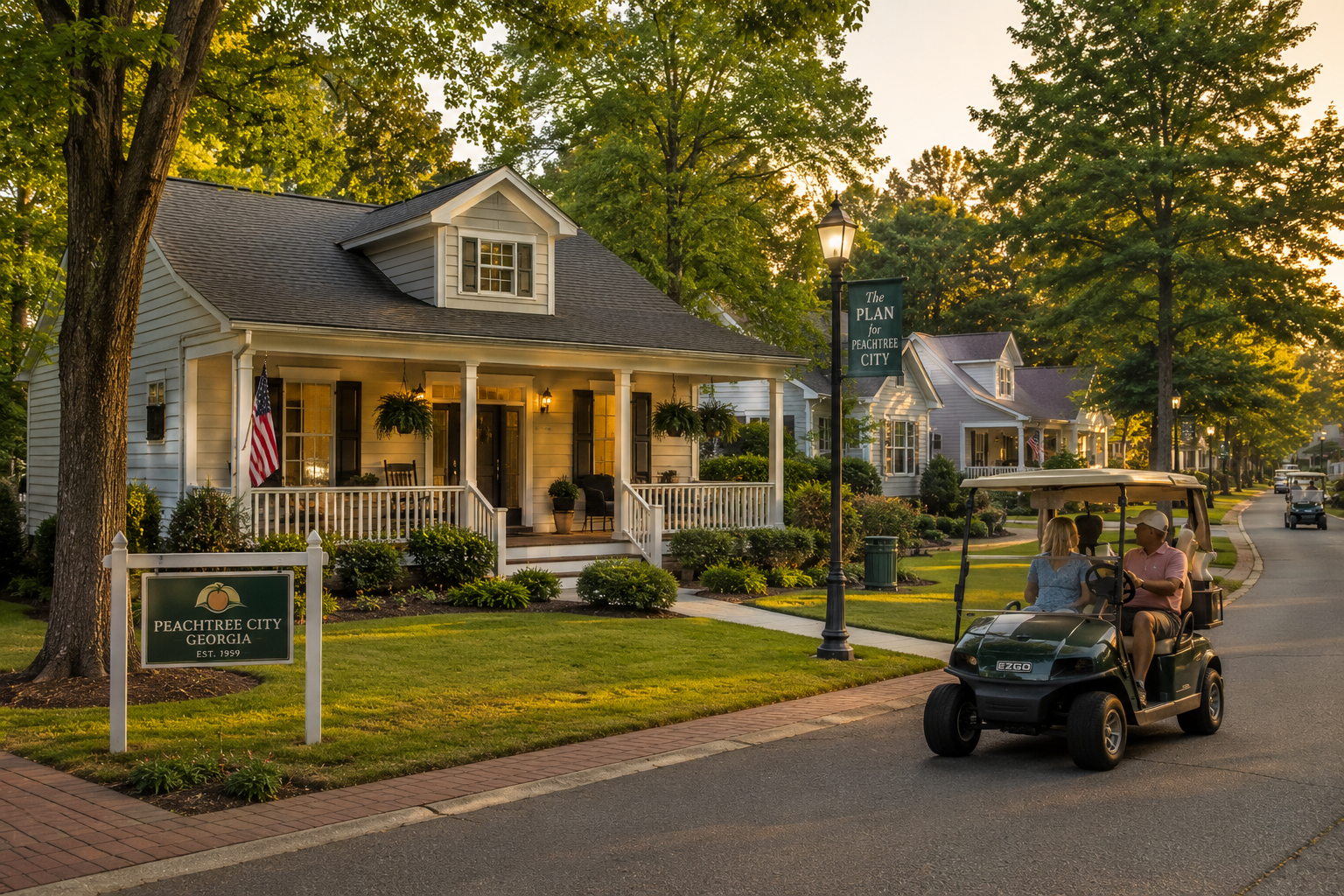
Peachtree City sits within the Fayette County Public Schools district, which has consistently ranked among the top public school districts in Georgia. SchoolDigger ranks Fayette County 9th–10th out of more than 200 Georgia school districts. U.S. News & World Report has ranked all five Fayette County high schools in the top 100 in Georgia.
The high schools serving Peachtree City and surrounding Fayette County:
McIntosh High School. 201 Walt Banks Rd, Peachtree City, GA 30269. Serves most of central and northern Peachtree City. Enrollment around 1,740 students grades 9–12. AP participation rate of 61%. Ranked #23 in Georgia and #679 nationally by U.S. News (2024 rankings). 5-star SchoolDigger rating.
Starr's Mill High School. 193 Panther Path, Fayetteville, GA 30215. Serves portions of southern Peachtree City and surrounding Fayette County. Enrollment around 1,360 students grades 9–12. AP participation rate of 70%. Ranked #25 in Georgia and #731 nationally by U.S. News. 5-star SchoolDigger rating. Braelinn Elementary is in the Starr's Mill feeder pattern.
Whitewater High School. 100 Wildcat Way, Fayetteville, GA 30215. Serves portions of Fayette County including some areas adjacent to PTC. Ranked #43 in Georgia by U.S. News.
Sandy Creek High School. 360 Jenkins Rd, Tyrone, GA 30290. Serves portions of northern Fayette County including Tyrone. Ranked #83 in Georgia.
Fayette County High School. 1 Tiger Trl, Fayetteville, GA 30214. Ranked #92 in Georgia.
The middle and elementary schools follow village-aligned feeder patterns: Braelinn Elementary, Crabapple Lane Elementary, Huddleston Elementary, Kedron Elementary, Oak Grove Elementary, and Peachtree City Elementary all sit within or adjacent to the city, with feeder middle schools at Booth, Flat Rock, J.C. Booth, and Rising Starr.
Attendance zones do not always follow village lines. A Kedron Village address might be zoned to McIntosh or to a different school depending on the specific street. Research and visit schools to determine fit for your family. Always verify zoning by specific property address before writing an offer. A house zoned to a different school can affect both your daily life and resale value, so don't rely on a listing's general school references. Pull the zoning directly from the Fayette County school district website using the property address.
What to Do in Peachtree City: Parks, Lakes, and the Things You'll Actually Use
The recreation amenities are a real part of what people are paying for here, and they're worth understanding in detail because they shape daily life more than any single restaurant or shop.
The three lakes:
Lake Peachtree is the largest and the only one that allows swimming. Drake Field, a 4-acre park on the lake, offers swimming, fishing, and kayaking access. Only about 100 homes carry full boating rights on Lake Peachtree, which makes those properties uniquely valuable. No motor boats on the other lakes.
Lake Kedron allows fishing and non-motorized boats (kayaks, paddleboards). It's smaller and more residential in feel.
Lake McIntosh is the newest of the three and sits on the eastern edge of the city. Also fishing and non-motorized boating.
Frederick Brown Jr. Amphitheater (The Fred): A 2,500-seat outdoor amphitheater that books national touring acts throughout the spring, summer, and fall. You can bring your own food and drinks. Locals show up by golf cart and stake out spots on the lawn.
Kedron Fieldhouse and Aquatic Center: Indoor and outdoor pools, fitness center, gymnastics, swim team facilities. A central recreation hub for families.
Picnic Park and Drake Field: Adjacent waterfront parks on Lake Peachtree with playgrounds, splash pad for kids, and direct path access.
BMX Track: Yes, there's an actual BMX track. It's part of the city's parks system and hosts regular events.
Country clubs and golf: Flat Creek Country Club (private, in Aberdeen/Glenloch), Braelinn Golf Club, and Planterra Ridge Golf Club provide private and semi-private golf, tennis, and pool memberships. Flat Creek is the most established and has the deepest membership.
Line Creek Nature Area and Flat Creek Nature Area: Wooded trails along the creeks, popular for hiking, birdwatching, and getting deeper into the wooded landscape that the path system runs through.
Shopping and dining: Each village has its own shopping center (Aberdeen Village, Braelinn Village, Kedron Village, Westpark Walk in Wilksmoor, plus the Highway 54 corridor through Glenloch), and the city has more than 100 restaurants ranging from chains to local-owned spots. Major retail includes Target, Walmart, Home Depot, Publix, Kohl's, and the Avenue Peachtree City (open-air shopping center on Highway 54).
Senoia is 20 minutes south. Worth knowing because Senoia became famous as a filming location for The Walking Dead and now has a walkable downtown with restaurants, antique shops, and Nic & Norman's (Norman Reedus and Greg Nicotero's restaurant). It's a common day-trip destination for PTC residents.
Trilith Studios and the Town at Trilith: About 10 miles east in Fayetteville. The 700-acre studio complex with 32 soundstages remains the largest film production facility in Georgia. The adjacent Town at Trilith is a 235-acre walkable master-planned community with restaurants, shops, the Trilith Guesthouse hotel, and the under-development Trilith Live entertainment complex. Worth visiting on a weekend even if you don't plan to live there.
Specific Streets and Subdivisions to Know
This is the part where general guides go vague. Buyers who do well in PTC have a sense of the specific neighborhoods worth targeting. Here are the ones I'd flag:
Kedron Estates (Kedron Village): Custom homes on larger lots, some multi-acre, along Flat Creek. Higher price point ($800K–$1.5M+), strong McIntosh zoning typically, well-established.
Smokerise (Kedron Village): Established subdivision with mature trees and lots in the $700K–$1.1M range. Walkable to Kedron Village shopping.
Planterra (Wilksmoor / West Village): Newer construction with access to Planterra Ridge Golf Club. Mix of production and semi-custom builds, $600K–$1M+.
Cardiff Park (Glenloch Village): Established 1980s/1990s subdivision with strong commute access via Highway 54. $500K–$800K typical.
Braelinn Estates (Braelinn Village): Older established homes with substantial trees and lots, golf-course-adjacent in places. $500K–$900K.
The Cottages at Stoney Point and similar attached communities: Townhome and condo inventory that gives buyers a PTC address at a lower entry point. Pricing typically $250K–$450K depending on size and section.
Walnut Grove and Flat Creek (Aberdeen Village): Original 1970s and 1980s ranch and split-level inventory on substantial lots. Renovation candidates and entry points for buyers who want PTC at the lower end of the single-family market.
Wynnmeade (Aberdeen Village): Established neighborhood with cart path access, ranch-style and traditional homes, $450K–$700K range.
Heritage Pointe and Stonebridge (Wilksmoor Village): Newer construction subdivisions in the West Village, $550K–$900K.
Summergrove (just outside city limits in unincorporated Fayette but commonly grouped with PTC): Master-planned community with its own clubhouse, pool, and tennis. $400K–$650K typical.
Always cross-reference the subdivision with the specific school zoning, the specific village shopping center proximity, and the specific path access. Two homes on the same street can have very different daily-life implications based on whether the path runs behind the property or two blocks away.
Comparing Peachtree City to Other Metro Atlanta Options
Most PTC buyers I work with are evaluating it against one of three categories of alternatives. Here's how it stacks up.
PTC vs. North Fulton (Alpharetta, Milton, Roswell, Johns Creek): North Fulton dominates the conversation for corporate relocation buyers because of GA-400 access to the tech corridor, but PTC wins on three things: walkability and the path system (North Fulton has nothing comparable), proximity to Hartsfield (PTC is dramatically closer than any North Fulton suburb), and price point at the entry level. North Fulton wins on commute to North Atlanta employment centers, retail density, and inventory volume. If your work is in Alpharetta, Sandy Springs, or the Perimeter, PTC is wrong for you. If your work is at Hartsfield or you're fully remote, PTC can be the better fit.
PTC vs. East Cobb (Marietta area): Both attract families prioritizing schools. East Cobb wins on intown Atlanta access (Buckhead, Midtown via I-75), broader retail and dining density, and proximity to The Battery and Truist Park. PTC wins on the path system, lake amenities, the Hartsfield commute, and a more contained, planned-community feel. East Cobb is a large unincorporated community of 164,000+ people. PTC is a defined city of 38,000 with cohesive design. Different vibes, different commute math.
PTC vs. Senoia / Newnan: This is the comparison for buyers who specifically want South Metro and small-town feel. Senoia is more historic and has the Walking Dead tourism economy. Newnan is larger and has Piedmont Newnan Hospital and Ashley Park retail. PTC has the path system, the lakes, and a more planned-community feel. Senoia and Newnan have more land per dollar for larger acreage. PTC has stronger transit infrastructure for everyday life within the city.
PTC vs. South Fulton / Tyrone: Tyrone is the smaller, more rural neighbor immediately north of PTC, with horse properties and large-acreage homes. South Fulton offers price points well below PTC for buyers prioritizing budget over amenities. PTC's premium reflects the path system, school district reputation, and master-planned amenities that don't exist in either alternative.
Who Is Peachtree City Right For?
PTC tends to be the right fit when:
You work at Hartsfield-Jackson, Trilith Studios, somewhere in South Metro, or fully remote
The path system, walkability, and outdoor-active lifestyle are core to what you want, not amenities you'd rarely use
You're prioritizing Fayette County Public Schools and willing to verify zoning by specific property address
You want a contained, planned community where daily life happens within the city limits
You value lake access, golf, and outdoor recreation as part of your weekly routine
You're a hybrid worker going downtown 2–3 days a week, not 5
Think carefully about PTC if:
You commute daily to downtown Atlanta, Midtown, Buckhead, or Sandy Springs. The 45 to 80 minute morning drive will wear on you
You want the dense restaurant, bar, and cultural scene of intown Atlanta. PTC is a suburb in feel, not an urban experience
You need MARTA access. Fayette County has no MARTA service and the nearest station is at Hartsfield
You want the urban or new-urbanist density of Town at Trilith. PTC is suburban with paths, not a walkable downtown core
You're hoping for substantial appreciation as a primary investment thesis. PTC appreciates steadily but moderately, not at intown Atlanta rates
Buyer Scenarios: Who Lands Where in Peachtree City
After years of working with buyers across Metro Atlanta and watching how the search process actually plays out, certain patterns repeat in Peachtree City. Here are the most common scenarios and how they tend to resolve.
The Delta pilot or flight attendant relocating from another base. This is one of the most common PTC buyer profiles, and it usually lands in Aberdeen, Glenloch, or Kedron. The priority is Hartsfield commute reliability, and PTC delivers that better than almost any suburb in Atlanta. Price point typically lands in the $500K–$800K range, with airline crew often prioritizing single-story or main-level primary suites because of the demands of the schedule. Path access matters less for this buyer than commute math.
The hybrid corporate relocation buyer with school-age kids. Often coming from the Northeast, the West Coast, or another Southern metro for a corporate move. This buyer compares PTC against North Fulton, East Cobb, and sometimes Dunwoody. The decision typically comes down to whether the corporate office is in North Atlanta (where PTC loses) or whether the role is hybrid with limited in-office days (where PTC competes well). When PTC wins, this buyer usually lands in Kedron, Wilksmoor, or the McIntosh zone of Glenloch, with budgets in the $600K–$1M range and a strong focus on school zoning.
The Trilith Studios or film industry professional. Whether working at Trilith directly or in adjacent production, post-production, or vendor work, this buyer values being within 20 minutes of the studio without being inside Town at Trilith itself. PTC offers more space, more established schools, and a different lifestyle than the new-urbanist Trilith community. Budget varies widely depending on role and tenure, but $500K–$900K is common.
The empty-nester or downsizer from intown Atlanta. Often coming from Decatur, Brookhaven, Buckhead, or Sandy Springs, this buyer wants to trade urban density for the path system, the lakes, and the simpler day-to-day rhythm of a planned community. They tend to target Aberdeen or Braelinn for the established trees and the proximity to Lake Peachtree, with budgets often in the $500K–$800K range. The honest catch: some of these buyers miss the urban food and cultural density within six to twelve months and either supplement with frequent intown trips or eventually move back. The ones who stay are the ones who genuinely use the path system, the lakes, and the outdoor-active lifestyle on a weekly basis.
The fully remote professional in their 30s or 40s. The work-from-home category that exploded after 2020 and remains a major PTC buyer segment. This buyer is choosing PTC over intown Atlanta because of price-per-square-foot, schools (if there are kids), and lifestyle. Budgets vary widely. The best fit for this buyer is usually Wilksmoor, Kedron, or the newer sections of Braelinn, with home offices and outdoor space as top priorities.
The investor or second-home buyer. Less common in PTC than in other Metro Atlanta markets because of the price point and the family-oriented community profile, but it does happen, particularly for short-term rental near Trilith Studios for production crews and for lakefront properties with Lake Peachtree boating rights. These properties are limited (around 100 homes with full boating rights) and trade as specialty assets.
Each of these scenarios has different implications for budget, neighborhood, and timing. If you're not sure which one fits you, that's exactly the conversation I have with buyers in the first meeting.
Frequently Asked Questions About Living in Peachtree City
1. What is the median home price in Peachtree City in 2026? Depending on the data source, the median sale price in early 2026 ranges from $515,510 (Zillow Home Value Index) to $724,700 (Houzeo), with Redfin reporting $590,000 and Movoto reporting $624,999. Most single-family buyers are shopping in the $500K–$800K range, with townhomes and condos starting in the mid-$200Ks and custom homes reaching $1M–$2M+. The wide spread reflects the city's range of housing types and village price differences.
2. How long is the commute from Peachtree City to Hartsfield-Jackson Airport? About 25 minutes off-peak via Highway 74 to I-85 North. During morning rush (6:30–9:00 AM), expect 35–50 minutes. The reliable airport access is a major reason PTC has historically been popular with Delta pilots, flight crews, and frequent business travelers.
3. What are the best high schools in Peachtree City? The three Fayette County high schools serving PTC and surrounding areas are McIntosh High School (#23 in Georgia per U.S. News), Starr's Mill High School (#25 in Georgia), and Whitewater High School (#43 in Georgia). All three carry 5-star SchoolDigger ratings. Attendance zoning varies by specific property address, so verify zoning directly with Fayette County Public Schools before writing an offer.
4. What does it cost to register a golf cart in Peachtree City? For residents, $45 for a 3-year cycle (2026–2028). Non-residents pay $250 annually ($15 registration plus $235 path user fee). Carts must be registered within 10 days of purchase. You'll need proof of ownership, photo ID, and the registration fee.
5. Can kids drive golf carts in Peachtree City? Age 16 and older can operate without a license. Age 15 can operate with a learner's permit. Ages 12–14 can operate only when accompanied by a parent, grandparent, legal guardian, or licensed adult 18+ in the front seat. Under 12 cannot operate.
6. Which village in Peachtree City is best for new construction? Wilksmoor (the West Village) has the most active new construction inventory in the city, with builds from the 2000s forward including current new construction. Kedron and parts of Braelinn also have newer inventory. Aberdeen and Glenloch are dominated by 1970s and 1980s construction.
7. Is Peachtree City a good place to live if I work downtown Atlanta? It's workable for hybrid schedules (2–3 days in-office), challenging for daily five-day commuters. Plan for 45–55 minutes off-peak and 60–80 minutes in morning rush each way to downtown. Many PTC residents who work downtown either negotiate hybrid arrangements or eventually relocate closer in.
8. What's the difference between Peachtree City and Peachtree Corners? They're entirely different cities. Peachtree City is in Fayette County, about 30 miles south of downtown Atlanta. Peachtree Corners is in Gwinnett County, north of Atlanta. They share only the name. Buyers confuse them constantly, especially in online searches.
9. Can you swim in the lakes in Peachtree City? Only Lake Peachtree allows swimming. Drake Field on Lake Peachtree has a designated swimming area. Lake Kedron and Lake McIntosh allow non-motorized boating and fishing but not swimming. Only about 100 homes carry full boating rights on Lake Peachtree, which makes those properties particularly valuable.
10. Are there townhomes or condos in Peachtree City? Yes. About 4.27% of housing units are row houses or attached homes, and about 15.61% are larger apartment complexes. Townhome and condo inventory ranges from roughly $250K to $450K depending on size, age, and section. The Greens at Braelinn and The Retreat at Kedron Village are two larger apartment communities.
11. Is Peachtree City near Trilith Studios? About 10 miles east, in Fayetteville. The drive is 15–20 minutes via local roads. Trilith Studios sits on a 700-acre complex with 32 soundstages and remains the largest film production facility in Georgia. The adjacent Town at Trilith is a walkable master-planned community with restaurants, shops, and the Trilith Guesthouse hotel.
12. How fast are homes selling in Peachtree City in 2026? Median days on market ranges from 52 to 65 days depending on data source, roughly double the pace from 2024–2025. The market has shifted in favor of buyers compared to the pandemic-era frenzy, but homes still sell faster than the national average. Sale-to-list ratios run around 97–98%, meaning sellers are accepting close to asking but not necessarily above.
13. Do I need a car if I live in Peachtree City? Yes, for trips outside the city. Within the city limits, many residents run daily errands by golf cart, including trips to school, the grocery store, restaurants, the gym, the amphitheater. But Fayette County has no MARTA service, the nearest train station is at Hartsfield, and any trip outside PTC requires a car. The cart replaces a second car for some households; it rarely replaces the first.
Working With Me on a Peachtree City Purchase
I work with buyers throughout Metro Atlanta and know how to evaluate Peachtree City against the alternatives, how to read the village price differences, how to verify school zoning by specific address, and what to look for in path access and lake proximity that will hold value at resale. If you're relocating, comparing PTC to other Atlanta suburbs, or ready to start your search here, let's talk.
Visit kristenjohnsonrealestate.com or reach out directly. Come as you are, come on home.
Looking for more Metro Atlanta neighborhood guides? I've covered the Cobb County cluster including East Cobb, Marietta, Smyrna, and Vinings, plus the North Fulton cluster with Alpharetta, Milton, Roswell, and Johns Creek. Browse the full guide series at kristenjohnsonrealestate.com.