

Easiest Commutes to Atlanta's Major Job Hubs: Where to Live for Midtown, Perimeter & Downtown in 2026
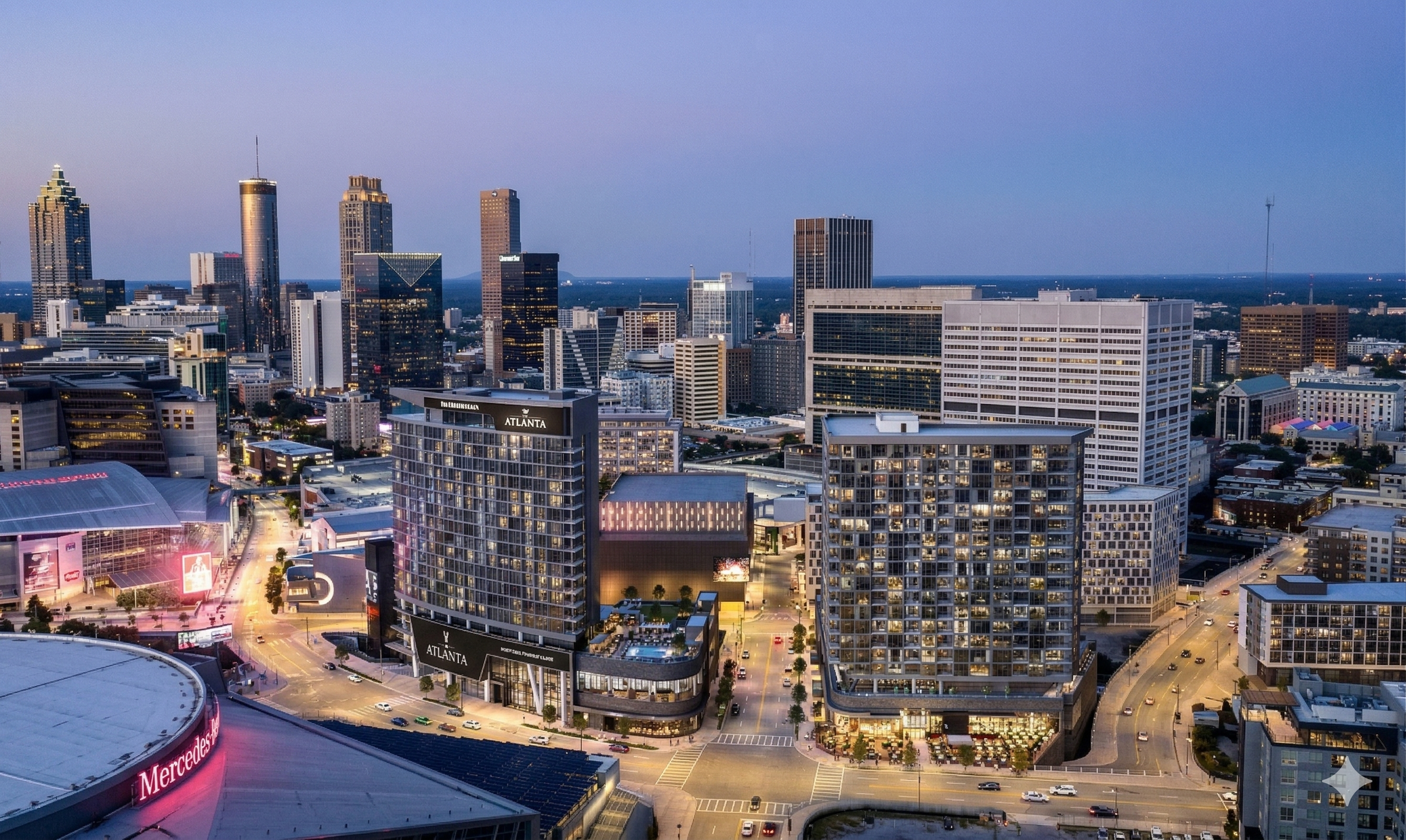
If your job is in Midtown, Central Perimeter, or Downtown and you want the shortest, most predictable commute, the neighborhoods that consistently deliver are the intown communities along the MARTA rail lines, the close-in pockets that sit on the right side of the highway from your office, and a handful of suburbs that line up directly with the corridor you'll be driving. The wrong answer, almost every time, is the neighborhood that looked close on a map.
That last point is the one I spend the most time on with buyers, and it's the one out-of-town agents and listing-site distance estimates get wrong constantly. "Metro Atlanta" covers a huge amount of ground, and two homes that look like neighbors on a map can have commutes that differ by 40 minutes once you account for which highway feeds your office, which direction the traffic is moving at 8 a.m., and whether you can take a train instead of sitting in it.
I work with buyers across Metro Atlanta, including relocators who are buying before they've ever driven the route, and the commute question comes up in almost every search. So this is the honest version: where the commutes to each of the three big job centers actually work, where they don't, and what those minutes cost you in home price. The numbers here are realistic rush-hour numbers, not the off-peak figure a mapping app shows you on a Sunday afternoon. Always confirm against your specific office address and your actual work schedule before you commit.
Here's what you need to know.
First, Why "Close on a Map" Is the Most Expensive Mistake You Can Make
Atlanta's traffic is directional and corridor-bound, and that changes everything about how you read distance here.
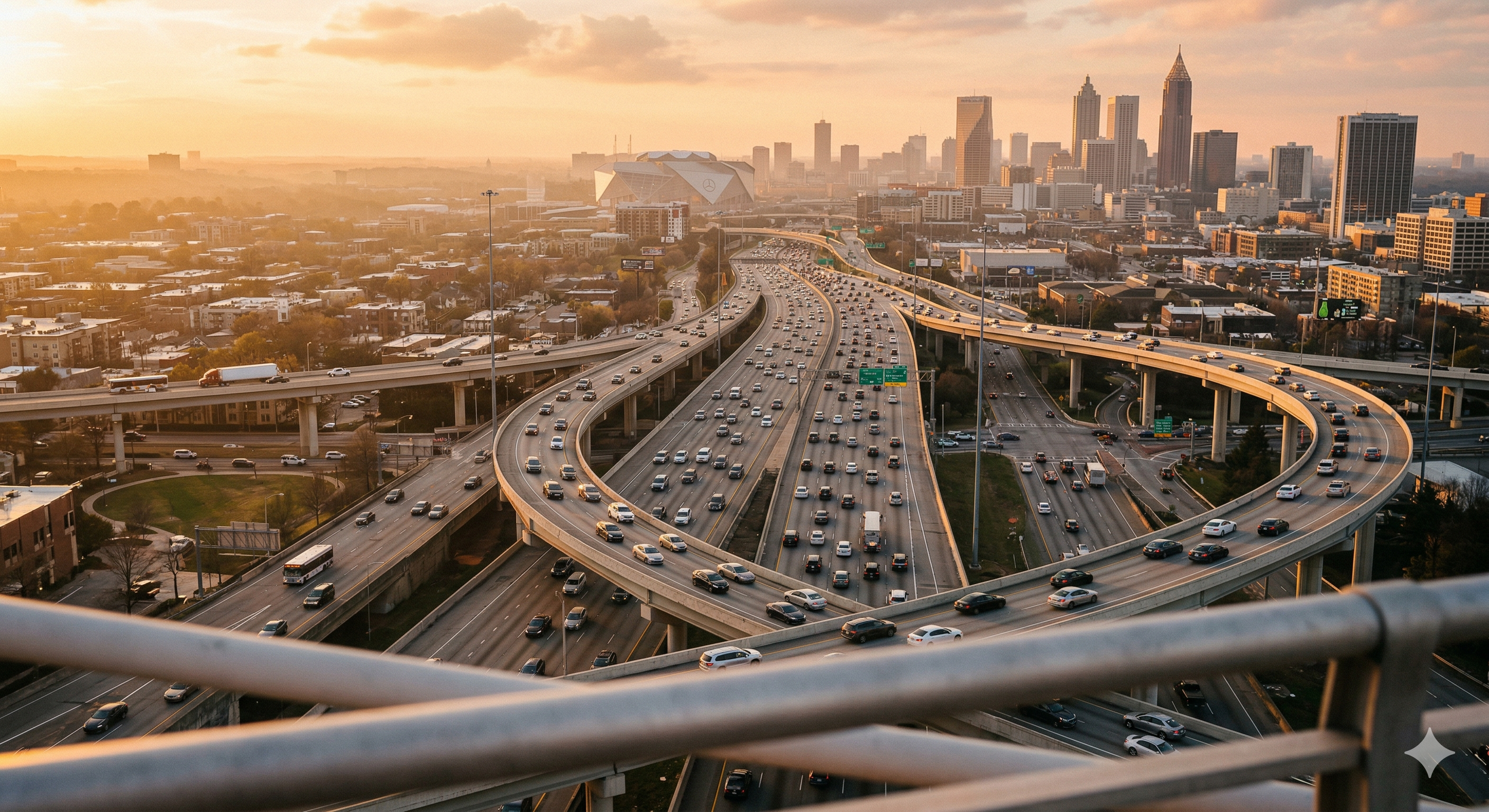
A home seven miles from your office can be a 15-minute drive or a 50-minute one depending entirely on whether those seven miles run with rush-hour traffic or against it, and whether they cross one of the chokepoints that the entire region funnels through. The Downtown Connector, where I-75 and I-85 merge through the center of the city, is the most obvious one. GA 400 into and out of North Fulton is another. I-285 across the top end is a third. If your route crosses one of those at peak hours, your mileage stops predicting your time.
This is why I tell relocation buyers to stop thinking in miles and start thinking in three questions: Which highway or rail line connects my home to my office? Am I driving with the morning flow or against it? And is there a train that lets me opt out of the road entirely? Answer those and you can predict your commute. Rely on a listing site's "20 minutes to Downtown" estimate and you'll be renegotiating your whole quality of life six weeks after you close.
A few realities that shape every number in this guide:
The reverse commute is real leverage. Most morning traffic flows inbound, from the suburbs toward the urban job centers. If you live close in and your office is in a suburban hub like Central Perimeter, you're often driving against the heaviest flow, which can cut your time dramatically. I'll point out where that works below.
MARTA rail changes the math, but only in specific places. Atlanta's rail system is limited compared to older cities, but where it runs, it runs well, and it lets you skip traffic entirely. The catch is that it only serves certain neighborhoods and certain job hubs directly. A neighborhood three blocks from a rail station is a fundamentally different commute proposition than one three miles away, even if home prices look similar.
Construction is a 2026 factor you have to price in. The GA 400 Express Lanes project broke ground in spring 2026 and is scheduled to run through 2031, which means active work zones along the North Fulton corridor for years. The much larger I-285 Top End Express Lanes project is still working through its environmental and permitting phases on the western half. If you're buying along GA 400 or the top end of I-285, you're buying into a construction zone for the medium term, with a future tolled express option on the other side of it.

The Three Job Hubs, Defined
Before we talk neighborhoods, it helps to be precise about where these jobs actually are, because each hub has a different shape and a different transit story.
Midtown is the densest corporate and tech center in the city, running roughly from North Avenue up to the edge of Buckhead, anchored by Georgia Tech and Technology Square. This is where the recent corporate growth has concentrated. Google runs a roughly 500,000-square-foot office here. Microsoft built its Atlantic Yards campus with more than 500,000 square feet of space. Norfolk Southern moved its corporate headquarters into Tech Square. Add the startups and research operations clustered around Georgia Tech, plus financial and professional services firms, and Midtown is the most walkable, most transit-served job district in Atlanta. It sits on the MARTA Red and Gold lines at the Midtown and Arts Center stations.
Central Perimeter is the suburban office powerhouse on the northern arc of I-285, spread across Dunwoody, Sandy Springs, and Brookhaven. It has one of the highest concentrations of corporate headquarters per capita in the country. State Farm built a regional hub campus of more than half a million square feet in Dunwoody, connected directly to the Dunwoody MARTA station. Mercedes-Benz USA, UPS, Cox Enterprises, Newell Brands, Inspire Brands, Graphic Packaging, and Intercontinental Exchange all anchor headquarters or major operations here. More than 120,000 people work in the district. It's served by the MARTA Red Line at the Medical Center, Sandy Springs, Dunwoody, and North Springs stations.
Downtown is the government, education, hospitality, and convention core, plus a major redevelopment story. Georgia State University is woven through the central business district with thousands of students and staff. Georgia-Pacific is headquartered here. City of Atlanta, Fulton County, and State of Georgia government jobs cluster around the Capitol and Five Points. The Georgia World Congress Center, Mercedes-Benz Stadium, State Farm Arena, and the convention and hospitality economy add tens of thousands more. And Centennial Yards, a roughly $5 billion redevelopment of the old rail gulch, is under construction with several million square feet of planned office and the first phases timed in part to the 2026 FIFA World Cup. Downtown is the convergence point of all four MARTA rail lines at Five Points, which makes it the most rail-accessible job center in the region.
The practical takeaway: Midtown and Downtown are genuinely train-commutable from a real list of neighborhoods. Central Perimeter is train-accessible only along the Red Line corridor, and for most people it's a drive.
How I Read Commute Numbers (and Why Mine Look Different From a Mapping App)
When I give a buyer a commute estimate, I give a range, not a single number, and the range is built around the morning rush window of roughly 7 to 9 a.m. and the evening window of roughly 4 to 6:30 p.m.
Off-peak, almost everything in this guide is faster than what I list. At 10 a.m. on a Tuesday, you can get almost anywhere intown in 15 to 20 minutes. That number is useless for planning a life around a 9-to-5, which is why mapping-app estimates feel optimistic. The honest planning number is the one you'll hit Monday through Thursday when you actually have to be somewhere.
I also separate drive time from rail time, because they're different products. A 35-minute train ride where you can read, work, or decompress is not the same as a 35-minute drive where you're fighting the Connector. Plenty of my buyers will happily accept a longer rail commute over a shorter drive, and plenty feel the opposite. Knowing which one you are should shape your search.
One more thing I check that listing sites never will: the last mile. A neighborhood can be a quick train ride to a station near your office and still leave you a 15-minute walk or shuttle on the far end. Central Perimeter is the classic example, where some campuses sit a real distance from the rail station. I factor the whole door-to-door trip, not just the headline number.
Easiest Commutes to Midtown
If you work in Midtown, you have the widest, easiest set of housing options of any of the three hubs, because Midtown is both centrally located and directly on rail.
The shortest commutes belong to the neighborhoods immediately around it. Ansley Park sits inside Midtown's eastern edge and is a walk-or-five-minute-drive proposition to Tech Square. Morningside-Lenox Park and Virginia-Highland are just east, typically 8 to 15 minutes by car even at peak. Old Fourth Ward sits to the southeast with quick surface-street access and the BeltLine connecting it on foot and bike. West Midtown is directly across the Connector and runs 8 to 15 minutes outside of the worst backups.
The rail story for Midtown is strong. Any neighborhood on the Red or Gold line south of Midtown, or north of it through Buckhead and Brookhaven, can reach the Midtown or Arts Center stations without touching a highway. From Brookhaven on the Gold Line, the train to Midtown runs about 18 to 22 minutes, no parking required.
The honest caution is the western and northern suburbs. From Smyrna and Vinings, the drive into Midtown via I-75 and the Connector is reasonable off-peak and frustrating at rush hour. From East Cobb, Roswell, and Alpharetta, Midtown is a real commitment at peak hours, especially with the GA 400 construction now in play.
| Where You Live | Off-Peak Drive | Morning Rush (7–9 AM) | MARTA Rail Option |
|---|---|---|---|
| Ansley Park / Morningside | 5–10 min | 8–15 min | Walk / short ride to Arts Center |
| Old Fourth Ward | 8–12 min | 10–18 min | BeltLine bike / bus |
| West Midtown | 8–12 min | 12–20 min | Limited (bus) |
| Buckhead | 12–18 min | 20–30 min | Red/Gold direct, ~10–15 min |
| Brookhaven | 15–20 min | 30–40 min | Gold Line direct, ~18–22 min |
| Decatur | 18–25 min | 35–45 min | Blue Line + transfer at Five Points |
| Smyrna / Vinings | 15–20 min | 30–45 min | None direct |
| Roswell / Alpharetta | 30–35 min | 50–75 min | None direct (drive to North Springs) |
These are planning ranges, not guarantees. A wreck on the Connector can blow up any of them, and your exact office location inside Midtown shifts the math by a few minutes. I'll run real numbers against your specific address when we narrow your search.
Easiest Commutes to Central Perimeter
Central Perimeter is the hub where your housing choice matters most, because the train only helps along one corridor and the rest is driving.
If your office is at State Farm, Cox, Mercedes-Benz USA, UPS, or any of the Perimeter Center towers, the shortest commutes belong to the close-in northern communities. Living in Dunwoody, Sandy Springs, or Brookhaven puts you 5 to 15 minutes from most of the district. Brookhaven in particular gives you a short drive to Perimeter plus quick access to Buckhead and Midtown, which is why it works so well for two-career households.
The rail option here is the Red Line, with stations at Medical Center, Sandy Springs, Dunwoody, and North Springs. From Buckhead, the Red Line into Perimeter runs about 10 to 15 minutes, and the State Farm campus connects directly to the Dunwoody station, which is a genuine no-car commute if your office is in that complex. The asterisk I always add: several Perimeter campuses sit a notable distance from the rail platform, so check whether your specific building is a walk or a shuttle ride from the station before you count on the train.
The reverse-commute advantage is strongest for this hub. If you live intown, say in Morningside-Lenox Park or Buckhead, and drive north to Perimeter in the morning, you're often moving against the heaviest inbound flow. That can make a Perimeter commute from an intown address more livable than people assume, especially by rail.
The honest caution is North Fulton. From Roswell, Alpharetta, Milton, and Johns Creek, Perimeter is a GA 400 commute, and GA 400 is now under active express-lane construction through 2031. Off-peak it's a quick trip. At rush hour, and during construction, plan for real variability. The future tolled lanes will eventually give you a paid fast option, but that's years out.
| Where You Live | Off-Peak Drive | Morning Rush (7–9 AM) | MARTA Rail Option |
|---|---|---|---|
| Dunwoody / Sandy Springs | 5–10 min | 8–15 min | Red Line, on-corridor |
| Brookhaven | 10–15 min | 15–25 min | Short drive to Red Line |
| Buckhead | 12–18 min | 25–35 min | Red Line direct, ~10–15 min |
| Chamblee / Doraville | 10–15 min | 15–25 min | Gold Line + drive/transfer |
| Intown (Midtown / Va-Hi) | 18–25 min | 30–45 min (reverse commute helps) | Red Line north, ~25–30 min |
| Roswell / Alpharetta | 20–30 min | 35–55 min (GA 400 construction) | Drive to North Springs, then Red |
| Decatur / East side | 25–35 min | 40–55 min | Multi-transfer, not ideal |
The pattern is clear: Central Perimeter rewards living north and close. The further east or northwest you go, the more the commute swings on traffic and the less the train helps you.
Easiest Commutes to Downtown
Downtown is the most rail-accessible job center in the region, because all four MARTA lines converge at Five Points. If you work near Five Points, Georgia State, the Capitol, the Georgia World Congress Center, or the Centennial Yards district, a train commute is genuinely realistic from a long list of neighborhoods.
The shortest drives belong to the close-in southern and eastern neighborhoods. Grant Park and Summer Hill sit just south of the core and run 8 to 15 minutes by car. Old Fourth Ward is a quick surface-street trip to the northeast edge of Downtown.
The rail picture is where Downtown really separates from the other hubs. On the east-west Blue and Green lines, Inman Park and Reynoldstown, Candler Park and Lake Claire, Kirkwood near East Lake, and the City of Decatur all have rail stations with a straight shot to Five Points and Georgia State, no transfer required. Decatur to Georgia State runs about 20 to 25 minutes by train. On the Red and Gold lines south of Downtown, the Westside neighborhoods of West End, Oakland City, and Adair Park sit on rail with a short ride into the core.
From Midtown, Downtown is four stops south on the Red or Gold line, roughly an 8 to 10 minute ride, or a 10 to 20 minute drive.
The honest caution is the same as always: the northern suburbs. From North Fulton, Downtown is the longest of the three hub commutes by car at rush hour, because you're crossing the entire intown core to get there. If Downtown is your office and you want to live north, the realistic move is to live near a rail station and let the train carry you past the worst of it.
| Where You Live | Off-Peak Drive | Morning Rush (7–9 AM) | MARTA Rail Option |
|---|---|---|---|
| Grant Park / Summer Hill | 8–12 min | 12–20 min | Bus / short hop |
| West End / Oakland City | 10–15 min | 12–20 min | Red/Gold direct, ~10 min |
| Inman Park / Reynoldstown | 12–18 min | 15–25 min | Blue/Green direct, ~10 min |
| Kirkwood / East Lake | 15–22 min | 20–30 min | Blue Line direct, ~15–20 min |
| City of Decatur | 18–25 min | 25–40 min | Blue Line direct, ~20–25 min |
| Midtown | 10–15 min | 15–25 min | Red/Gold direct, ~8–10 min |
| Brookhaven | 18–25 min | 25–40 min | Gold Line direct, ~25 min |
| Roswell / Alpharetta | 35–40 min | 55–80 min | Drive to North Springs, then ~35 min rail |
If a no-car commute is a priority for you, Downtown is the hub that makes it most achievable, and the Blue Line east-side neighborhoods are the strongest combination of rail access and home value in the city right now.
The MARTA Rail Question: Which Neighborhoods Let You Skip the Car?
Here's the rail logic in plain terms, because it's the single biggest lever on commute quality and most buyers underuse it.
MARTA's rail system is shaped like a cross. The Red and Gold lines run north-south, sharing track through the center of the city, then splitting north of Lindbergh, with the Red Line heading up through Buckhead toward Perimeter and North Springs, and the Gold Line heading up through Brookhaven toward Doraville. The Blue and Green lines run east-west, sharing track through the core and splitting on either end. All of them meet at Five Points Downtown.
What that means for your commute:
For a Downtown job, almost any rail neighborhood works, because everything connects at Five Points.
For a Midtown job, the north-south corridor is your friend. Anything on the Red or Gold line, from the Westside south stations up through Buckhead and Brookhaven, reaches Midtown without a transfer.
For a Central Perimeter job, only the Red Line reaches you directly, which means Buckhead, Sandy Springs, Dunwoody, and the Medical Center area are your on-rail options. East-side neighborhoods can technically get there, but the transfers make it slow enough that most people just drive.
The neighborhoods that get talked about most for rail-based commuting are the Blue Line east-side communities, because they pair a direct Downtown ride with relative value, and the Red and Gold corridor neighborhoods, because they reach two of the three hubs. If you want to genuinely reduce or eliminate car dependence, prioritize a home within a comfortable walk of a station, not just one in a "MARTA-accessible" ZIP code. The difference between a three-block walk and a three-mile drive to the platform is the difference between actually riding the train and never using it.
What If Your Household Commutes to Two Different Hubs?
This is one of the most common real puzzles I solve, and it almost never gets addressed by generic neighborhood guides: two working adults, two different job hubs, one house.
The corridor that solves this best is the Red and Gold line spine through the north-central part of the city. A home in Buckhead or Brookhaven gives one person a manageable trip to Central Perimeter and the other a reasonable ride to Midtown or Downtown, often with at least one of them on rail. Brookhaven is the one I reach for most in these conversations, because it sits at a genuine crossroads: quick to Perimeter by car, on the Gold Line for Midtown and Downtown, and close to Buckhead.
If both hubs are intown, say one person in Midtown and one Downtown, the easy answer is an east-side rail neighborhood or a central intown community, since those two hubs are only a few train stops apart anyway.
The hardest combination is one hub intown and one in North Fulton, because you're asking a single location to serve two opposite directions on GA 400. In those cases I usually steer toward the Brookhaven-to-Sandy Springs band as a compromise point, and we talk honestly about whether one person should plan around rail or flexible hours.
The point is that a two-hub household should not pick a neighborhood by averaging two commutes on a map. It should pick the corridor that gives each person a real, separate path to work. That's a conversation worth having before you tour a single home.
Highway Reality Check: The Connector, GA 400, and I-285
A quick, honest word on the roads themselves, because they're the constraint behind every number above.
The Downtown Connector is the merged stretch of I-75 and I-85 through the heart of the city, and it's the spine that Midtown and Downtown commuters share. It backs up in both directions at peak, and an incident on it ripples across the whole region. The closer your home-to-office route stays off the Connector at rush hour, the more predictable your life is. This is a big part of why rail-served intown neighborhoods commute so well: the train doesn't care that the Connector is parked.
GA 400 is the North Fulton lifeline, feeding Perimeter, Buckhead, and points south. As of 2026 it's under active Express Lanes construction, a 16-mile project from the North Springs MARTA station up into Forsyth County, scheduled to run through 2031, with variable-priced toll lanes and future bus rapid transit on the far side. If you're buying along GA 400, factor years of construction-zone driving into your decision, with a paid fast lane eventually available when it opens.
I-285, the perimeter highway, carries the cross-town and Central Perimeter traffic. The Top End Express Lanes project across the northern arc is a massive future undertaking, still working through permitting on its western half, so the relief it promises is well out on the horizon. For now, the top end is one of the most congested stretches in the country at peak, which is exactly why living close to your Perimeter office matters so much.
None of this should scare you off a neighborhood. It should just inform which side of which road you choose to live on, and whether a train is part of your plan.
What These Commutes Cost You in Home Price
Commute convenience is priced into Atlanta real estate, and being clear-eyed about the tradeoff is part of buying well.
In broad strokes, the close-in intown neighborhoods with the best rail access and shortest drives to Midtown and Downtown carry a premium. You're paying for location and time, and in the strongest rail-and-walkability pockets that premium is real. The east-side Blue Line neighborhoods tend to offer the best balance of direct Downtown rail access and relative value, which is why I point a lot of commute-focused buyers there first. The Westside rail neighborhoods south of Downtown offer some of the most direct transit access in the city at price points below the east side, which is a genuine commute-value story when you read it through the lens of station proximity rather than anything else.
In the suburbs, the math flips. North Fulton and the further-out communities generally give you more house and more land for the money, and you're trading those dollars for highway minutes. For some buyers that trade is obviously worth it, especially if their schedule is flexible or their office offers hybrid days. For a five-day-a-week, in-office, rush-hour commuter, those same minutes can erode the value of the larger house fast.
The honest framework I use with buyers is this: decide how many hours a week you're willing to spend commuting, convert your candidate neighborhoods into that real weekly number, and only then compare home prices. A house that's $80,000 cheaper but costs you six extra hours a week in the car is a very different deal than it looks like on a listing. I can build that comparison out for your specific situation, and it changes a lot of searches.
For the dollars-and-cents side of any of these neighborhoods, my individual area guides go deep on current pricing, and posts like how much house you can afford in Atlanta help you anchor the budget before we tour.
How to Pick: Questions to Ask Before You Buy for a Commute
Before you fall for a house, run it through these:
What is the door-to-door commute at the time I actually leave, not off-peak? Pull it up for 8 a.m. on a weekday, not whenever you happen to be looking.
Which highway or rail line connects me, and am I going with or against the morning flow? The reverse commute can turn a "too far" neighborhood into a great fit.
If I'm counting on rail, how far is the home from the station, and how far is the station from my office door? Both ends matter.
Is my route dependent on the Connector, GA 400, or the I-285 top end at peak? If so, build in variability and consider whether a train route exists as a backup.
How many days a week am I actually in the office? Hybrid schedules change which neighborhoods are realistic, sometimes dramatically.
If you can answer those five honestly, you'll avoid the single most common relocation regret I see, which is buying for the house and discovering the commute six weeks later.
Frequently Asked Questions
Which Atlanta neighborhoods have the easiest commute to Midtown? The neighborhoods immediately around Midtown give the shortest trips: Ansley Park, Morningside, Virginia-Highland, Old Fourth Ward, and West Midtown are all typically 8 to 15 minutes by car even at peak. For a no-car option, any neighborhood on the MARTA Red or Gold line, including Buckhead and Brookhaven, reaches Midtown without a transfer. Brookhaven to Midtown by train runs roughly 18 to 22 minutes.
What's the best place to live if I work in Central Perimeter? The close-in northern communities of Dunwoody, Sandy Springs, and Brookhaven put you 5 to 15 minutes from most of the Perimeter Center district. If your office connects to the Dunwoody MARTA station, as the State Farm campus does, you can commute without a car. Living intown and reverse-commuting north is also more livable than many people expect, because you're driving against the heaviest inbound traffic.
Can I commute to Downtown Atlanta without a car? Yes, more easily than to any other hub. All four MARTA rail lines meet at Five Points in Downtown, so a long list of neighborhoods have a direct, no-transfer train ride. The Blue Line east-side neighborhoods like Inman Park, Reynoldstown, Kirkwood, and Decatur are especially strong, as are the Red and Gold line Westside neighborhoods south of Downtown like West End and Oakland City.
Is it worth living in North Fulton if I work intown? It depends entirely on your schedule and tolerance for variability. From Roswell, Alpharetta, Milton, or Johns Creek, an intown commute means GA 400 and often the Connector, which can run 50 to 80 minutes at peak, and GA 400 is under express-lane construction through 2031. If you're hybrid, have flexible hours, or prioritize space over time, it can work. For a five-day in-office, rush-hour commute to Downtown, it's a heavy lift.
How accurate are the commute times that listing sites show? Treat them with caution. Most listing-site and mapping-app estimates default to off-peak conditions, which can understate a real rush-hour commute by 20 to 40 minutes, and they don't account for which direction traffic is flowing or whether a rail option exists. I always run commute numbers against your actual office address and your real departure time before we get serious about a neighborhood.
Does living near a MARTA station actually save time? It can, but only if the home is within a genuine walk of the station and the station connects directly to your job hub. A home three blocks from a Blue Line stop is a real no-car commute to Downtown. A home in the same ZIP code but three miles from the platform usually means you drive anyway. Proximity to the actual station, on both the home end and the office end, is what makes rail pay off.
What is the reverse commute and why does it matter in Atlanta? The reverse commute means traveling against the dominant traffic flow, which in Atlanta is mostly inbound toward the urban core in the morning. If you live close in and your office is in a suburban hub like Central Perimeter, you're often driving against the worst of it, which can meaningfully shorten your trip. It's why some intown-to-Perimeter commutes beat what the distance suggests.
Will the GA 400 and I-285 express lanes help my commute? Eventually, and at a price. The GA 400 Express Lanes broke ground in 2026 and are scheduled to open around 2031, adding variable-priced toll lanes from North Springs into Forsyth County plus future bus rapid transit. The I-285 Top End Express Lanes are a larger, later project still working through permitting on the west side. Until then, both corridors mean construction in the near term, so buy with current conditions in mind, not the future relief.
Which single neighborhood works best for a household commuting to two different hubs? There's no universal answer, but the Red and Gold line corridor through Buckhead and Brookhaven solves the most two-hub puzzles, because it offers a manageable drive to Central Perimeter plus rail access toward Midtown and Downtown. The right pick depends on which two hubs and whether either person can lean on the train. This is exactly the kind of tradeoff I map out with two-career households before we tour.
Let's Match Your Search to Your Actual Commute
The neighborhood that's right for your commute depends on your specific office, your real schedule, and whether you'd rather drive a little less or ride the train a little more. I work with buyers across Metro Atlanta, including relocators buying before they've driven a single route, and running honest, address-specific commute numbers is part of how I keep people from buying a house they love and a commute they don't.
Visit kristenjohnsonrealestate.com or reach out directly and we'll build your search around the life you'll actually be living. Come as you are, come on home.
Looking for more Metro Atlanta neighborhood guides? I've covered the close-in intown communities, including Brookhaven, the City of Decatur, Kirkwood, and Old Fourth Ward, plus the North Fulton suburbs like Roswell and Alpharetta. If your work is remote or hybrid, my guide to the best Atlanta neighborhoods for remote workers is a useful companion. Browse the full guide series at kristenjohnsonrealestate.com.